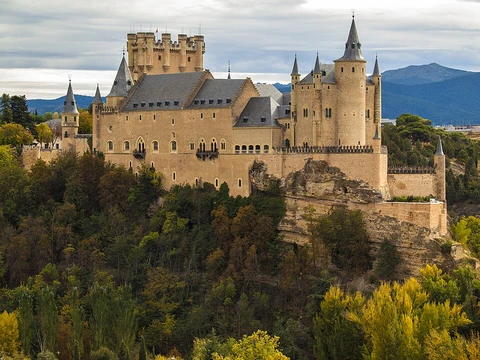
Malbork Castle
Largest castle by land area; UNESCO World Heritage Site.

Malbork Castle, officially the Castle of the Teutonic Order in Malbork, is a massive Brick Gothic fortress in the Polish town of Malbork. It was built starting in the 1200s and greatly expanded in the 1300s, and it holds the title of the world’s largest castle by land area, as well as a UNESCO World Heritage designation. The Teutonic Order, a German Catholic crusading order, constructed it as an Ordensburg fortress and called it Marienburg after Mary, the mother of Jesus. During the Thirteen Years' War in 1457, Bohemian mercenaries sold the castle to Poland’s King Casimir IV to settle debts. It then became one of several Polish royal residences and housed Polish offices and institutions, with a brief interruption under Swedish occupation, until the First Partition of Poland in 1772. After that, it remained under German control for more than 170 years, until 1945, though it fell into disrepair as military advances made it obsolete.
The Teutonic Order was founded in 1191 in Acre, in what is now Israel. After the last major Crusader stronghold in the Levant fell in 1291, the Order moved to Venice before eventually arriving in Prussia. The castle was built after the Order conquered Old Prussia, around 1222 to 1274, mainly to secure their control following the suppression of the Great Prussian Uprising in 1274. No original construction documents survive, so historians have pieced together the building phases from architecture, administrative records, and later histories. Work continued until about 1300 under Commander Heinrich von Wilnowe. The castle sits on the southeastern bank of the Nogat River. Its importance grew after the Teutonic Knights took Gdańsk and Eastern Pomerania in 1308, moving their administrative center from Elbing to Marienburg. Grand Master Siegfried von Feuchtwangen, arriving from Venice, oversaw the next building phase. In 1309, amid the persecution of the Knights Templar and the takeover of Danzig, he moved the Order’s headquarters to the Prussian part of its monastic state, choosing Marienburg for its convenient location on the Nogat in the Vistula Delta, as water transport was essential.
The castle was expanded repeatedly to accommodate the growing number of knights, eventually becoming the largest fortified Gothic building in Europe, covering nearly 21 hectares. It features several subdivisions and many layers of defensive walls, divided into three separate castles—High, Middle, and Lower—separated by dry moats and towers. At its peak, it housed about 3,000 brothers in arms. The outermost walls enclose 21 hectares, four times the area of Windsor Castle, with the developed part designated as a World Heritage Site covering 18.038 hectares. Its position on the Nogat allowed easy access for barges and trading ships from the Vistula and the Baltic. The Teutonic Knights collected tolls from passing ships and held a monopoly on amber trade. After the town joined the Hanseatic League, many Hanseatic meetings took place there.
In 1361, the future Grand Duke of Lithuania, Kęstutis, was briefly imprisoned in the castle. Polish King Casimir III the Great visited in 1365. In the summer of 1410, after the Order’s defeat at the Battle of Grunwald, the castle was besieged. Heinrich von Plauen successfully defended it during the Siege of Marienburg, though the town outside was destroyed. By 1456, during the Thirteen Years' War, the Order faced severe financial trouble. Its cities revolted against higher taxes meant to cover ransoms and war costs. Long-unpaid Bohemian mercenaries agreed to sell Malbork and leave, compensated with funds raised by Polish General Stibor de Poniec of Ostoja in Danzig. In 1457, King Casimir IV Jagiellon granted Danzig several privileges in thanks for its wartime support and entered Malbork Castle in triumph. The town’s mayor, Bartholomäus Blume, held out against Polish forces for three more years, but was captured and executed in 1460. A monument to him was erected in 1864.
In 1466, both castle and town became part of the Polish Malbork Voivodeship in Royal Prussia. From 1457, it served as one of several Polish royal residences and the seat of Polish offices and institutions until the First Partition of Poland in 1772. UNESCO designated the Castle of the Teutonic Order in Malbork and its museum a World Heritage Site in December 1997. It is one of two such sites in north-central Poland, alongside the Medieval Town of Toruń, founded in 1231. The castle was also named one of Poland’s official national Historic Monuments on 8 September 1994, with its listing maintained by the National Heritage Board of Poland.
- Construction period
- 1274–1406 (most historians accept 132 years)
- Location
- Malbork, Poland
- Built by
- Teutonic Order
- Land area
- 21 hectares (52 acres)
- UNESCO designation
- 1997
- Polish Historic Monument designation
- 8 September 1994
Verified Timeline
Lore & Background
The castle was expanded several times to house the growing number of Knights. Soon, it became the largest fortified Gothic building in Europe, on a nearly 21-hectare (52-acre) site. It consists of three separate castles – the High, Middle and Lower Castles, separated by multiple dry moats and towers. The castle once housed approximately 3,000 'brothers in arms.' In 1361, the future Grand Duke of Lithuania Kęstutis was briefly imprisoned in the castle. In 1365, Polish King Casimir III the Great visited. In the summer of 1410, the castle was besieged following the Order's defeat at the Battle of Grunwald; Heinrich von Plauen successfully led the defence in the Siege of Marienburg (1410). By 1456, during the Thirteen Years' War, the Order's Bohemian mercenaries agreed to sell Malbork. In 1457, King Casimir IV Jagiellon entered Malbork Castle in triumph. From 1568 the castle housed the Polish Admiralty (Komisja Morska), and in 1584 one of the Polish Royal Mints was established there. Also, the largest arsenal of the Polish–Lithuanian Commonwealth was located in the castle. During the Thirty Years' War, in 1626 and 1629 Swedish forces occupied the castle. They invaded and occupied it again from 1656 to 1660 during the Deluge. After the First Partition of Poland in 1772, the castle was used as a barracks for the Prussian Army and also as a poorhouse. In 1816, Theodor von Schön, governor of West Prussia, began the restoration of the castle. In 1945 during fighting in the area, more than half the castle was destroyed.
Reader's Guide
Malbork Castle is significant as the largest castle in the world by land area and a prime example of Brick Gothic architecture. Its construction by the Teutonic Order after the conquest of Old Prussia (c. 1222–1274) marked a key phase in the Order's control of the area. The castle's favourable position on the river Nogat allowed easy access by barges and trading ships. During their governance, the Teutonic Knights collected river tolls from passing ships and controlled a monopoly on the trade of amber. When the city became a member of the Hanseatic League, many Hanseatic meetings were held there. The castle's later role as a Polish royal residence for over 300 years reflects the shifting political landscape of Central Europe. The castle's designation as a UNESCO World Heritage Site in December 1997 and as a Polish national Historic Monument on 8 September 1994 underscores its architectural and historical importance. Today, it houses the Malbork Castle Museum, founded in 1961, and remains a major tourist attraction.
Did You Know?
- The castle once housed approximately 3,000 'brothers in arms.'
- In 1361, the future Grand Duke of Lithuania Kęstutis was briefly imprisoned in the castle.
- From 1568 the castle housed the Polish Admiralty (Komisja Morska), and in 1584 one of the Polish Royal Mints was established there.
- The outermost castle walls enclose 21 ha (52 acres), four times the enclosed area of Windsor Castle.
- In 1945 during fighting in the area, more than half the castle was destroyed.
Common Misconceptions (Editorial)
Some people mistakenly believe Malbork Castle was always under Polish control, but it was originally built by the Teutonic Order and remained under German rule for over 170 years after the First Partition of Poland in 1772. Another common misconception is that the castle was solely a royal residence; in reality, it housed the Polish Admiralty, a royal mint, and the largest arsenal of the Polish–Lithuanian Commonwealth, serving multiple strategic functions.
Why It Matters (Editorial)
Malbork Castle endures as a monumental testament to the shifting tides of medieval power, from its origins as a Teutonic stronghold to its role as a Polish royal residence and later a Prussian barracks. Its sheer scale—the largest castle in the world by land area—reminds us how architecture can embody both the ambition and the conflict of the era, while its careful restoration after near-total destruction in 1945 highlights the enduring value placed on preserving shared cultural heritage.
Frequently Asked Questions
Who is Malbork Castle?
Malbork Castle is a Brick Gothic fortress situated in Malbork, Poland, originally raised by the Teutonic Knights beginning in the 13th century. It later served as a Polish royal residence and stayed under German administration until 1945.
What are Malbork Castle's powers/role?
The complex functioned as the administrative seat of the Teutonic Order's Grand Master and subsequently as a residence for Polish monarchs. Its sprawling 21-hectare (52-acre) footprint makes it the largest castle in the world measured by land area.
How does Malbork Castle's story end?
After more than 170 years of German rule, the castle reverted to Polish control at the close of World War II in 1945. Today it operates as a UNESCO World Heritage Site and a major cultural landmark.
Why is Malbork Castle important?
It is the world's largest brick castle by land area and received UNESCO World Heritage inscription in 1997. Poland also designated it a Historic Monument on 8 September 1994, underscoring its national and global significance.
When was Malbork Castle built?
Construction ran from 1274 through 1406, a span of roughly 132 years that most historians accept. The most substantial phase of expansion took place during the 14th century.
More in Castles 1-22
Spotted an error? Know more?
This is a living reference — every entry is fact-audited, and reader corrections feed straight into our audit queue. Suggest an edit · See this site's audit record