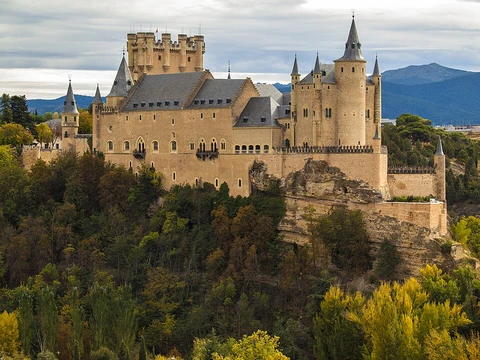
Eltz Castle
Medieval German castle never destroyed, owned by same family since 1200s.

Eltz Castle, known in German as Burg Eltz, is a medieval fortress perched in the hills above the Moselle River, situated between Koblenz and Trier, Germany. A branch of the House of Eltz has continuously inhabited it since the 12th century, and the family still owns it today. Along with Bürresheim Castle and Lissingen Castle, it is one of only three castles in the Eifel region that have never been destroyed. The castle sits on a 70-meter-high rock spur, with the Elzbach River—a northern tributary of the Moselle—flowing around three of its sides. The Eltz Forest that surrounds it has been designated a nature reserve under the Flora-Fauna-Habitat and Natura 2001 programs.
The castle is a *Ganerbenburg*, meaning it was built as a shared fortress for joint heirs. Such castles were divided into separate sections belonging to different families or branches of a single family, often arising when multiple lords with limited resources pooled their wealth to construct a single defensive structure. In medieval Europe, only wealthy lords could afford castles; many owned just a village or part of one, living instead in modest "knight's houses" barely larger than their tenants' homes. Under inheritance laws in parts of the Holy Roman Empire, estates had to be split among all successors. When each individual share was too small to fund a personal castle, these heirs could build one together, each owning a private residential section while sharing the fortifications. At Eltz, three branches of the family collaborated, resulting in three separate building complexes. The main part of the castle comprises these family quarters, featuring eight towers that rise 30 to 40 meters high, with up to eight stories. Thick exterior walls fortify them, while the inner courtyard side reveals partial timber framing. About 100 family members once lived in the castle's over 100 rooms. A village once stood south of the castle, housing the servants, craftsmen, and their families who supported the estate.
The castle's site lies in a region that was a key trade route connecting rich farmlands to their markets during the Roman era. After the Western Roman Empire collapsed in the late 5th century, the Franks conquered the area. When Charlemagne's empire was divided, the land passed to his son Louis the Pious in 814. During this period, a simple manor hall with an earthen palisade occupied the site. Several centuries later, the House of Eltz began constructing the Platteltz, a Romanesque keep built atop the old manor hall, which remains the castle's oldest section. By 1157, the fortress had become an important part of the Holy Roman Empire under Frederick Barbarossa, continuing to protect trade routes from the Moselle Valley and the Eifel region.
The castle faced its only serious military conflicts between 1331 and 1336 during the Eltz Feud. Regional lords, including Johann of Eltz and other free imperial knights, opposed the territorial policies of Balduin von Trier, the Elector and Prince-Archbishop of Trier. In response, Balduin besieged Johann at Eltz Castle. He bombarded it with primitive cannons called *Pot-de-fer* and catapults from a small siege castle, Trutzeltz Castle, built on a rocky outcrop above (its ruined walls remain visible on the castle's northern side). The siege ended after two years when the free imperial knights agreed to accept Trier's laws and sovereignty. Archbishop Balduin reinstated Johann as Burgrave, but only as his vassal, no longer a free knight.
In 1470, Philipp zu Eltz began construction of the 10-story Greater Rodendorf House, named after the family's land holdings in Lorraine. Its oldest part is the flag hall, featuring a late Gothic vaulted ceiling, likely originally a chapel. Work finished around 1520. The Little Rodendorf House, completed in 1540, is also late Gothic and contains a vaulted "banner-room." In 1472, the House of Rübenach finished a castle wing in late Gothic style, including the Rübenach Lower Hall, living room, and a bedchamber with opulently decorated walls. In 1615, the House of Kempenich replaced the castle's original hall; every room in this section could be heated, a luxury when other castles might have only one or two heated rooms.
During the Palatinate War of Succession from 1688 to 1689, many early Rhenish castles were destroyed, but Eltz was spared. Its lord at the time, Hans Anton zu Eltz-Üttingen, was a senior officer in the Royal French Army of Louis XIV and used his influence to remove the castle from the list of buildings slated for destruction. During French rule on the Rhine from 1794 to 1815, Count Hugo Philipp zu Eltz was thought to have fled. The French confiscated his possessions on the Rhine and near Trier, including Eltz Castle and its associated goods, which were held at French headquarters in Koblenz. In 1797, it turned out that Count Hugo Philipp had remained hidden in Mainz; he returned to reclaim his lands, goods, and wealth. By 1815, he became the castle's sole owner after purchasing the Rübenacher house and the landed property of the barons of Eltz-Rübenach.
In the mid-19th century, Count Karl zu Eltz restored the castle. Between 1845 and 1888, 184,000 marks (equivalent to €2,680,000 in 2021) were spent on exterior renovations.
- location
- Hills above the Moselle between Koblenz and Trier, Germany
- type
- Medieval castle (Ganerbenburg)
- founded
- 12th century (House of Eltz presence); earliest structure (Platteltz) built on s
- height
- 70-meter (230 ft) rock spur; towers 30–40 meters (98–131 ft)
- owners
- House of Eltz (three branches: Rübenach, Rodendorf, Kempenich)
- status
- Never destroyed; open to public seasonally
Verified Timeline
Lore & Background
The castle is a so-called Ganerbenburg, or castle belonging to a community of joint heirs. This is a castle divided into several parts, which belong to different families or different branches of a family. In the case of Eltz, the family comprised three branches and the existing castle was enhanced with three separate complexes of buildings. The main part of the castle consists of the family portions. At up to eight stories, these eight towers reach heights of between 30 and 40 metres (98 and 131 ft). They are fortified with strong exterior walls; to the yard, they present a partial framework. About 100 members of the owners' families lived in the over 100 rooms of the castle. A village once existed below the castle, on its south side, which housed servants, craftsmen, and their families supporting the castle. The oldest part of the castle is the Platteltz, a Romanesque keep built on the site of an old manor hall. By 1157 the fortress was an important part of the Holy Roman Empire under Frederick Barbarossa. Between 1331–1336, the castle endured the only serious military conflicts in its history during the Eltz Feud when lords in the region including Johann of Eltz, together with free imperial knights, opposed the territorial policies of Balduin von Trier who was the Elector and Prince-Archbishop of Trier. Balduin lay siege to Johann at Eltz Castle. It was bombarded by primitive cannons known as Pot-de-fer and catapults from a small siege castle, Trutzeltz Castle, built on a rocky outcrop on the hillside above the castle. The siege ended after two years when the free imperial knights agreed to accept the laws and sovereignty of Trier. Archbishop Balduin reinstated Johann to the Burgrave, but only as his vassal and no longer as a free knight. Started in 1470 by Philipp zu Eltz, the 10-story Greater Rodendorf House takes its name from the family's land holding in Lorraine. The oldest part is the flag hall with its late Gothic vaulted ceiling, which was probably originally a chapel. Construction was completed around 1520. The Little Rodendorf house was finished in 1540, also in Late Gothic style. In 1472 the House of Rübenach completed the castle wing that has Late Gothic architecture. In 1615 the House of Kempenich house replaced the castle's original hall. Every room in this part of the castle could be heated; in contrast, other castles might only have one or two heated rooms. During the Palatinate War of Succession from 1688 to 1689, many of the early Rhenish castles were destroyed. However, the castle was saved from destruction because its lord at the time was Hans Anton zu Eltz-Üttingen who was also a senior officer in the Royal French Army of Louis XIV. Eltz-Üttingen was able to use his position to delete the castle bearing his name from the list of buildings and fortifications to be destroyed. Count Hugo Philipp zu Eltz was thought to have fled during the French rule on the Rhine from 1794 to 1815. The French confiscated his possessions on the Rhine and nearby Trier which included Eltz castle. In 1797, when Count Hugo Philipp later turned out to have remained hidden in Mainz, he came back to reclaim his lands, goods and wealth. In 1815 he became the sole owner of the castle through the purchase of the Rübenacher house and the landed property of the barons of Eltz-Rübenach.
Reader's Guide
Eltz Castle is significant as a rare example of a Ganerbenburg that has never been destroyed, preserving its medieval architecture across three family wings. Its continuous occupation by the House of Eltz since the 12th century provides an unbroken lineage rare among German castles. The castle's survival through the Palatinate War of Succession, when many Rhenish castles were destroyed, was due to the political position of its lord. Extensive 19th-century restoration (1845–1888) and modern preservation work (2009–2012) have maintained the structure. The castle's cultural impact includes its appearance on the German 500 Deutsche Mark note (1965–1992), as a filming location for The Ninth Configuration, and as inspiration in comics and video games. Today, the Rübenach and Rodendorf wings are open to the public seasonally, displaying a treasury and armory, while the Kempenich branch still resides in their portion.
Did You Know?
- Eltz Castle is one of only three castles in the Eifel region that have never been destroyed, along with Bürresheim Castle and Lissingen Castle.
- During the Eltz Feud (1331–1336), the castle was bombarded by primitive cannons known as Pot-de-fer from a siege castle called Trutzeltz, whose ruined walls can still be seen on the northern side.
- The castle was saved from destruction in the Palatinate War of Succession because its lord, Hans Anton zu Eltz-Üttingen, was a senior officer in the Royal French Army of Louis XIV and had it removed from the list of buildings to be destroyed.
- From 1965 to 1992, an engraving of Eltz Castle was used on the German 500 Deutsche Mark note.
- The Rübenach and Rodendorf family wings are open to the public, while the Kempenich branch continues to use their third of the castle.
The Ganerbenburg – A Castle Built by Three Families
The concept of a Ganerbenburg is one of the most distinctive features of Eltz Castle. In medieval parts of the Holy Roman Empire, inheritance law demanded that estates be split among all successors. For lords who owned only a single village or even a fraction of one, this meant their individual share was far too modest to fund a castle. Instead of settling for a simple knight's house barely larger than a tenant's dwelling, these co-heirs pooled their resources to construct a shared fortress. Each branch received its own residential complex within the overall structure, while the defensive walls and fortifications were collectively maintained. At Eltz, three branches of the House of Eltz each added their own building complex to the site. The main family portions rise to as many as eight stories, with towers reaching between 30 and 40 metres in height, fortified by strong exterior walls that present a partial framework toward the inner yard. At one point, roughly 100 family members occupied the more than 100 rooms, while a supporting village of servants and craftsmen clustered on the south side below the rock spur.
The Eltz Feud – A Two-Year Siege
Between 1331 and 1336, Eltz Castle faced the only serious military threat in its entire history. The conflict, known as the Eltz Feud, erupted when regional lords including Johann of Eltz, alongside free imperial knights, resisted the territorial ambitions of Balduin von Trier, who held the dual titles of Elector and Prince-Archbishop of Trier. Balduin responded by laying siege to Johann at the castle. The attackers employed primitive cannons called Pot-de-fer and catapults, launching their assault from Trutzeltz Castle, a small siege fortification constructed on a rocky outcrop on the hillside above Eltz. The remains of that siege castle can still be glimpsed today as a few ruined walls on the northern side of the main structure. After two years of standoff, the free imperial knights capitulated, agreeing to accept the laws and sovereignty of Trier. Archbishop Balduin did reinstate Johann to the position of Burgrave, but only as a vassal rather than the free knight he had previously been.
Saved by a French General – The Palatinate War
During the Palatinate War of Succession in 1688 and 1689, a wave of destruction swept through the Rhenish region, and many early castles along the Rhine were razed. Eltz Castle, however, escaped this fate through an extraordinary stroke of personal diplomacy. The lord of the castle at the time, Hans Anton zu Eltz-Üttingen, held a senior officer's position in the Royal French Army of Louis XIV. Leveraging his standing within the French military command, he managed to have the castle bearing his family name struck entirely from the list of fortifications and buildings designated for destruction. This single act of intervention preserved a structure that had already survived centuries of political upheaval. The castle's survival during this period is all the more remarkable when one considers that it stands alongside only Bürresheim Castle and Lissingen Castle as the sole castles in the Eifel region that have never been destroyed.
Centuries of Care – Preservation and Restoration
The castle's long survival owes much to sustained investment in its physical integrity. In the mid-19th century, Count Karl zu Eltz undertook a major restoration program spanning from 1845 to 1888. The project cost 184,000 marks, equivalent to roughly 2.68 million euros in 2021, and focused on extensive construction work that carefully preserved the existing architecture rather than overhauling it. More recently, between 2009 and 2012, a second wave of security and restoration work addressed urgent structural concerns. The vault of the flag hall, a late Gothic feature in the Greater Rodendorf House, was at risk of partial collapse and was carefully secured. Walls and the porch of the Kempenich section received reinforcement, nearly all slate roofs were replaced, ceiling structural problems were remedied, and wood damage throughout the interior was repaired. This ongoing commitment to maintenance ensures that the castle's medieval and Gothic fabric endures for future generations of the House of Eltz.
Common Misconceptions (Editorial)
- People sometimes assume that the castle’s survival through centuries of European warfare was due to its remote or defensible location, but the facts show it was spared from destruction in the Palatinate War of Succession specifically because its then-lord, Hans Anton zu Eltz-Üttingen, was a senior officer in the Royal French Army and had it removed from the demolition list. - It is also a common belief that the castle has always been owned by a single, unified family line; in reality, it was a Ganerbenburg divided among three branches (Rübenach, Rodendorf, Kempenich), and the current sole ownership only came in 1815 when Count Hugo Philipp purchased the Rübenacher portion.
Why It Matters (Editorial)
Eltz Castle endures not just as a physical structure but as a rare living link to the medieval feudal world, having been continuously inhabited by the same family for over 800 years. Its survival against the odds — through sieges, wars, and political upheaval — reminds us that history is often shaped as much by individual decisions and alliances as by grand military or economic forces.
Frequently Asked Questions
What is Eltz Castle and where is it located?
Eltz Castle is a medieval fortress perched on a 70-meter rock spur in the hills above the Moselle River, in the stretch of Germany between Koblenz and Trier. Its towers rise another 30 to 40 meters above the spur, giving the complex a striking silhouette over the valley.
Why is Eltz Castle so famous?
It is one of only three castles in the Eifel region that was never destroyed, and it has remained in the hands of the same family, the House of Eltz, since the 12th century. That combination of unbroken survival and continuous private ownership makes it a rarity among medieval German fortifications.
What does 'Ganerbenburg' mean in the context of Eltz Castle?
A Ganerbenburg is a castle shared among joint heirs, and Eltz operates under exactly that arrangement. Three separate building complexes on the site each belong to a different branch of the House of Eltz—Rübenach, Rodendorf, and Kempenich—so the castle is effectively three properties in one.
How old is Eltz Castle and what was built first?
The earliest structure on the site, called Platteltz, was erected on the foundations of an earlier manor hall during the 12th century. The current complex of towers and wings grew around that original core over the following centuries.
Can you visit Eltz Castle today?
Yes, the castle welcomes the public on a seasonal basis rather than year-round, since it is still privately owned by the House of Eltz. Visitors can walk through the three distinct building complexes during the open months.
More in Castles 1-22
Spotted an error? Know more?
This is a living reference — every entry is fact-audited, and reader corrections feed straight into our audit queue. Suggest an edit · See this site's audit record