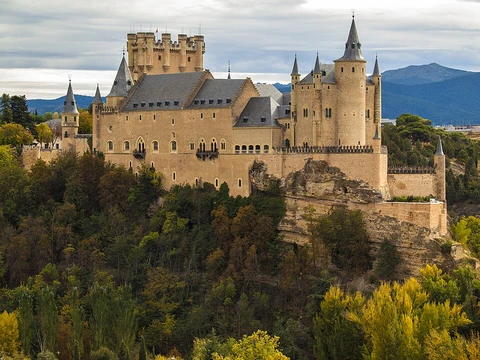
Krak des Chevaliers
A preserved medieval castle and former Hospitaller stronghold in Syria.

Krak des Chevaliers is a medieval castle in Syria, widely regarded as one of the most important preserved medieval castles in the world. The site was first fortified in the 11th century by Kurdish troops stationed there by the Mirdasid dynasty, from which it derived its early Arabic name, Ḥiṣn al-Akrād, or "fort of the Kurds." In 1142, Raymond II, Count of Tripoli, granted the fortress to the Knights Hospitaller. The order began rebuilding the castle in the 1140s, completing the work by 1170, when an earthquake caused damage. A second major phase of construction in the 13th century transformed it into a concentric castle, adding the outer wall and giving the structure its present appearance. This period, particularly the first half of the 13th century, is considered the castle’s golden age. At its peak, Krak des Chevaliers housed a garrison of about 2,000 men, enabling the Hospitallers to exact tribute from a wide surrounding area. The castle served as both a military base and an administrative center for the County of Tripoli. From the 1250s, the Hospitallers’ fortunes declined, and in 1271 the Mamluk Sultanate captured the castle after a 36-day siege, reportedly through a forged letter that tricked the knights into surrendering. In the 19th century, renewed interest in Crusader castles led to architectural surveys of the site. A settlement later formed within the castle walls, causing damage; its 500 inhabitants were relocated in 1933, and the French Alawite State undertook clearing and restoration. Syria assumed control upon independence in 1946. The castle sits on a hill in the Homs Gap, west of Homs, near the Lebanese border. Since 2006, it has been a UNESCO World Heritage Site. It suffered partial damage during the Syrian civil war but was recaptured by government forces in 2014, after which reconstruction and conservation began.
- Location
- Syria, approximately 40 km west of Homs
- Constructed
- 11th century (original); rebuilt by Hospitallers from 1140s
- Peak garrison
- Around 2,000
Lore & Background
Perched atop a 650-meter hill east of Tartus in the Homs Gap, Krak des Chevaliers commands a strategic route connecting Tripoli and Homs. The site was first fortified in the 11th century by Kurdish troops garrisoned there by the Mirdasids. In 1142, it was granted to the Knights Hospitaller, who began rebuilding in the 1140s, completing the work by 1170 when an earthquake struck. A second major building phase in the 13th century transformed the castle into a concentric fortress, adding the outer wall that defines its current appearance. This period, the first half of the 13th century, is considered its golden age, when it housed a garrison of roughly 2,000 men, enabling the Hospitallers to exact tribute from a wide surrounding area. The castle served as both a military base and an administrative center for the order’s border holdings in the County of Tripoli. Its limestone peak offered natural defensive advantages, and the fertile, well-watered plain below was vulnerable to raids from nearby Homs, which remained under Muslim control. The castle remained in Hospitaller hands until 1271, when the Mamluks captured it after a 36-day siege, reportedly through a forged letter from the Hospitallers’ Grand Master that induced surrender. Today, the village of al-Husn surrounds the castle, and the site, along with Qal’at Salah El-Din, has been a UNESCO World Heritage Site since 2006.
Reader's Guide
Krak des Chevaliers stands as a key example of medieval military architecture and Crusader fortification. The castle's evolution from a Kurdish garrison to a Hospitaller administrative and military center illustrates the shifting power dynamics of the Crusader states. Its concentric design, developed in the 13th century, influenced later castle building. The site's damage during the Syrian civil war and subsequent reconstruction highlight its ongoing cultural significance. The castle's history, including its capture via a forged letter, reflects the complex interplay of warfare, diplomacy, and religion in the medieval Levant.
Did You Know?
- The name 'Krak' derives from the Syriac word 'karak', meaning a walled city or fortress.
- The castle was originally known in Arabic as 'Ḥiṣn al-Akrād', or 'fort of the Kurds'.
Common Misconceptions (Editorial)
- Some may think "Krak" is a European or Crusader-origin term, but it actually derives from the Syriac word "karak," meaning a walled city or fortress. - It is commonly assumed the castle was originally built by the Hospitallers, but the site was first inhabited in the 11th century by Kurdish troops garrisoned by the Mirdasids, and was originally known in Arabic as "Ḥiṣn al-Akrād" (fort of the Kurds).
Why It Matters (Editorial)
Krak des Chevaliers endures not only as a masterpiece of medieval military architecture, but as a symbol of the layered histories that define the Middle East—a place where Kurdish, Arab, and Crusader influences converged. Its preservation allows us to study how power, faith, and fortification shaped the region, and why such landmarks remain vital to understanding our shared past.
Frequently Asked Questions
What is Krak des Chevaliers?
Krak des Chevaliers is a massive medieval fortress in modern-day Syria, best known as the primary stronghold of the Knights Hospitaller in the County of Tripoli. It is frequently cited as one of the best-preserved examples of Crusader-era castle architecture still standing today.
Where exactly is Krak des Chevaliers located?
The fortress sits in the Homs Governorate of Syria, roughly 40 kilometers west of the city of Homs. Its elevated position on a rocky plateau gave it commanding views of the surrounding plain, which was a key factor in its long-standing strategic value.
More in Castles 1-22
Spotted an error? Know more?
This is a living reference — every entry is fact-audited, and reader corrections feed straight into our audit queue. Suggest an edit · See this site's audit record