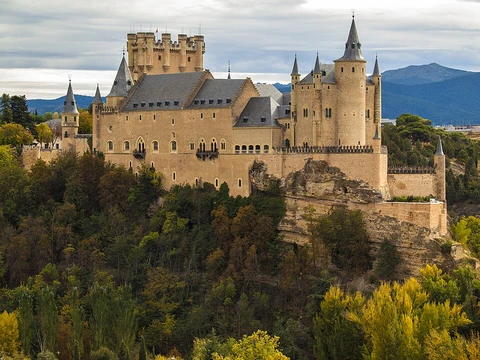
Chateau de Chenonceau
A Loire Valley château spanning the river Cher.

The Château de Chenonceau, located in the Centre-Val de Loire region near the village of Chenonceaux, is a French castle built across the river Cher. It ranks among the most famous châteaux in the Loire Valley and, after the Palace of Versailles, attracts the most visitors of any château in France.
The property was first recorded in the 11th century. The present structure was erected between 1514 and 1522 on the base of an old mill, with later additions extending it over the river. The bridge crossing the Cher was constructed from 1556 to 1559 based on plans by Renaissance architect Philibert de l'Orme, and the gallery atop it was built from 1570 to 1576 following designs by Jean Bullant.
Architecturally, the château blends late Gothic and early Renaissance styles. Its gardens and interiors are open to the public. Designated a Monument historique in 1840, Chenonceau drew about 800,000 visitors in 2007.
In the 13th century, the estate belonged to the Marques family. The original castle was burned in 1412 as punishment for owner Jean Marques’s sedition. He rebuilt a château and fortified mill in the 1430s. His indebted heir, Pierre Marques, was later forced to sell.
Thomas Bohier, chamberlain to King Charles VIII, bought the property in 1513 and demolished most of it, though the 15th-century keep remained. He built a new residence between 1515 and 1521, with work overseen by his wife Katherine Briçonnet, who hosted French nobility, including King Francis I on two occasions.
In 1535, Francis I seized the château from Bohier’s son due to unpaid debts. After Francis died in 1547, Henry II gave it to his mistress, Diane de Poitiers. She became deeply attached to the estate and in 1555 commissioned Philibert de l'Orme to build the arched bridge linking the château to the opposite bank. She also planted extensive flower and vegetable gardens and fruit trees, laid out in four triangles on stone terraces along the river. Although Diane was the mistress of the castle, ownership remained with the crown until 1555, when legal maneuvers finally granted it to her.
After Henry II’s death in 1559, his widow Catherine de' Medici forced Diane to exchange Chenonceau for Château Chaumont. Catherine made it her favorite residence, adding new gardens. As regent, she spent lavishly on the château and hosted spectacular nighttime parties. In 1560, the first fireworks display in France occurred during celebrations for her son Francis II’s ascension. The grand gallery extending across the bridge was dedicated in 1577. Catherine also added rooms between the chapel and library on the east side and a service wing on the west side of the entry courtyard. An engraving by Jacques Androuet du Cerceau in 1579 showed an even larger expansion plan, which would have made the current château a small part of a vast manor.
Upon Catherine’s death in January 1589, the château passed to her daughter-in-law, Louise of Lorraine, wife of King Henry III. Louise was at Chenonceau when she learned of her husband’s assassination in August 1589 and fell into depression. She spent the next 11 years wandering the corridors in mourning clothes, surrounded by black tapestries embroidered with skulls and crossbones, until her death in January 1601.
Henry IV secured Chenonceau for his mistress Gabrielle d’Estrées by paying Catherine de’ Medici’s debts, which Louise had inherited. In return, Louise left the château to her niece Françoise de Lorraine, then six years old and betrothed to four-year-old César, Duke of Vendôme, Gabrielle’s son by Henry IV. The château remained with the Duke of Vendôme and his descendants for over a century. The Bourbons used it mainly for hunting. In 1650, Louis XIV became the last king of the ancien régime to visit. The Duke of Bourbon bought the château in 1720 and gradually sold off its contents, with many statues ending up at Versailles.
In 1733, the estate was sold for 130,000 livres to Claude Dupin, a wealthy squire. His wife, Louise Dupin, was the natural daughter of financier Samuel Bernard and actress Manon Dancourt. Described as intelligent, beautiful, and highly cultivated, Louise ran a literary salon at Chenonceau that attracted Enlightenment figures such as Voltaire, Montesquieu, Fontenelle, Buffon, Marivaux, and Condillac. Claude Dupin had a son, Louis Claude, from his first wife Marie-Aurore de Saxe, who was the grandmother of writer George Sand.
- Location
- Near Chenonceaux, Indre-et-Loire, Centre-Val de Loire, France
- Architects
- Philibert de l'Orme (bridge); Jean Bullant (gallery)
- Architectural style
- Late Gothic and early Renaissance
Lore & Background
The Château de Chenonceau is a French château that spans the river Cher, located near the small village of Chenonceaux in the Centre-Val de Loire region. It is one of the most renowned châteaux of the Loire Valley. The current structure was built between 1514 and 1522 on the foundations of an old mill, with a bridge over the river constructed from 1556 to 1559 to designs by the Renaissance architect Philibert de l’Orme. A gallery atop the bridge was added from 1570 to 1576, designed by Jean Bullant. The architecture blends late Gothic and early Renaissance styles. The estate is first mentioned in writing in the 11th century. The château features a medieval keep, the last remnant of an earlier castle, located in the forecourt and still surrounded by moats. Its formal gardens were planted in four triangular sections, set along the riverbanks and buttressed by stone terraces. The château has been a designated Monument historique since 1840. Today, it is a major tourist attraction, receiving around 800,000 visitors in 2007, and is the most visited château in France after the Palace of Versailles.
Reader's Guide
The Château de Chenonceau is significant for its architectural blend of late Gothic and early Renaissance, its innovative bridge and gallery spanning the Cher, and its continuous occupation by notable historical figures. It served as a royal residence, a site of lavish parties under Catherine de' Medici, and a literary salon under Louise Dupin, hosting Enlightenment thinkers. During the French Revolution, Louise Dupin saved it from destruction by arguing it was essential as the only bridge across the river for many leagues. In the 20th century, it was used as a hospital in World War I and as an escape route during World War II. Today it remains a major tourist attraction, owned by the Menier family, and is designated a Monument historique.
Did You Know?
- During World War II, the château was used as a means of escaping from the Nazi-occupied zone to the 'free' zone on the opposite bank of the Cher.
- Jean-Jacques Rousseau worked on his book Émile while serving as secretary to Louise Dupin at Chenonceau.
Why It Matters (Editorial)
The Château de Chenonceau endures not only as a masterpiece of Late Gothic and early Renaissance architecture but as a living monument to human ingenuity and defiance. Its bridge-gallery, designed by Philibert de l'Orme and Jean Bullant, served as a literal lifeline during World War II, transforming a symbol of aristocratic grace into a vessel of survival. This fusion of beauty and purpose ensures Chenonceau remains more than a tourist destination—it is a story of resilience.
Frequently Asked Questions
Why is Chateau de Chenonceau important?
First mentioned in written sources as far back as the 11th century, the site represents centuries of continuous architectural development culminating in a Late Gothic and early Renaissance masterpiece. Its design of spanning a river is virtually unmatched among the châteaux of the Loire Valley.
More in Castles 1-22
Spotted an error? Know more?
This is a living reference — every entry is fact-audited, and reader corrections feed straight into our audit queue. Suggest an edit · See this site's audit record