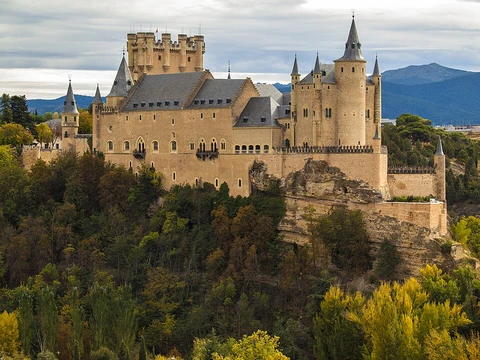
Castel Sant'Angelo
Hadrian's tomb turned papal fortress and museum.

via Wikipedia: Castel Sant'Angelo · see source
Castel Sant’Angelo, also known as the Mausoleum of Hadrian, is a towering cylindrical structure in Parco Adriano, Rome. It was originally built between 134 and 139 AD on the northern bank of the Tiber River as a tomb for Emperor Hadrian and his family. The mausoleum was a decorated cylinder topped with a garden and a golden quadriga. Hadrian’s ashes, along with those of his wife Sabina and his first adopted son Lucius Aelius, were interred there a year after his death in 138. Subsequent emperors were also entombed here, with the last recorded deposition being that of Caracalla in 217. The urns likely rested in what is now called the Treasury Room. Hadrian also constructed the Pons Aelius, a bridge directly aligned with the mausoleum, which still provides a scenic approach and is famous for its Baroque angel statues holding instruments of the Passion. The tomb’s contents and decorations were largely lost after its conversion into a military fortress in 401 and its incorporation into the Aurelian Walls. Visigoth looters scattered the urns and ashes during Alaric’s sack of Rome in 410. During a Gothic siege in 537, defenders threw original bronze and stone statuary down upon attackers. One notable survivor is the capstone of a funerary urn, likely Hadrian’s, which later covered the tomb of Otto II in Saint Peter’s Basilica and was eventually incorporated into a Renaissance baptistery. The building’s present name derives from a legend that the Archangel Michael appeared atop the mausoleum, sheathing his sword to signal the end of a plague in 590. In the 14th century, popes began converting the structure into a castle, and Pope Nicholas III connected it to St. Peter’s Basilica via a fortified corridor called the Passetto di Borgo. It served as a refuge for Pope Clement VII during the Sack of Rome in 1527. The castle also functioned as a prison, holding figures such as Giordano Bruno, Benvenuto Cellini, and Cagliostro, with executions occurring in a small inner courtyard. Later, a bronze statue of Saint Michael replaced an earlier marble one, and the castle is now a museum.
- type
- Mausoleum, fortress, castle, museum
- location
- Rome, Italy
- commissioned_by
- Roman Emperor Hadrian
- height
- Once the tallest building in Rome
- current_use
- Museo Nazionale di Castel Sant'Angelo
Lore & Background
Originally a decorated cylinder with a garden top and golden quadriga, it housed Hadrian's ashes, those of his wife Sabina, and his first adopted son Lucius Aelius. The urns were likely kept in what is now called the Treasury Room. Hadrian also built the Pons Aelius facing the mausoleum, which still provides a scenic approach from central Rome. A capstone of a funerary urn, probably Hadrian's, survived and was later incorporated into a Renaissance baptistery at Saint Peter's Basilica. A 15th-century traveler recounted a version where Pope Gregory I, after destroying a pagan idol, saw an angel atop the castle wiping blood from his sword and sheathing it. The popes converted the structure into a castle beginning in the 14th century; Pope Nicholas III connected it to St Peter's Basilica via the Passetto di Borgo.
Reader's Guide
Castel Sant'Angelo stands as a layered monument to Roman imperial ambition, medieval papal power, and Renaissance culture. Originally built as a dynastic tomb for Emperor Hadrian and his successors, its transformation into a military fortress in the 5th century and later a papal castle reflects the shifting political and religious landscape of Rome. The structure's role as a refuge during the Sack of Rome and as a prison for notable figures like Giordano Bruno and Benvenuto Cellini underscores its function as a site of both protection and coercion. Today, as the Museo Nazionale di Castel Sant'Angelo, it preserves artifacts and stories from its varied past, including a bronze statue of Saint Michael by Peter Anton von Verschaffelt that still crowns the building. The castle's ongoing connection to St. Peter's Basilica via the Passetto di Borgo and a planned pedestrian tunnel highlights its continued significance in Rome's urban fabric.
Did You Know?
- The capstone of a funerary urn, probably that of Hadrian, survived and was later incorporated into a Renaissance baptistye at Saint Peter's Basilica.
- The castle was used as a prison; Giordano Bruno was imprisoned there for six years.
Common Misconceptions (Editorial)
Some people believe Castel Sant'Angelo was always a fortress or castle, but it was originally commissioned by Emperor Hadrian as a mausoleum for himself and his family. Others may think the building’s only connection to Saint Michael is its name, but the lore recounts that Pope Gregory I saw an angel atop the castle sheathing his sword, leading to the dedication.
Why It Matters (Editorial)
Castel Sant’Angelo endures as a rare monument that physically embodies Rome’s layered history, from imperial burial site to papal fortress to public museum. Its survival and transformation remind us that great structures are never static, but continually reinterpreted by the cultures that inherit them.
Frequently Asked Questions
What is Castel Sant'Angelo?
It is a massive cylindrical monument in Rome that began as Emperor Hadrian's personal tomb, was later converted into a papal stronghold, and now operates as a national museum. Fans of castle architecture often point to it as a rare example of a structure that has cycled through tomb, fortress, and public exhibition roles.
Why is it called 'Sant'Angelo' instead of just Hadrian's Mausoleum?
The 'Saint Angel' portion of the name reflects its later dedication to Saint Michael the Archangel after popes repurposed it as a defensive castle. The original Roman name, Mausoleum of Hadrian, still appears in some older references.
Was Castel Sant'Angelo ever the tallest building in Rome?
Yes, during its 2nd-century construction it rose above every other structure in the city and dominated the skyline for centuries. Its rotunda form gave it a height advantage over the flat-roofed buildings typical of ancient Rome.
What can visitors actually see inside Castel Sant'Angelo today?
As the Museo Nazionale di Castel Sant'Angelo, it offers tours of the papal apartments, the fortified upper levels, and the original mausoleum chambers. The elevated walkways also provide sweeping panoramic views across the Roman cityscape.
More in Castles 1-22
Spotted an error? Know more?
This is a living reference — every entry is fact-audited, and reader corrections feed straight into our audit queue. Suggest an edit · See this site's audit record