Seven-card stud
A classic stud poker variant with seven cards per player.

Yagamichega · CC BY-SA 4.0
Seven-card stud, sometimes called Seven-Toed Pete or Down-The-River, is a type of stud poker. Before Texas hold 'em became hugely popular in the 2000s, seven-card stud was one of the most common poker variants played in homes across the United States and in casinos on the East Coast. Today, it is less common in casinos but remains popular online. The game typically works best with two to eight players, though eight may require special rules for the final cards if no one folds, and nine players are possible. In casinos, a small ante and a bring-in are standard; in home games, only an ante is usually used. Seven-card stud is the "S" in HORSE and similar mixed-game formats.
**Rules**
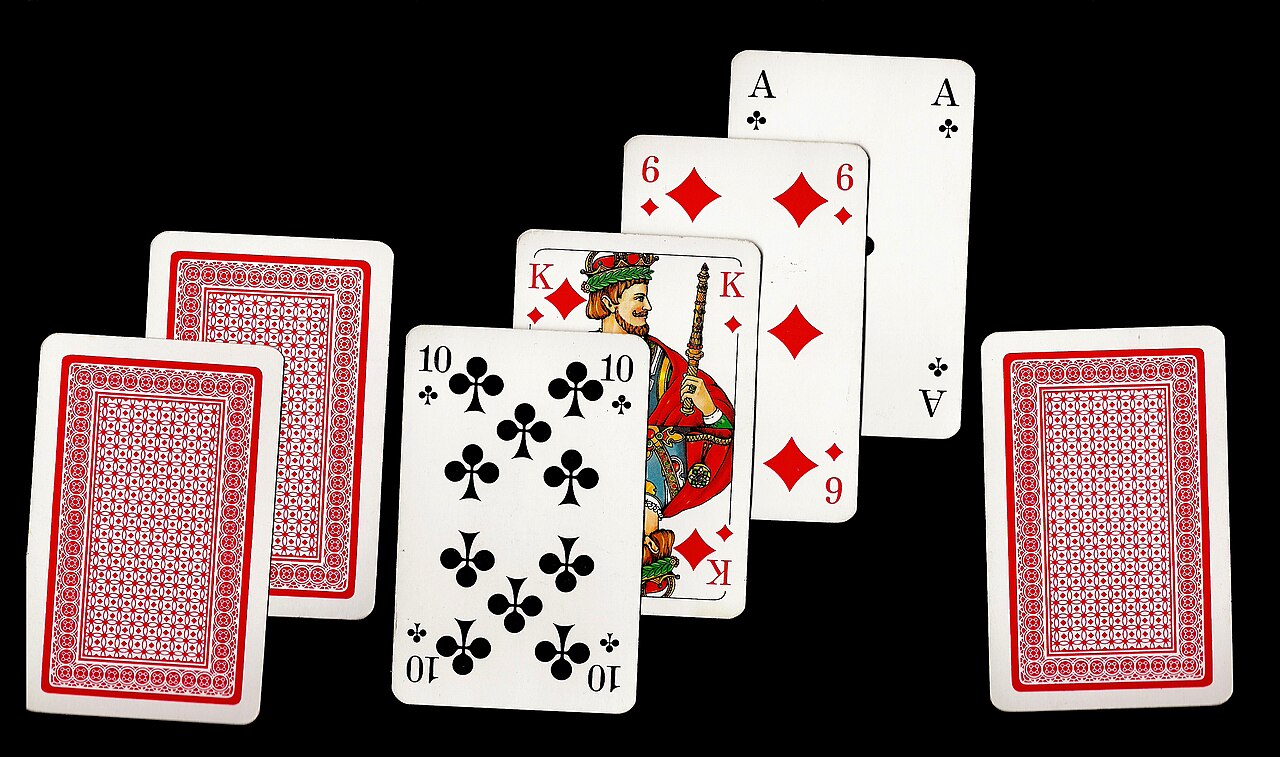
The game starts with each player receiving two cards face down and one card face up. The player with the lowest-ranking up-card must pay the bring-in, and betting then proceeds clockwise. The bring-in counts as an open, so the next player cannot check. If two players have equally low up-cards, the suit breaks the tie to assign the bring-in (using high card by suit rules). If there is no bring-in, the first betting round begins with the player showing the highest up-card, who may check; in this case, suits do not break ties, and if two players have the same high up-card, the one closest to the dealer's left acts first.
After the first betting round, another up-card is dealt to each player (after a burn card, starting from the dealer's left for all subsequent rounds). A second betting round follows, starting with the player whose face-up cards make the best poker hand. Since fewer than five cards are visible, straights, flushes, and full houses do not count for this ranking. On this and all later betting rounds, the player with the best face-up hand acts first and may check or bet up to the game's limit.
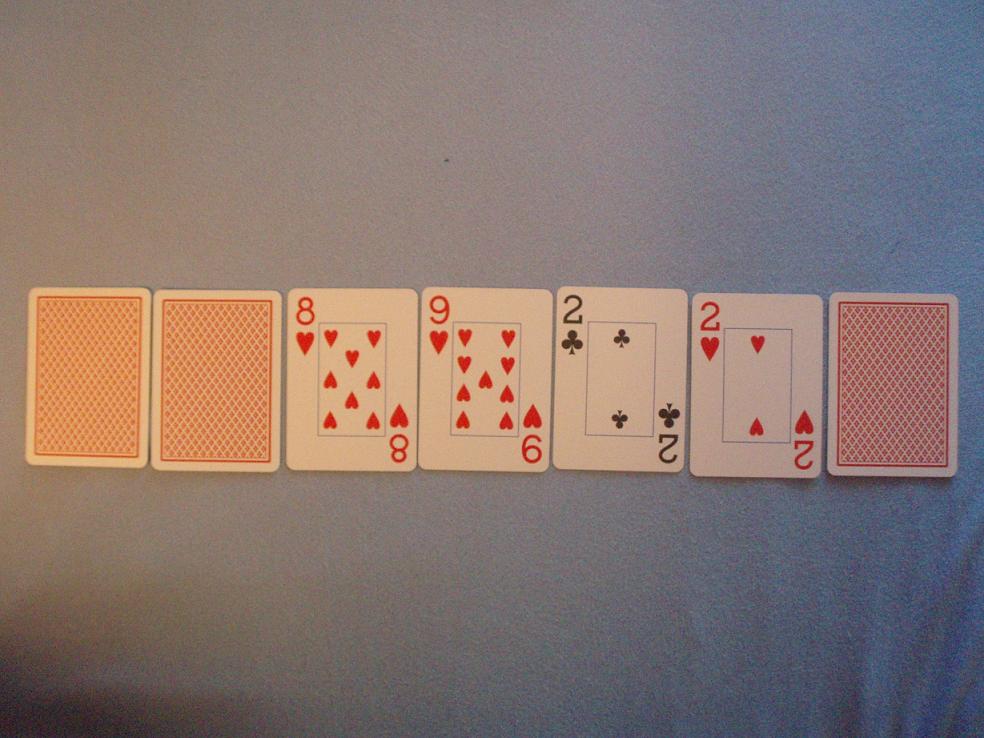
The second round is followed by a third up-card and betting round, then a fourth up-card and betting round, and finally a down-card, a fifth betting round, and a showdown if needed. The game is summarized as "two down, four up, one down." At showdown, each player makes the best five-card hand from their seven cards. With seven cards each for eight players plus four burn cards, that totals 60 cards—more than a 52-card deck. This is usually not a problem because players fold early. If the deck runs out, the four burn cards can be used; if still insufficient, a single community card is dealt to the center for the final round instead of a down-card. Discarded cards from folded hands are not reused. Players use the information from face-up cards to make strategic decisions, knowing that a folded card cannot appear in another opponent's hand.
**Variants**
Several variations of seven-card stud exist, where each player gets a set number of cards. Not all are found in poker rooms, but they can be played at home. "Down the River" is the basic version played in poker rooms. "Mississippi" removes the betting round between fourth and fifth streets, leaving only four betting rounds, and deals the fourth and fifth cards face up, making it more like Texas hold 'em. In "roll your own," four rounds of two down cards each are dealt, and each player must "roll" one card face up, followed by a betting round; except for the first round, the rolled card may come from any round. In "Queens and after," all Queens are wild, and the card dealt face up immediately after a Queen becomes wild as well; if another Queen appears face up, the wild card changes to the card following that new Queen. "Baseball" makes 3s and 9s wild, and a 4 dealt face up gives the player an extra card. "Low Chicago" gives half the pot to the lowest spade in the hole; "High Chicago" gives it to the highest spade; "Chicago" can mean either. "Acey Ducey" makes aces and twos wild. One-eyed Jacks or the Suicide King can also be specified as wild. Razz is a lowball version where the goal is the lowest hand. In "Seven-Card Stud High-Low" (also called Seven-Card Stud/8 or Seven-Card Stud Split), the pot is split between the highest and lowest hands, provided the low hand is at least an 8-high.
**Sample deal**
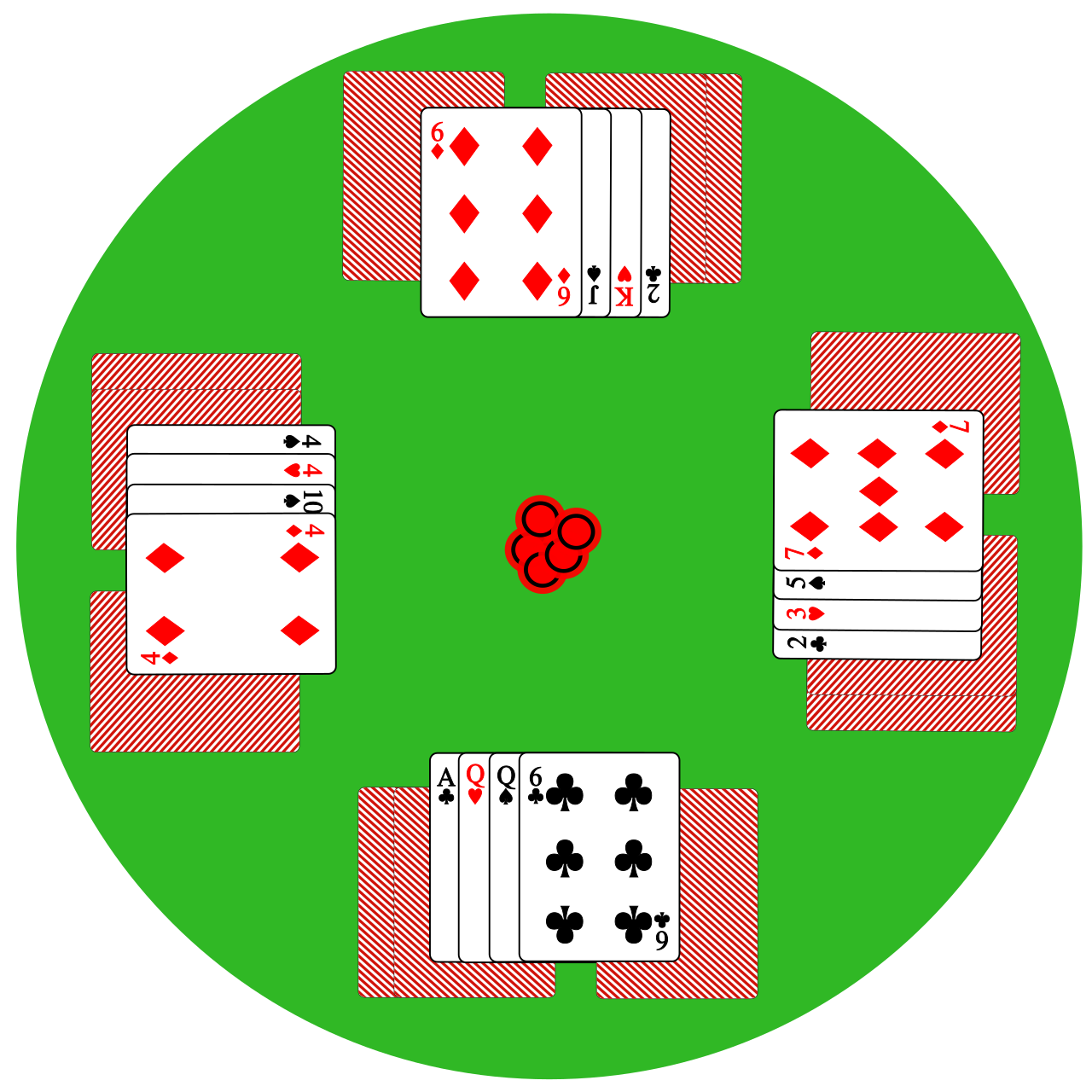
This sample assumes four players: Jimmy (dealer), Larry (to his left), Craig (to Larry's left), and Katherine (to Craig's left). All ante 25¢. Jimmy deals two downcards and one upcard to each, starting with Larry and ending with himself. Larry gets 4♠, Craig gets K♦, Katherine gets 4♦, and Jimmy gets 9♣. With a $1 bring-in, Katherine must start betting because her 4♦ is lower than Larry's 4♠ by suit. She bets the required $1. The bring-in sets the current bet to $1, so Jimmy cannot check; he calls. Larry folds (turning his upcard face down and discarding). Craig raises to $3. Katherine folds, and Jimmy calls. Jimmy then deals a second face-up card to each remaining player.
- Players
- 2 to 8
Lore & Background
Seven-card stud, also known as Seven-Toed Pete or Down-The-River, is a variant of stud poker that, before the rise of Texas hold 'em in the 2000s, was one of the most widely played poker variants in both home games across the United States and casinos in the eastern part of the country. While less common in casinos today, it remains popular online. The game accommodates two to eight players, though eight may require special rules for the final cards if no one folds; nine players are possible. In casinos, a small ante and bring-in are standard, while home games typically use only an ante. Seven-card stud is the "S" game in HORSE and similar mixed formats. The deal proceeds as "two down, four up, one down"—each player receives two cards face down and one face up. The player with the lowest-ranking up-card pays the bring-in, which counts as an open, preventing the next player from checking. If two players share the same low card, suit breaks the tie. If no bring-in is used, the highest up-card acts first and may check. After the first betting round, a second up-card is dealt, followed by a betting round starting with the best face-up poker hand (straights and flushes do not yet count). This pattern repeats for two more up-cards and betting rounds, then a final down-card and a fifth betting round before showdown. Players use visible cards to make strategic decisions, knowing that folded cards will not reappear. If the deck runs out, burn cards are reused; if insufficient, a single community card is dealt for the final round.
Reader's Guide
Seven-card stud is the 'S' game in HORSE and similar mixed game formats. Its significance lies in its historical dominance before Texas hold 'em's rise, particularly in home games and eastern US casinos. The game's structure—two down, four up, one down—requires players to use visible cards to infer opponents' holdings and adjust strategy. Variants include Mississippi (four betting rounds), roll your own, Queens and after, Baseball, Chicago, Acey Ducey, and Razz. In Seven-Card Stud High-Low, the pot is split between the highest and lowest hand if the low hand is topped by at least an 8. The sample deal illustrates typical play: four players ante, a bring-in is forced, betting proceeds, and the best five-card hand from seven cards wins. The game appears in popular culture at the end of Tennessee Williams' play A Streetcar Named Desire, where a character says 'This game is seven-card stud.'
Did You Know?
- Seven-card stud is also known as Seven-Toed Pete or Down-The-River.
- In casino play, a small ante and bring-in are common; in home games, only an ante is typical.
- If the deck is exhausted, the four previously dealt burn cards can be used.
- Razz is a lowball form of seven-card stud where the objective is to get the lowest hand possible.
Gallery
Frequently Asked Questions
What is Seven-card stud and what nicknames does it go by?
It is a classic stud poker variant in which each player receives seven cards total—one face-down hole card plus six face-up cards dealt over successive betting rounds. Gamblers also call it Seven-Toed Pete or Down-The-River, names that stuck in home-game circles for decades.
How many players can sit at a Seven-card stud table?
The rules accommodate anywhere from two to eight participants. That range makes it flexible for small private games as well as full casino tables.
How does Seven-card stud compare to Texas hold'em?
Before hold'em surged in popularity during the 2000s, seven-card stud was one of the most widely played poker variants in U.S. home games and in eastern casinos. Today it has lost much of its casino-floor presence but remains a standard option in online poker.
Where can I still play Seven-card stud in 2025?
Many brick-and-mortar casinos have trimmed their poker menus in favor of hold'em, so you are more likely to find the game on online poker platforms that keep a broader variant list. A handful of eastern U.S. casinos and private home-game circles still run it regularly.
Why do fans still care about Seven-card stud if it is less common now?
Veteran players often cite the face-up community of cards as giving the variant a more open, reading-heavy strategic feel compared to hold'em's two-card hole structure. That transparency keeps it a favorite for players who enjoy tracking opponents' likely hands round by round.
More in Card & Tabletop Games 1-24
Spotted an error? Know more?
This is a living reference — every entry is fact-audited, and reader corrections feed straight into our audit queue. Suggest an edit · See this site's audit record