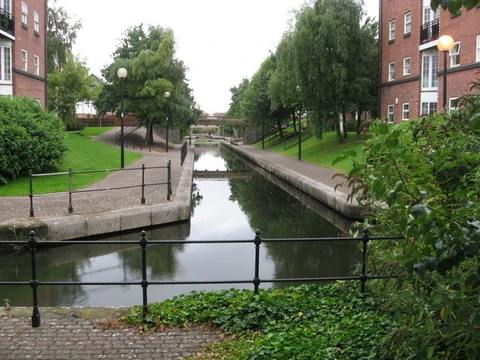
Red Flag Canal

The Red Flag Canal is an irrigation canal located 80 kilometers northwest of Anyang in the northern extremity of Henan, China. It begins near the border of Henan and Shanxi, drawing water from the Zhang River, which flows from Shanxi and later forms the boundary between Hebei and Henan near Handan. The canal’s dam sits close to the corner where the three provinces meet. The main channel winds along the side of a cliff, passing through 42 tunnels and following the Taihang Mountains. The main canal is 71 kilometers long, and when including all its distribution branches, the entire irrigation system is claimed to have a total length of 1,500 kilometers. This network irrigates the fields of the Linzhou district.
Construction was initiated during the Great Leap Forward and carried out in the 1960s, with the main channel completed in 1965. The entire canal was dug by hand labor alone. In its time, the Red Flag Canal was hailed as a major achievement of Chinese workers and became the subject of several movies. It was featured in propaganda both within China and abroad as an example of what workers could accomplish through local mass initiative. In 1972, the Italian film director Michelangelo Antonioni visited Linzhou (then called Linxian) and the Red Flag Canal while making his documentary *Chung Kuo, Cina* about China during the Cultural Revolution.
- location
- 80 km northwest of Anyang, Henan, China
- main_canal_length
- 71 km (44 mi)
- water_source
- Zhang River
- irrigates
- Linzhou district
Lore & Background
The Red Flag Canal is an irrigation canal located northwest of Anyang in the northern extremity of Henan, China. Its appearance is defined by its dramatic course along the sheer side of a cliff, notably at a point known as Tiger's Mouth Cliff, where the canal is built directly into the rock face. The canal begins near the border of Henan and Shanxi, diverting water from the Zhang River, which flows from Shanxi and later forms the border between Hebei and Henan near Handan. The dam that controls the water is situated near the corner where the three provinces of Henan, Shanxi, and Hebei meet. From there, the canal winds through the Taihang Mountains, passing through 42 tunnels hewn through the mountain rock. The main canal is 71 kilometers long, and including its many distribution branches, the entire irrigation system is claimed to have a total length of 1,500 kilometers. This system irrigates the fields of the Linzhou district. The canal was initiated during the Great Leap Forward and built entirely by hand labor in the 1960s, with the main channel completed in 1965. It was hailed as a great achievement of Chinese workers and featured in propaganda as an exemplar of local mass initiative and worker capability. The canal was also the subject of several movies and was visited in 1972 by Italian filmmaker Michelangelo Antonioni for his documentary *Chung Kuo, Cina*.
Reader's Guide
The Red Flag Canal is an irrigation canal located northwest of Anyang in northern Henan, China. It begins near the border of Henan and Shanxi, diverting water from the Zhang River, which flows from Shanxi and forms the border between Hebei and Henan near Handan. The dam sits near the corner where the three provinces meet. The canal winds around the side of a cliff, passing through 42 tunnels and along the Taihang Mountains. The main canal is 71 kilometers long, with many branches distributing water to irrigate the fields of the Linzhou district. The entire irrigation system is claimed to have a total length of 1,500 kilometers.
Initiated during the Great Leap Forward, the canal was built entirely by hand labor in the 1960s, with the main channel completed in 1965. It was considered a great achievement of Chinese workers and was featured in propaganda both within China and abroad as an exemplar of worker capability and local mass initiative. Several movies were made about the canal. In 1972, Italian film director Michelangelo Antonioni visited Linzhou (then Linxian) and the canal while filming his documentary *Chung Kuo, Cina* about China during the Cultural Revolution. The canal remains a notable example of large-scale manual infrastructure construction from that period.
Did You Know?
- The Red Flag Canal includes 42 tunnels through the Taihang Mountains.
- The main canal is 71 km long, with the total irrigation system claimed to be 1,500 km.
- The canal diverts water from the Zhang River near the border of Henan, Shanxi, and Hebei provinces.
More in Canals And Waterways 1-24
Spotted an error? Know more?
This is a living reference — every entry is fact-audited, and reader corrections feed straight into our audit queue. Suggest an edit · See this site's audit record