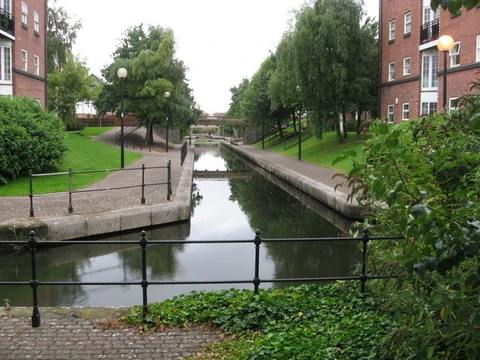
Ghent–Terneuzen Canal
Canal linking Ghent, Belgium, to Terneuzen, Netherlands.

via Wikipedia: Terneuzen · see source
The Ghent–Terneuzen Canal, also referred to as the Sea Canal, links the Belgian city of Ghent with the port of Terneuzen on the Westerschelde Estuary in the Netherlands, providing Ghent with improved maritime access. Construction took place between 1823 and 1827 under the initiative of the Dutch King, at a time when the future Belgium and the Netherlands were united following the Congress of Vienna. After Belgium’s secession in 1830, Dutch authorities blocked traffic to and from Belgium until 1841. The canal was later enlarged between 1870 and 1885, achieving a central depth of 6.5 metres, a base width of 17 metres, and a surface width of 68 metres, with bridges rebuilt along the Belgian section. Further improvements were governed by bilateral acts in 1880. In the early 1880s, contracts were awarded for a new lock and lateral canal east of Sas van Gent, as well as widening and deepening on Dutch territory, with works completed by September 1885. As steamships grew larger, new negotiations led to a 1895 agreement between Belgium and the Netherlands for 21 improvement works, ratified by the Dutch Parliament in 1897. A new lock at Terneuzen was tendered in 1900, and contracts for the lock and other works were awarded in 1901 and 1904 to Belgian contractors. The canal hosted the Cluysen–Ter Donck Regatta for decades and the European Rowing Championships during the 1913 Ghent Expo. Major enlargement continued, notably in the early 1960s. In 2015, Flanders and the Netherlands signed a treaty for a new lock at Terneuzen, costing €920 million and comparable in size to the Panama Canal expansion locks. Today, the canal is 200 metres wide and accommodates ships up to 125,000 gross tonnage.
- width
- 68 metres at the surface
Verified Timeline
Lore & Background
The Ghent–Terneuzen Canal, also called the Sea Canal, links Ghent in Belgium to the port of Terneuzen on the Westerschelde Estuary in the Netherlands. Excavated between 1823 and 1827 on the initiative of the Dutch King, it was built when Belgium and the Netherlands were a united country. After Belgium’s secession in 1830, Dutch authorities blocked traffic until 1841. The canal was enlarged between 1870 and 1885 to a depth of 6.5 metres at its centre, a bottom width of 17 metres, and a surface width of 68 metres, with bridges rebuilt accordingly. Further improvements were regulated by bilateral acts in 1880. A lateral canal east of Sas van Gent, including a new lock, was completed on 1 September 1885. By the late 19th century, increasing ship sizes prompted new negotiations, leading to a 1895 agreement for 21 improvement works at Terneuzen, Sluiskil, and Sas van Gent. A new lock at Terneuzen was tendered in 1900. The canal hosted the Cluysen - Ter Donck Regatta from 1888 to 1954 and the European Rowing Championships during the 1913 Ghent Expo. Major enlargement occurred in the early 1960s. In February 2015, Flanders and the Netherlands signed a treaty for a new lock at Terneuzen, costing €920M and comparable in size to the Panama Canal expansion locks. Today the canal is 200 metres wide and accommodates ships up to 125,000 gross tonnage.
Reader's Guide
The Ghent–Terneuzen Canal, also called the Sea Canal, connects Ghent, Belgium, to the port of Terneuzen on the Westerschelde Estuary in the Netherlands, giving Ghent improved sea access. Construction began between 1823 and 1827 at the initiative of the Dutch King, when Belgium and the Netherlands were united under the Congress of Vienna. After Belgium’s secession in 1830, the Dutch blocked traffic until 1841. Enlargement between 1870 and 1885 deepened the canal to 6.5 meters at its center, with a bottom width of 17 meters and a surface width of 68 meters, requiring bridge reconstructions along the Belgian section. Further improvements were governed by bilateral acts in 1880. A lock and lateral canal east of Sas van Gent were completed in September 1885. As steamships replaced sailing vessels, Ghent’s competitiveness depended on further enlargement, leading to an 1895 agreement between Belgium and the Netherlands for 21 improvement works at Terneuzen, Sluiskil, and Sas van Gent. A new lock at Terneuzen was tendered in 1900, with contracts awarded to Belgian contractors in 1901 and 1904. The canal hosted the Cluysen - Ter Donck Regatta from 1888 to 1954, and the European Rowing Championships during the 1913 Ghent Expo. Major enlargement continued, notably in the early 1960s. In 2015, Flanders and the Netherlands signed a treaty for a new lock at Terneuzen, costing €920 million and comparable in size to Panama Canal expansion locks. Today the canal is 200 meters wide, accommodating ships up to 125,000 gross tonnage.
Did You Know?
- The port of Terneuzen is the third-largest in the Netherlands, after those of Rotterdam and Amsterdam.
- The largest plant of Dow Chemical Company outside of the United States is located at Terneuzen.
- Terneuzen's passenger rail service was withdrawn in 1951.
- The Western Scheldt Tunnel, which connects Terneuzen to the rest of the Netherlands, opened in March 2003.
- Before 1877, the city was often called Neuzen.
Strategic Waterways & Historical Roots
Terneuzen was a strategically located port on the waterways to Ghent, in present-day Belgium. First mentioned in 1325, it received city rights in 1584. The city of Terneuzen is located on the southern shore of the Western Scheldt estuary. The Ghent–Terneuzen Canal is still an important shipping route connecting the Port of Ghent.
Industrial Heart of the Canal
The Ghent–Terneuzen Canal is still an important shipping route connecting the Port of Ghent. The port of Terneuzen is the third-largest in the Netherlands, after those of Rotterdam and Amsterdam. The largest plant of Dow Chemical Company outside of the United States is located at Terneuzen, on the west side of the Ghent–Terneuzen Canal.
Connectivity & Transport Challenges
Terneuzen can be reached from the rest of the Netherlands via the Western Scheldt Tunnel, which opened in March 2003. Terneuzen is not linked to the rest of the Netherlands by rail, although the Dow Chemical plant is served by a freight-only line to Ghent in Belgium (Terneuzen's passenger rail service was withdrawn in 1951).
The Municipality at the Canal's Edge
Terneuzen is a city and municipality in the southwestern Netherlands, in the province of Zeeland, in the middle of Zeelandic Flanders. With almost 55,000 inhabitants, it is the most populous municipality of Zeeland. Before 1877, the city was often called Neuzen. The municipality of Terneuzen consists of the following population centres.
Frequently Asked Questions
What is the Ghent–Terneuzen Canal?
It is a navigable waterway that links the Belgian city of Ghent to the Dutch port of Terneuzen on the Scheldt Estuary. Locals and mariners often call it the Zeekanaal, or 'Sea Canal,' because it provides a direct route to open water.
Who was behind building the Ghent–Terneuzen Canal?
The project was initiated by the Dutch King and constructed between 1823 and 1827. Its purpose was to give Ghent a more reliable and efficient connection to the sea for trade and industry.
How wide is the Ghent–Terneuzen Canal at the surface?
The canal measures 68 metres across at water level. That width was not the original dimension; the channel has been widened in successive phases to keep up with ever-larger commercial vessels.
Why does the Ghent–Terneuzen Canal matter to shipping?
It is the principal maritime artery out of Ghent, turning the inland city into a functioning seaport by connecting it straight to the Westerschelde. Without it, Ghent's industrial output would lack a practical route to international shipping lanes.
Has the canal been modified since its 1827 opening?
Yes, it has gone through multiple rounds of enlargement over the following two centuries. Each upgrade was driven by the need to accommodate bigger draft, wider beams, and heavier tonnage as global shipping standards grew.
More in Canals And Waterways 1-24
Spotted an error? Know more?
This is a living reference — every entry is fact-audited, and reader corrections feed straight into our audit queue. Suggest an edit · See this site's audit record