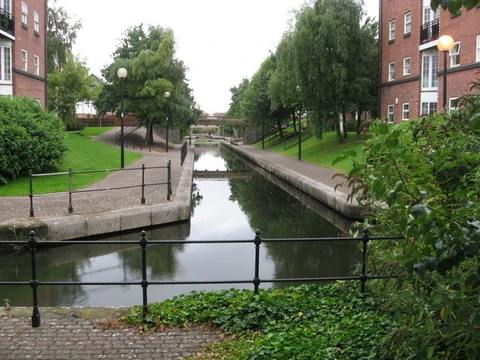
Oder–Havel Canal
German canal linking Oder and Havel rivers, built 1908–1914.

The Oder–Havel Canal, originally called the Hohenzollern Canal, was constructed in Germany from 1908 to 1914. It largely took over from the older Finow Canal. The waterway is part of the larger Havel-Oder-Wasserstraße, which also includes the Hohensaaten-Friedrichsthaler Wasserstraße, the Oderhaltung, and the Schwedter Querfahrt. Stretching 82.8 kilometers (51.4 miles) with a width of 33 meters (36 yards), the canal connects the Oder River near the Polish town of Cedynia, close to Szczecin, to the Havel River—a tributary of the Elbe—near Berlin. A ship lift was added in 1934 at Niederfinow, providing a vertical lift of 36 meters (118 feet). Its caisson measures 85 meters by 12 meters by 2.5 meters (278.9 ft × 39.4 ft × 8.2 ft) and could handle vessels with a displacement of up to 1,000 tonnes. The canal’s effective start is at the current mouth of the Oranienburger Havel. It passes through the Lehnitzsee, a lake not originally part of the Havel, and reaches the Lehnitzschleuse. Much of its route follows the former Malz Canal, then replaces the Finow Canal up to its eastern terminus. The canal’s summit level runs from the headwater of the Lehnitz lock to the Niederfinow boat lift. Water for this summit is supplied from the Havel’s catchment area, supplemented by advertising water and, during dry periods, from the Müritz-Havel waterway and the Elde.
- length
- 82.8 km (51.4 mi)
- width
- 33 m (36 yd)
- built
- 1908–1914
- original_name
- Hohenzollern Canal
- key_feature
- Niederfinow ship lift (built 1934)
Verified Timeline
Quick Facts
- Canal Length
- 82.8 km
- Date Began
- 1908
- Date Completed
- 1914
- Start Point
- Oder River, near Cedynia, at the border between Germany and Poland
- End Point
- Havel, near Berlin, Germany
Facts from the source article.
Lore & Background
The Oder–Havel Canal was built between 1908 and 1914, originally known as the Hohenzollern Canal, mostly replacing the Finow Canal. The assumed start of the actual Oder–Havel Canal is the current mouth of the Oranienburger Havel. It leads through the Lehnitzsee, which previously did not belong to the Havel, and reaches the Lehnitzschleuse. Most of the canal follows the former Malz Canal and then replaces the older Finow Canal up to its eastern end. Its top parting extends from the headwater of the Lehnitz lock to the Niederfinow boat lift. The natural resources of the catchment areas of the Havel and the advertising water and, in the event of drought, the Müritz-Havel waterway and the Elde are used to supply the water to the vertex.
Reader's Guide
The Oder–Havel Canal is a major waterway connecting the Oder and Havel rivers, forming part of the Havel-Oder-Wasserstraße. It runs from Cedynia near Szczecin on the Oder to the Havel near Berlin, stretching 82.8 km with a width of 33 m. In 1934 a ship lift was built on the canal, near Niederfinow. Its vertical lift was 36 metres (118 ft). The dimensions of the caisson are 85 m × 12 m × 2.5 m (278.9 ft × 39.4 ft × 8.2 ft). It could lift vessels of up to 1000 tonnes displacement. The canal's water supply is managed using natural resources from the Havel catchment area and, during drought, the Müritz-Havel waterway and the Elde.
Did You Know?
- The Oder–Havel Canal was originally known as the Hohenzollern Canal.
- It mostly replaced the older Finow Canal.
- In 1934 a ship lift was built on the canal, near Niederfinow, with a vertical lift of 36 metres.
- The ship lift's caisson dimensions are 85 m × 12 m × 2.5 m.
- The ship lift could lift vessels of up to 1000 tonnes displacement.
More in Canals And Waterways 1-24
Spotted an error? Know more?
This is a living reference — every entry is fact-audited, and reader corrections feed straight into our audit queue. Suggest an edit · See this site's audit record