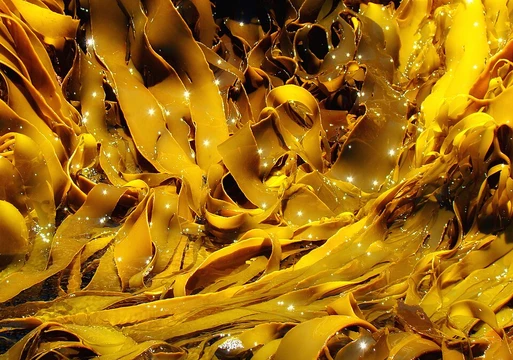
Laminaria
A genus of brown kelp with economic and ecological importance.

Laminaria is a genus of brown seaweed, part of the kelp order Laminariales, with 31 species found naturally in the north Atlantic and northern Pacific. The genus is notable for its large size and long, tough blades, and it holds economic importance. Depending on the species, common names include Devil's apron (referring to the shape), sea colander (for holes in the blade), or simply tangle. These seaweeds create habitat for fish and many invertebrates.
The life cycle of Laminaria involves a heteromorphic alternation of generations, unlike that of Fucus. During meiosis, male and female zoospores are produced separately; these then grow into male and female gametophytes. The female egg matures inside the oogonium until fertilized by male sperm. The most visible stage is the sporophyte, which consists of a holdfast, a stipe, and blades. Laminaria spends most of its time in this sporophyte phase, alternating with a microscopic gametophyte phase. Note that *Laminaria japonica* is now considered a synonym of *Saccharina japonica*, and *Laminaria saccharina* is now classified as *Saccharina latissima*.
**History** Laminaria first reached China from Hokkaido, Japan, in the late 1920s. There, it was cultivated on a much larger industrial scale. The rocky shores and cold waters of Dalian, on the northern coast of the Yellow Sea, provided excellent growing conditions. Harvested for food, the dry-weight yield in 1949 was 40.3 metric tons. Laminaria requires cold water and can only survive above 36° N latitude. In 1949, the Chinese began commercial farming of laminaria as a crop, boosting dry-weight production to 6,200 metric tons. China still produces large amounts of farmed laminaria, though output has declined since the 1980s due to new mariculture technology.
**Farming practices** The floating raft method is the standard approach: young laminaria sporophytes are attached to submerged ropes, which are then tied to floating rafts.
**Ecology** Laminaria thrives in colder ocean waters, such as those in Arctic regions, and prefers rocky shores where it can attach. Its height offers shelter that the open ocean often lacks. Invertebrates are among the organisms living among the algae; sea snails and other invertebrates feed on the blades. Other creatures, like sea urchins, eat the holdfasts, which can kill the algae.
Quick Facts
- Taxon
- Laminaria
Facts from the source article.
Lore & Background
Laminaria arrived in China from Hokkaido, Japan in the late 1920s. Once in China, Laminaria was cultivated on a much larger industrial scale. The rocky shores at Dalian, the northern coast of the Yellow Sea, along with its cold waters provided excellent growing conditions for these species. Laminaria was harvested for food and 1949 yielded 40.3 metric tons of dry weight. Laminaria need cold water to survive and can only live above 36° N latitude. In 1949, the Chinese started to commercially grow laminaria as a crop. This increased the production of dry weight to 6,200 metric tons. Farming laminaria is still a large production for China. However, since the 1980s production has dropped due to new mariculture technology.
The life cycle of Laminaria has heteromorphic alternation of generations which differs from Fucus. At meiosis the male and female zoospores are produced separately, then germinate into male and female gametophytes. The female egg matures in the oogonium until the male sperm fertilizes it. The most apparent form of Laminaria is its sporophyte phase, a structure composed of the holdfast, the stipe, and the blades. While it spends its time predominately in the sporophyte phase, it alternates between the sporophyte and its microscopic gametophyte phase. Laminaria expresses a haplo-diplophasic life history, in which it alternates from a macroscopic thallic sporophyte structure to a filamentous, microscopic gametophyte. The sporophyte structure can grow to 7 metres (23 ft), which is large in comparison to other algae, but still smaller than the giant kelps such as Macrocystis and Nereocystis, which can grow up to 40–50 metres (130–160 ft). The gametophyte structure is no more than a few millimeters in length. In opposition to the gametophyte phase, which only consists of one type of tissue, the more complex sporophyte phase is made up of different types of tissue, including a sieve-like element which translocates photoassimilates.
Reader's Guide
Laminaria is notable for its economic and ecological roles. It is farmed using the floating raft method, in which young sporophytes are attached to submerged ropes, which are then attached to floating rafts. Laminaria is found in colder ocean waters, such as arctic regions, preferring rocky shores for attachment. Due to its height, it provides protection for creatures that the open ocean does not often give. Invertebrates such as sea snails feed on the blades, while sea urchins feed on the holdfasts, which can kill the algae. Red sea urchins, found on the North America Pacific Coast, can decimate kelp, including Laminaria, if not managed by sea otters. Species such as Coelopa pilipes feed and lay eggs on Laminaria when washed up on beaches.
Various species have been used for food since ancient times. The prepared parts, usually the blade, are consumed after boiling or drying. The greater proportion of commercial cultivation is for algin, iodine, and mannitol, used in industrial applications. In South Korea it is processed into laminaria jelly; in other countries it is used in fresh salad form, also canned for preservation. Many countries produce and consume laminaria products, the largest being China. A laminaria stick may be used to slowly dilate the cervix for medical procedures. Laminaria is a source of iodine, used to promote thyroid health. For energy, Laminaria is less desired due to its high ash content (33%) compared to wood (about 2%). Anaerobic digestion is the most promising practice to extract energy, though barriers remain. Laminaria also shows ability to absorb heavy metals from wastewater due to its alginate's favorable M/G ratio, binding cations such as Cu2+, Cd2+, and Pb2+.
Did You Know?
- Laminaria comprises 31 species native to the north Atlantic and northern Pacific Oceans.
- Laminaria japonica is now regarded as a synonym of Saccharina japonica.
- In 1949, China yielded 40.3 metric tons of dry weight of Laminaria, which increased to 6,200 metric tons after commercial farming began.
- Laminaria has an ash content of 33% when burned, compared to about 2% for wood.
More in Brown Macroalgae and Kelp 1-24
Spotted an error? Know more?
Reader corrections go straight into our review queue. Suggest an edit · How this site is sourced