Aquaculture of giant kelp
Cultivation of giant kelp for food, supplements, and potash.
Last updated
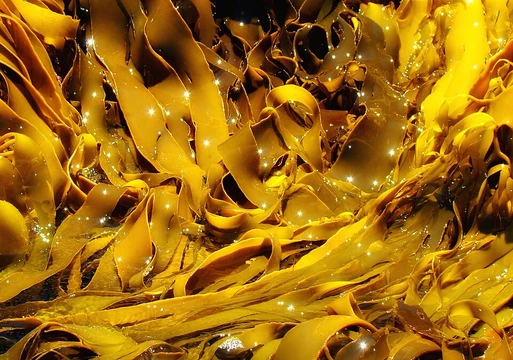
Aquaculture of giant kelp, Macrocystis pyrifera, involves growing this seaweed for products like food, dietary supplements, and potash. The kelp itself is rich in iodine, potassium, other minerals, vitamins, and carbohydrates.
History
In the early 1900s, California’s kelp beds were harvested for potash. Interest grew again in the 1970s and 1980s for alginate production and as a biomass source for animal feed during the energy crisis, but commercial farming of M. pyrifera never took off.
When the energy crisis ended and alginate prices dropped, research into farming it slowed. During the early 1990s, supply for alginate relied on managing and restoring natural beds. In California, the “Kelp bed project” transplanted adult specimens 3 to 6 meters long to stabilize harbor substrates and boost biodiversity.
Twenty-first century
In the twenty-first century, research is looking at using the kelp as feed for farmed fish. China and Chile are the top producers of aquatic plants and algae, each making over 300,000 tonnes in 2007, though how much of that is M. pyrifera is unclear.
Chile’s production is split evenly between brown algae (Phaeophytes) and red algae (Rhodophytes), while China grows a wider variety including green algae (Chlorophytes). Chilean experiments are exploring hybrids of M. pyrifera and M. integrifolia. Kelp farming is also developing in Oregon and British Columbia, and startups have begun leasing water in Alaska for large-scale cultivation.
Northern California lost 95% of its kelp ecosystems in the 2010s due to marine heatwaves. Recovery efforts focus on removing sea urchins, either by scuba divers or by their natural predator, the sea otter. An invasive brown algae, Sargassum horneri, first spotted in 2003, is also a problem. Researchers at UC Davis’s Bodega Marine Laboratory are developing replanting strategies, and volunteers from the Orange County Coastkeeper group are replanting giant kelp.
Humboldt State University started cultivating bull kelp at its research farm in 2021. State-level research to prevent kelp forest collapse was announced in July 2020. At the federal level, the KELP Act (H.R. 4458), introduced in July 2021, would create a NOAA grant program for kelp forest restoration. Ocean Rainforest, a Faroe Islands company, received $4.5 million in U.S. government funding to grow giant kelp on an 86-acre farm off Santa Barbara, California.
Quick Facts
- Chile phaeophyte share
- 50%
- Ocean rainforest funding
- $4.5 million
- Ocean rainforest farm size
- 86 acres
Facts from the source article.
Frequently Asked Questions
What is Aquaculture of giant kelp?
It refers to the deliberate cultivation of Macrocystis pyrifera, the giant kelp species, to harvest it for human food, dietary supplements, and industrial potash. The seaweed is notably dense in iodine, potassium, vitamins, and complex carbohydrates, which is what makes it commercially attractive.
Why did Aquaculture of giant kelp fail to become a major commercial industry?
A brief wave of investment in the 1970s and 1980s was tied to the energy crisis and high alginate prices, but once both pressures eased, funding for research dried up. As a result, large-scale commercial farming of M. pyrifera never reached a self-sustaining scale.
Where is Aquaculture of giant kelp active today?
Kelp farming continues in Oregon and British Columbia, while China and Chile each reported producing over 300,000 tonnes of aquatic plants and algae by 2007. In Chile, phaeophytes (brown algae like kelp) account for roughly half of that output, with the other half coming from red algae.
More in Brown Macroalgae and Kelp
Sources
Compiled from Wikipedia and the sources listed below. Text from Wikipedia is available under CC BY-SA 4.0; this entry is adapted from it.
- Wikipedia: Aquaculture of giant kelp (CC BY-SA 4.0).
Spotted an error? Know more?
Reader corrections go straight into our review queue. Suggest an edit · How this site is sourced