Stramenopile
Protists defined by tripartite stiff hairs, including brown algae and diatoms.
Last updated
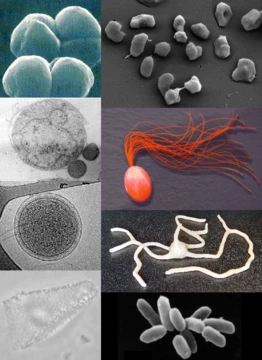
Stramenopiles are a diverse group of protists defined by the presence of tripartite stiff flagellar hairs and all their descendants.[1] Many stramenopiles have plastids containing chlorophyll a, chlorophyll c, and fucoxanthin, giving them off-green, orange, golden or brown colours.[2] The group includes major autotrophs like brown algae and diatoms, as well as heterotrophs and parasites.[2][3]
Scientific classification
- CladeEukaryota
- CladeSar<!-- Do not change Sar to SAR. The consensus was to use Sar in the taxonomy template. -->
- CladeStramenopiles
Named by Patterson 1989, emend. Adl et al. 2005
Sources: Wikipedia taxobox: Stramenopile (CC BY-SA 4.0)
Quick Facts
- Diversity
- >100,000 species
Facts from the source article.
Key facts and history
By 1956, Copeland used 'heterokont' to include xanthophytes, chrysophytes, silicoflagellates, hyphochytrids, and also unrelated groups like choanoflagellates and haptophytes.[4][5] This inconsistent usage made the meaning of 'heterokont' unclear without reference to a specific author's definition.[5] The presumed apomorphy of tripartite flagellar hairs is well characterized, with a flexible base, a long stiff tube, and delicate tip hairs called mastigonemes.[6] Stramenopiles are most closely related to alveolates and Rhizaria, together forming the SAR supergroup.[7]
The International Society of Protistologists formally adopted Stramenopiles as a taxonomic name in 2005.[8] While many stramenopiles contain stramenochrome plastids, molecular evidence indicates that the earliest-branching stramenopiles were colourless heterotrophs without plastids.[2]
References
- Wikipedia, "Stramenopile" (CC BY-SA 4.0), which cites: Hee, "Characterisation of Stramenopile-specific mastigoneme proteins in Phytophthora parasitica", Protoplasma, 2019, p. 521–535 (original not read by us) en.wikipedia.org
- Wikipedia, "Stramenopile" (CC BY-SA 4.0), which cites: Leipe, "The stramenopiles from a molecular perspective: 16S-like rRNA sequences from Labyrinthuloides minuta and Cafeteria roenbergensis", Phycologia, 1994, p. 369–377 (original not read by us) en.wikipedia.org
- Wikipedia, "Stramenopile" (CC BY-SA 4.0), which cites: Roberts, "Update on the pathogenic potential and treatment options for Blastocystis sp", Gut Pathogens, 2014, p. 17; Olsen, "Animal Parasites: their life cycles and ecology", Dover, 1986, p. 56 , 74–75; Nowicki, "Potato and tomato late blight caused by Phytophthora infestans: An overview of pathology and resistance breeding", Plant Disease, 17 August 2011, p. 4–17; Yool, "Role of diatoms in regulating the ocean's silicon cycle", Global Biogeochemical Cycles, 2003, p. n/a; Cock, "Brown algae", Current Biology, 2011-08-09, p. R573–R575; Guir en.wikipedia.org
- Wikipedia, "Stramenopile" (CC BY-SA 4.0), which cites: Copeland, "The Classification of Lower Organisms", Pacific Books, 1956 (original not read by us) en.wikipedia.org
- Wikipedia, "Stramenopile" (CC BY-SA 4.0), which cites: Blackwell, "Chromista revisited: A dilemma of overlapping putative kingdoms, and the attempted application of the botanical code of nomenclature", Phytologia, 2009; Patterson, "Problems in Phylogenetic Reconstruction", Academic Press, 1982 (we also read that source) en.wikipedia.org
- Wikipedia, "Stramenopile" (CC BY-SA 4.0), which cites: Bouck, "The structure, origin, and composition of the tubular mastigonemes of the Ochromonas flagellum", Journal of Cell Biology, 1 August 1971, p. 362–384; Blackman, "Identification of a Mastigoneme Protein from Phytophthora nicotianae", Protist, 2011, p. 100–114 (original not read by us) en.wikipedia.org
- Wikipedia, "Stramenopile" (CC BY-SA 4.0), which cites: Krylov, M. V.; Dobrovolskii, A. A.; Issi, I. V.; Michaelevich, B. I.; Podlipaev, S. A.; Reshetnyak, V. V.; Seravin, L. N.; et al. 1980. New concepts for the sys; Derelle, "A Phylogenomic Framework to Study the Diversity and Evolution of Stramenopiles (=Heterokonts)", Molecular Biology and Evolution, 10 August 2016, p. 2890–2898; "Phylogenomics reveals a new 'megagroup' including most photosynthetic eukaryotes", Biology Letters, August 2008, p. 366–369; Oborník, "International Review of Cell and Molecular Biology", Elsevier, 2013, p. 333–36 en.wikipedia.org
- Wikipedia, "Stramenopile" (CC BY-SA 4.0), which cites: Patterson, "The chromophyte algae: Problems and perspectives", Clarendon Press, 1989, p. 357–379; Patterson, "The Diversity of Eukaryotes", The American Naturalist, 1999, p. S96–S124; David, "A preliminary catalogue of the names of fungi above the rank of order", Constancea, 2002, p. 1–30; ; Adl, "Revisions to the Classification, Nomenclature, and Diversity of Eukaryotes", Journal of Eukaryotic Microbiology, 2019, p. 4–119; Dick, "Straminipilous Fungi: Systematics of the Peronosporomycetes Including Accounts of the Marine Straminipilous Pr en.wikipedia.org
Each numbered sentence above was checked against the source it cites before publication. Sentences citing Wikipedia adapt text from the English Wikipedia article Stramenopile (contributors), used under CC BY-SA 4.0; this entry is available under the same licence. Other sources were used for facts only; no text or images are copied from them.
More in Microbial Groups And Extremophiles
Sources
Compiled from Wikipedia and the sources listed below. Text from Wikipedia is available under CC BY-SA 4.0; this entry is adapted from it.
- Wikipedia: Stramenopile (CC BY-SA 4.0).
- Word definitions: the , each quoted from its Wikipedia article.
Spotted an error? Know more?
Reader corrections go straight into our review queue. Suggest an edit · How this site is sourced