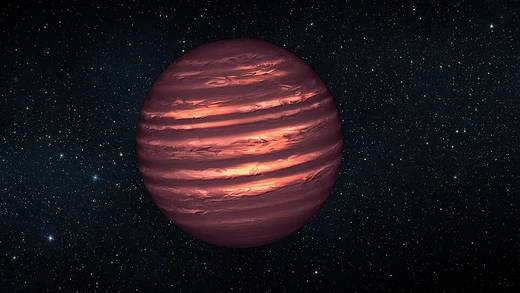
HD 4747
A nearby star with a directly imaged brown dwarf companion.
Last updated
HD 4747 is a star located about 61 light-years from Earth in the constellation Cetus. It is a low-amplitude spectroscopic binary, with its companion being a brown dwarf that has been directly imaged.
The star's binary nature was first identified in 2002 using the HIRES spectrograph at the W. M. Keck Observatory. Earlier instruments had missed the companion because their precision was worse than about 1 km/s, but HIRES, with a precision of 3 m/s, detected a radial velocity variation with a semi-amplitude of roughly 0.65 km/s. The orbit had a period of 6832 ± 653 days and an eccentricity of 0.64 ± 0.06, though the large uncertainty in the period came from the fact that the orbit was not yet closed over the 1731-day observation span. Based on the primary mass, the minimum mass of the companion fell within the brown dwarf range, making HD 4747 B one of the few brown dwarf candidates found within a few astronomical units of any star.
A revised orbital solution came in 2010, using data from the CORALIE spectrograph. With an additional 3068 days of radial velocity measurements, the orbital period was found to be roughly twice as long as originally thought, due to an increase in the fitted eccentricity. The minimum mass of the companion increased slightly but remained in the brown dwarf regime.
In 2013, adaptive optics imaging at the Keck Observatory failed to directly detect the companion, ruling out the possibility that it was a low-inclination stellar binary. A follow-up in 2014 turned up a candidate source, and additional images in 2015 confirmed that this object shares the star's proper motion and exhibits counter-clockwise orbital motion.
HD 4747B
Photometry suggests HD 4747B is most likely an L-type brown dwarf, possibly near the L/T transition. A preliminary dynamical mass places it at several times the mass of Jupiter.
Quick Facts
- Distance
- 61 light-years
- Constellation
- Cetus
- Eccentricity
- 0.64 ± 0.06
- Radial velocity semi-amplitude
- 0.65 km/s
Facts from the source article.
Lore & Background
The binarity of HD 4747 was announced in 2002 based on observations with the HIRES spectrograph at the W. M. Keck Observatory. The radial velocity variation caused by the companion had a semi-amplitude of approximately 0.65 km/s, which had evaded detection by earlier spectrographs due to their precision being poorer than about 1 km/s. With a period of 6832 ± 653 days and an eccentricity of 0.64 ± 0.06, the minimum secondary mass fell within the brown dwarf regime.
An updated orbital solution in 2010, using the CORALIE spectrograph and a 3068-day extension to the radial velocity time series, found the orbital period to be about twice as long as previously thought due to an increase in the fitted eccentricity, with the minimum mass increased slightly but remaining in the brown dwarf regime. A direct imaging attempt in 2013 using adaptive optics at Keck resulted in a non-detection, eliminating the possibility of a low-inclination stellar binary. A follow-up in 2014 yielded a candidate source, and additional images in 2015 confirmed common proper motion and showed orbital motion in a counter-clockwise direction.
Reader's Guide
HD 4747 B is significant as one of the few brown dwarfs directly detected and confirmed via common proper motion and orbital motion. Its detection history illustrates the progression from radial velocity discovery to direct imaging confirmation, a path that remains rare for brown dwarfs at close orbital separations. The initial radial velocity signal, with a semi-amplitude of only 0.65 km/s, required the precision of the HIRES spectrograph to be detected, highlighting the technological advances needed to find such low-mass companions.
The revision of the orbital period from about 6832 days to roughly twice that value demonstrates the challenges of orbit determination when the observational baseline does not cover a full orbit. The companion's photometric classification as an L-type brown dwarf, possibly near the L/T transition, places it in a key temperature regime for understanding substellar atmospheres. The preliminary dynamical mass provides an anchor for evolutionary models of brown dwarfs, though the exact value remains subject to refinement.
More in Brown Dwarfs
Sources
Compiled from Wikipedia and the sources listed below. Text from Wikipedia is available under CC BY-SA 4.0; this entry is adapted from it.
- Wikipedia: HD 4747 (CC BY-SA 4.0).
Spotted an error? Know more?
Reader corrections go straight into our review queue. Suggest an edit · How this site is sourced