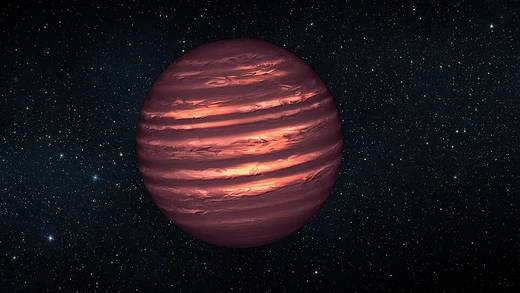
Cha 1107−7626
Lowest-mass object with hydrocarbons detected in its disk.
Last updated
Cha 1107−7626 is a free-floating planetary-mass object located in the Chamaeleon I star-forming region, approximately 190 parsecs from the Solar System. It is notable as the lowest-mass object with hydrocarbons detected in its disk as of May 2025, and it lies northwest of IC 2631.
Quick Facts
- Discovery year
- 2008
- Discoverers
- Kevin Luhman et al.
- Distance
- 190 pc
- Spectral type
- L0
- Mass range
- 6–10 Jupiter masses (refined 2025)
Facts from the source article.
Lore & Background
Cha 1107−7626 was discovered in 2008 by Kevin Luhman et al. using the Spitzer Space Telescope and the Magellan II telescope. Its spectral type was estimated as L0, based on weaker TiO and VO absorption compared to other low-mass members of the Chamaeleon I region such as OTS 44 and Cha 110913−773444. Initial mass estimates ranged from 0.004 to 0.01 solar masses (4.2–10.5 Jupiter masses), later refined by Laura Flagg et al. in 2025 using JWST instruments NIRSpec and MIRI to 6–10 Jupiter masses. The object has also been reported to gain 6 billion tonnes of mass per second during an outburst beginning in June 2025.
The circumstellar disk was first indicated by an infrared excess in Spitzer photometry. Optical spectroscopy with Magellan/LDSS-3 showed strong H-alpha emission, confirming active accretion of hydrogen gas from the disk.
VLT/SINFONI observations detected Paschen-beta line emission, another accretion signature. The MIRI low-resolution spectrum revealed emission features matching methane and ethylene, with hints of ethane. These hydrocarbons are common in disks around young very low-mass stars, and the mid-infrared spectrum closely resembles that of the low-mass star ISO-ChaI 147 in the same region, suggesting similar disk processes across different mass regimes.
An accretion burst was detected with the Very Large Telescope between June and August 2025, followed by JWST spectroscopy. During the outburst, the accretion rate increased six to eight times, reaching 10⁻⁷ solar masses per year—the highest measured in a planetary-mass object.
The Hα line developed a double peak and redshifted absorption, similar to magnetospheric accretion in young stars. The outburst also showed clear changes in hydrocarbon emission lines and the appearance of water vapor emission. Researchers identified a similar burst in 2016, and the event is classified as similar to EXor-type bursts in young stars.
Reader's Guide
Cha 1107−7626 holds significance as the lowest-mass object known to host hydrocarbons in its disk, bridging the gap between planetary-mass objects and very low-mass stars. The detection of methane, ethylene, and ethane in its disk, along with similarities to the disk of ISO-ChaI 147, suggests that isolated planetary-mass objects may form miniature planetary systems through processes analogous to those around stars. The carbon-rich gases in such disks could lead to carbon-rich atmospheres on any forming bodies, similar to Titan, while potentially producing carbon-poor solids if planets assemble late and lose carbon to the gas phase.
The object's accretion burst, the highest ever measured in a planetary-mass object, provides a rare window into episodic accretion behavior. The doubled-peaked Hα line and redshifted absorption during the outburst mirror magnetospheric accretion in young stars, indicating that similar physical mechanisms operate across a wide mass range. The detection of a prior burst in 2016 suggests such events may be recurrent. These findings, enabled by JWST and VLT observations, deepen understanding of how planetary-mass objects accumulate mass and evolve, and how their disks may give rise to diverse planetary compositions.
Frequently Asked Questions
What are Cha 1107−7626's key physical parameters?
The object has an L0 spectral type, a mass between 6 and 10 Jupiter masses, and a quiescent accretion rate on the order of 10⁻¹⁰ to 10⁻¹¹ solar masses per year. These figures place it firmly in the planetary-mass regime rather than the true brown-dwarf range.
Where is Cha 1107−7626 located relative to nearby objects?
It sits in the Chamaeleon I star-forming region, about 190 parsecs from the Solar System, and specifically northwest of the IC 2631 nebula. Its free-floating status means it is not gravitationally bound to any parent star.
More in Brown Dwarfs
Sources
Compiled from Wikipedia and the sources listed below. Text from Wikipedia is available under CC BY-SA 4.0; this entry is adapted from it.
- Wikipedia: Cha 1107−7626 (CC BY-SA 4.0).
- Word definitions: the Codexery glossary, each quoted from its Wikipedia article.
Spotted an error? Know more?
Reader corrections go straight into our review queue. Suggest an edit · How this site is sourced