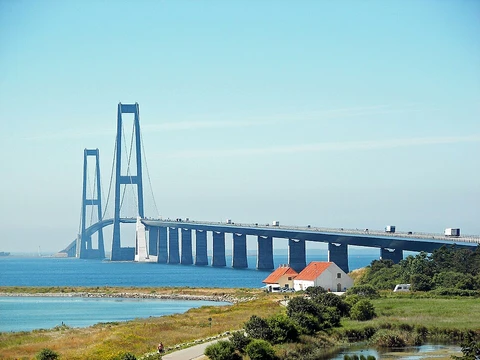
The Forth Bridge
Cantilever railway bridge across the Firth of Forth.

The Forth Bridge is a cantilever railway bridge spanning the Firth of Forth in eastern Scotland, about 9 miles west of central Edinburgh. Completed in 1890, it is regarded as a Scottish icon—voted Scotland’s greatest man-made wonder in 2016—and holds UNESCO World Heritage status. Its designers were English engineers Sir John Fowler and Sir Benjamin Baker. Though sometimes called the Forth Rail Bridge to distinguish it from the nearby Forth Road Bridge, that is not its official name.
Construction started in 1882, and the bridge opened on 4 March 1890, with the Duke of Rothesay (the future Edward VII) performing the ceremony. It carries the Edinburgh–Aberdeen railway line across the Forth between South Queensferry and North Queensferry, measuring 2,467 metres (8,094 ft) in total length. At its opening, it boasted the longest single cantilever bridge span in the world, a record it held until 1919, when the Quebec Bridge in Canada achieved a single span of 1,801 ft (549 m). The Forth Bridge remains the world’s second-longest single cantilever span, with two spans of 1,709 feet (521 m) each. Network Rail owns the bridge and its associated railway infrastructure.
Before the bridge existed, ferries served the crossing. In 1806, a pair of tunnels—one for each direction—was proposed. In 1818, James Anderson designed a three-span suspension bridge near the current site, requiring about 2,500 tonnes of iron. Wilhelm Westhofen remarked that this amount of iron spread over the length would have made it appear very light and slender—so light that on a dull day it would be barely visible, and after a heavy gale likely gone entirely.
During the railway era, Thomas Bouch designed a roll-on/roll-off ferry for the Edinburgh and Northern Railway between Granton and Burntisland, which opened in 1850 and was so successful that another was ordered for the Tay. In late 1863, a joint project between the North British Railway and Edinburgh and Glasgow Railway (which would merge in 1865) appointed Stephenson and Toner to design a Forth bridge, but the commission went to Bouch about six months later.
Building a suspension bridge that could handle railway traffic proved difficult. In 1863–1864, Bouch worked on a single-track girder bridge near Charlestown, where the river is about 2 miles wide but mostly shallow. Promoters worried about foundations in the silty riverbed—borings had gone 231 feet into mud without hitting rock—but Bouch’s experiments showed the silt could bear considerable weight. In late 1864, weighted caissons achieved a pressure of 5 t/sq ft on the silt, encouraging him to continue. In August 1865, NBR chairman Richard Hodgson proposed investing £18,000 to try a different foundation, as the caissons had not succeeded. Bouch then suggested a large pine platform (80 by 60 by 7 feet) under the piers, weighed down with 10,000 tonnes of pig iron to sink it to the silt level. The platform was launched on 14 June 1866 after difficulty moving it down greased planks, then moored for six weeks. The project was abandoned just before sinking the platform, because the NBR expected to lose through traffic after the Caledonian Railway and Scottish North Eastern Railway amalgamated. In September 1866, a shareholder committee investigating financial rumours found falsified accounts; by November the chairman and entire board had resigned. By mid-1867 the NBR was nearly bankrupt, and all work on the Forth and Tay bridges stopped.
The NBR took over the Queensferry ferry in 1867 and completed a rail link from Ratho in 1868, creating a continuous connection with Fife. Interest in bridging the Forth revived, and in 1871 Bouch proposed a stiffened steel suspension bridge on roughly the same line as the current rail bridge. This design was examined and approved by eminent civil engineers W. H. Barlow and William Pole. Parliament passed the Forth Bridge Railway Act in August 1873, authorising construction. Work began in September 1878 with a brick pier on the western end of Inchgarvie, an island in the Forth.
After the Tay Bridge collapsed in 1879, confidence in Bouch evaporated and work stopped. The public inquiry, chaired by Henry Cadogan Rothery, found the Tay Bridge “badly designed, badly constructed and badly maintained,” with Bouch “mainly to blame” for defects in construction and maintenance and “entirely responsible” for design defects. Notably, Bouch had failed to account properly for high winds; he had assumed a wind loading of only 10 lb/sq ft on the advice of the Astronomer Royal, accepted by Barlow. In response, the Board of Trade required all bridges to withstand a lateral wind loading of 56 lb/sq ft. Bouch’s 1871 Forth Bridge design fell far short of this figure.
- material
- steel
- owner
- Network Rail
Quick Facts
- Os Grid Reference
- NT 13554 79252
- Carries
- Rail traffic
- Crosses
- Firth of Forth
- Locale
- Edinburgh, Inchgarvie and Fife, Scotland
- Other Name
- Forth Rail Bridge
- Named For
- River Forth
- Owner
- Network Rail
- Maint
- Balfour Beatty under contract to Network Rail
- Preceded
- Forth Road Bridge
- Design
- Cantilever bridge
- Material
- Steel
- Length
- 8094 ft
Facts from the source article.
Lore & Background
The bridge carries the Edinburgh–Aberdeen line across the Forth between the villages of South Queensferry and North Queensferry. It continues to be the world's second-longest single cantilever span. Earlier proposals for crossing the Firth included tunnels and suspension bridges. Sir John Fowler, W. H. Barlow, and T. E. Harrison were then invited to propose new designs. The bridge was the first major structure in Britain to be constructed of steel.
Reader's Guide
The Forth Bridge is a cantilever railway bridge crossing the Firth of Forth in eastern Scotland, located west of central Edinburgh. Completed in 1890, it was designed by English engineers Sir John Fowler and Sir Benjamin Baker. The structure carries the Edinburgh–Aberdeen line between the villages of South Queensferry and North Queensferry. Upon opening, it held the record for the longest single cantilever bridge span in the world, a distinction it held until 1919 when the Quebec Bridge in Canada was completed; it remains the world’s second-longest single cantilever span. The bridge is a symbol of Scotland, having been voted the nation’s greatest man-made wonder in 2016, and is a UNESCO World Heritage Site. Its construction began in 1882 and it was opened on 4 March 1890 by the Duke of Rothesay, the future Edward VII. Before the bridge, ferries crossed the Firth. Earlier proposals included a pair of tunnels in 1806 and a three-span suspension bridge design by James Anderson in 1818. For the railway age, Thomas Bouch designed a roll-on/roll-off ferry between Granton and Burntisland that opened in 1850. Bouch later proposed a stiffened steel suspension bridge for the Forth, authorized by Parliament in 1873, with work starting in 1878. However, after the Tay Bridge collapsed in 1879, confidence in Bouch’s designs evaporated and the project was abandoned. The public inquiry into the Tay disaster found that bridge “badly designed, badly constructed and badly maintained,” with Bouch “mainly to blame.” In response, the Board of Trade required all bridges to withstand a lateral wind loading of 56 pounds per square foot, a standard Bouch’s design could not meet. The bridge and its railway infrastructure are owned by Network Rail.
Did You Know?
- It was the first major structure in Britain to be constructed of steel.
- It continues to be the world's second-longest single cantilever span.
Common Misconceptions (Editorial)
Some people think the Forth Bridge is a suspension bridge, but it is a cantilever railway bridge. Others may assume it was built by Scottish engineers, but it was designed by English engineers Sir John Fowler and Sir Benjamin Baker. A common belief is that the bridge is a single long span, but it is actually the world’s second-longest single cantilever span.
Why It Matters (Editorial)
The Forth Bridge endures as a landmark of human engineering and industrial ambition, proving that even daunting natural obstacles can be overcome with ingenuity and steel. Its continued use on the Edinburgh–Aberdeen line keeps it a living part of Scotland’s infrastructure, not just a piece of history.
Frequently Asked Questions
Who designed The Forth Bridge?
The structure was engineered by two Englishmen, Sir John Fowler and Sir Benjamin Baker, who collaborated on the project. Their cantilever design let a single continuous rail line cross the wide waterway without requiring piers in the shipping channel.
Why is The Forth Bridge a UNESCO World Heritage Site?
It received UNESCO recognition because its cantilever steel design represented a landmark leap in bridge engineering at the close of the nineteenth century. The structure also carries deep cultural weight as an iconic emblem of Scotland.
More in Great Bridges 1-22
Spotted an error? Know more?
This is a living reference — every entry is fact-audited, and reader corrections feed straight into our audit queue. Suggest an edit · See this site's audit record