The Brooklyn Bridge
First fixed East River crossing, longest suspension bridge when opened.

Christian David · CC BY-SA 4.0
The Brooklyn Bridge connects Manhattan and Brooklyn across New York City’s East River. It opened on May 24, 1883, as the first fixed crossing over that river and, at the time, was the world’s longest suspension bridge, with a main span of 1,595.5 feet (486.3 meters) and a deck 127 feet (38.7 meters) above mean high water. Originally called the New York and Brooklyn Bridge or the East River Bridge, it was officially renamed the Brooklyn Bridge in 1915.
Proposals for a bridge between Manhattan and Brooklyn date to the early 1800s. The design was by John A. Roebling, with further contributions from his son Washington Roebling, the project’s chief engineer, and Washington’s wife, engineer Emily Warren Roebling. Construction began in 1870, overseen by the New York Bridge Company, which was controlled by the Tammany Hall political machine. The project took thirteen years due to controversies and the design’s novelty. After opening, the bridge carried horse-drawn vehicles and elevated railway lines until 1950. As traffic grew, additional bridges and tunnels were built across the East River. The bridge has undergone renovations in the 1950s, 1980s, and 2010s due to gradual deterioration.
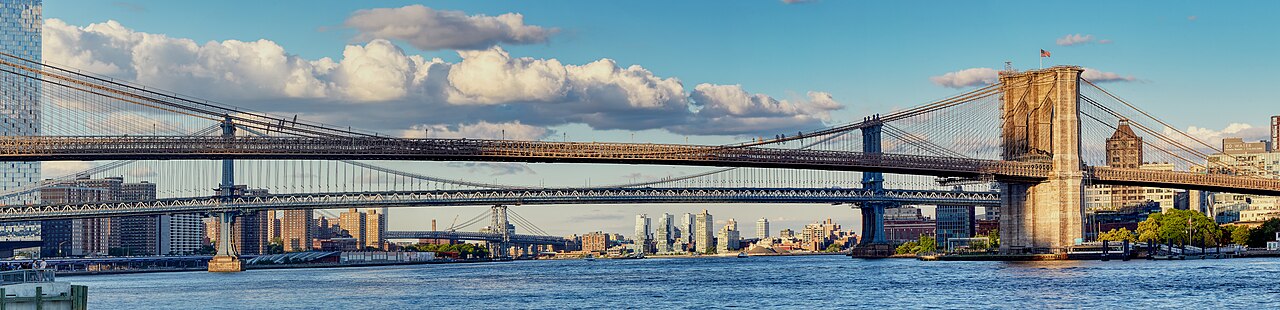
The Brooklyn Bridge is the southernmost of five vehicular bridges linking Manhattan Island and Long Island; the others are the Manhattan Bridge, Williamsburg Bridge, Queensboro Bridge, and Robert F. Kennedy Bridge (formerly Triborough Bridge). Only passenger vehicles, pedestrians, and bicycles are allowed. A major tourist attraction since its opening, it has become a New York City icon. Over the years, it has been used for stunts, performances, and also for crimes, attacks, and vandalism. It is a National Historic Landmark, a New York City landmark, and a National Historic Civil Engineering Landmark.
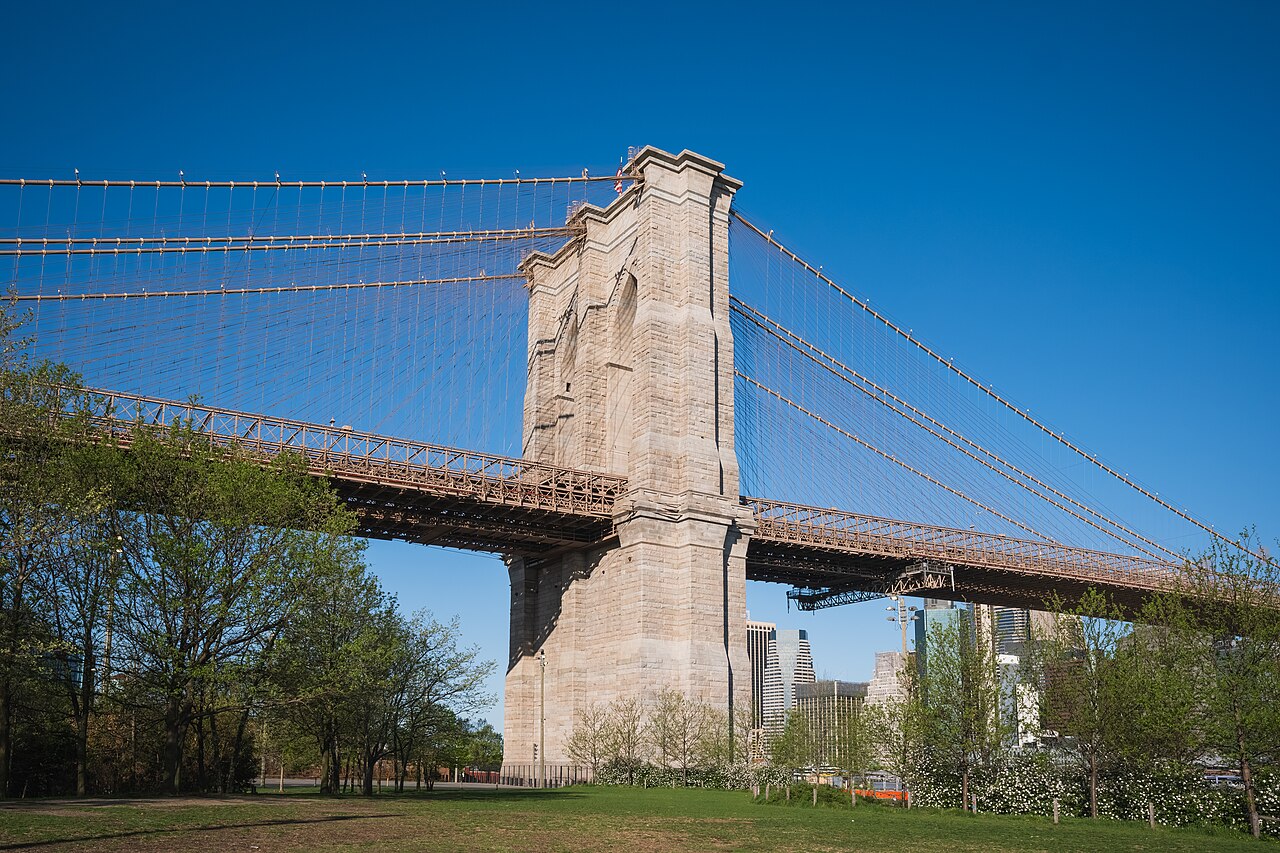
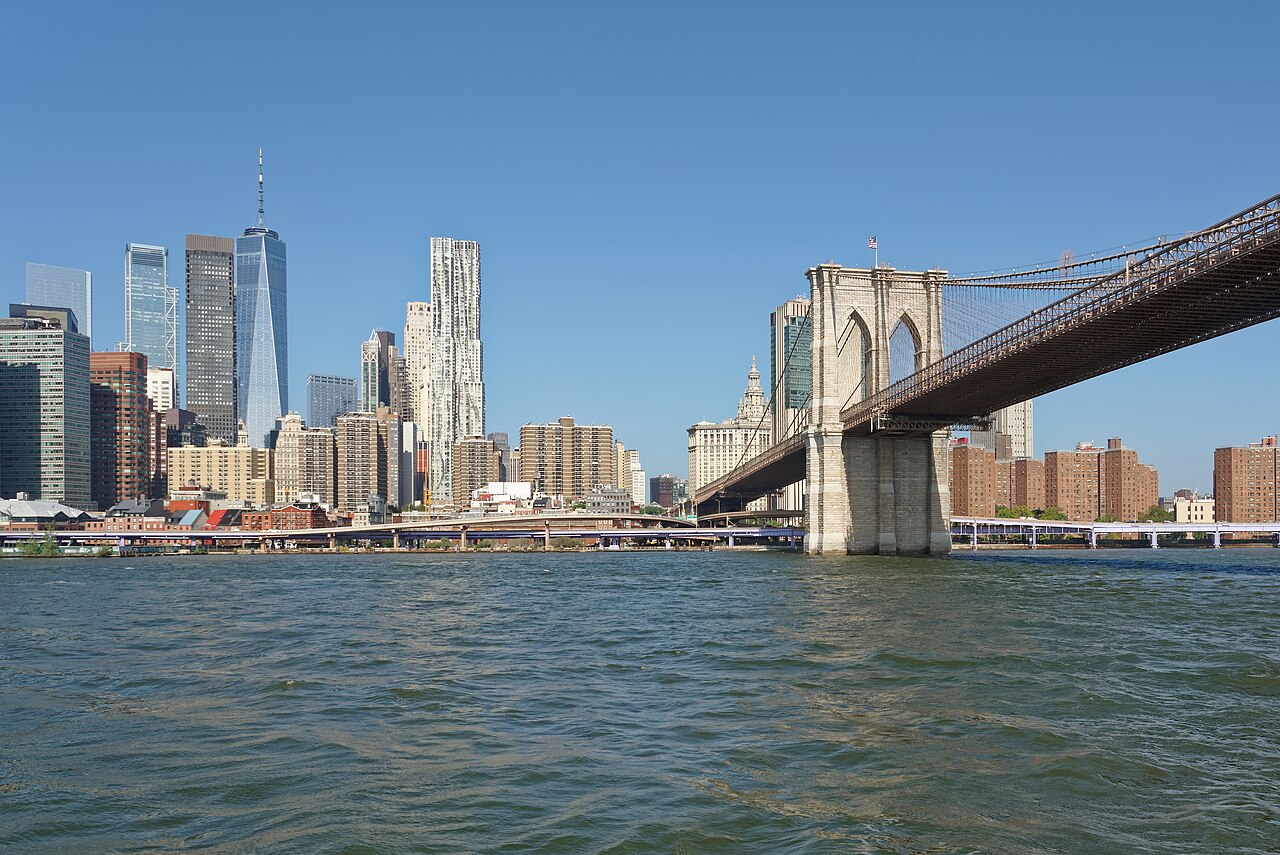
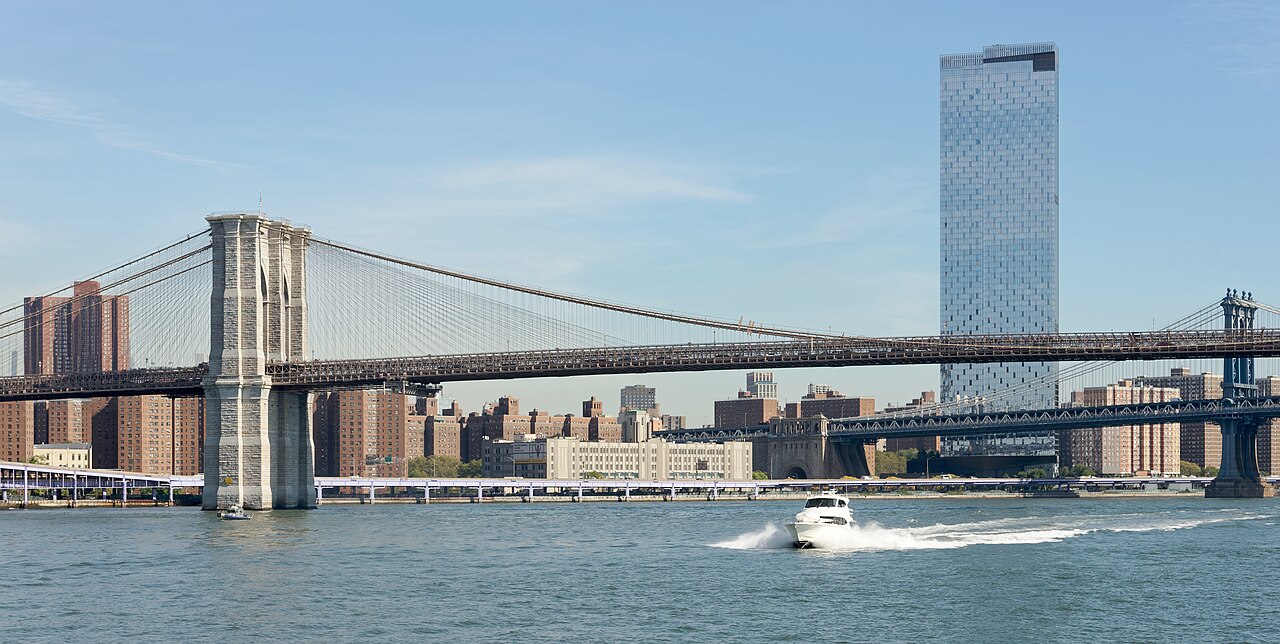
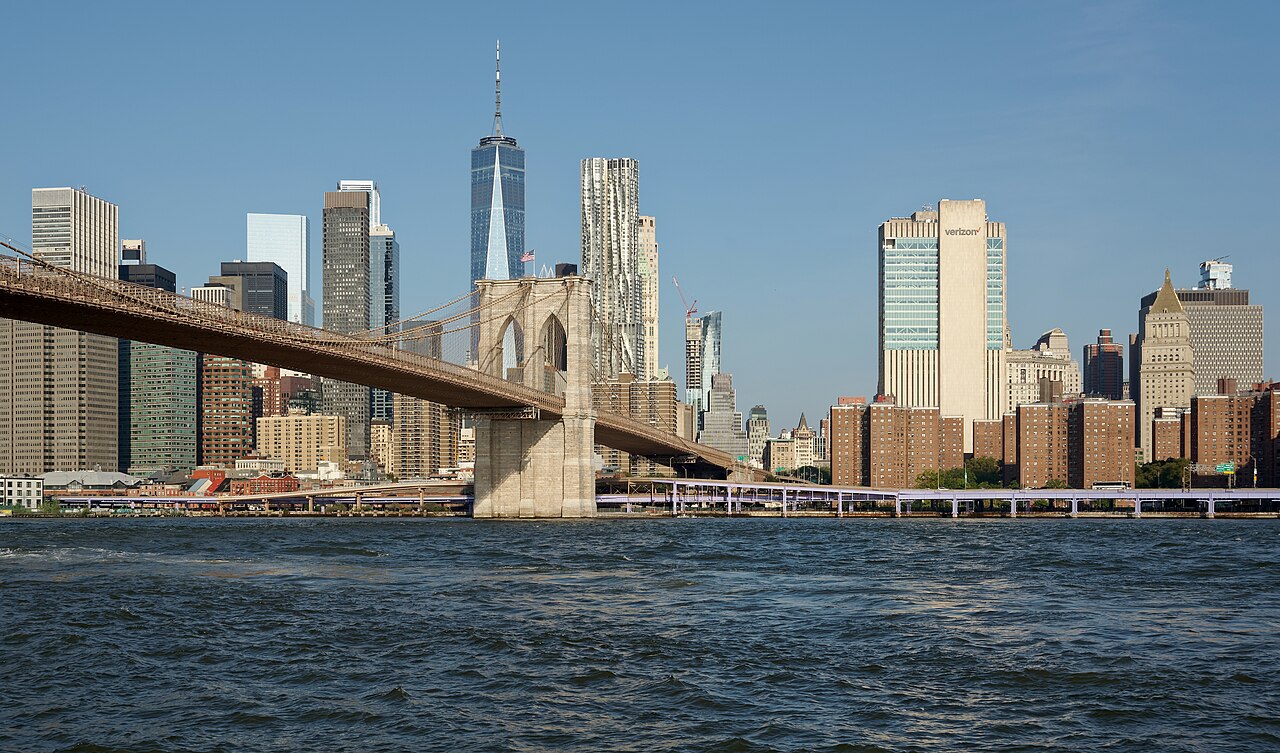
The bridge is an early steel-wire suspension bridge with a hybrid design combining cable-stayed and suspension elements, using both vertical and diagonal suspender cables. Its stone towers are neo-Gothic, with pointed arches. The New York City Department of Transportation says the original paint scheme was “Brooklyn Bridge Tan” and “Silver,” though other accounts claim it was originally entirely “Rawlins Red.”
To clear shipping in the East River, the bridge has long approach viaducts on both ends. Including approaches, it measures 6,016 feet (1,834 meters) from the curb at Park Row in Manhattan to Sands Street in Brooklyn; a separate measurement of 5,989 feet (1,825 meters) is sometimes given, from the curb at Centre Street in Manhattan. The main suspension span is 1,595.5 feet long and 85 feet (26 meters) wide. The bridge expands and contracts 14 to 16 inches with temperature changes. Navigational clearance is 127 feet above mean high water. A 1909 article noted that at the center of the span, height above mean high water could fluctuate by more than 9 feet due to temperature and traffic loads. The side spans, between each tower and its anchorage, are 930 feet (280 meters) long. John Roebling designed the truss system to be six to eight times stronger than he thought necessary, but due to a supplier’s fraudulent substitution of inferior wire, the bridge was reappraised as only four times as strong. The open truss structure supporting the deck is subject to fewer aerodynamic problems. The main and side spans are supported by trusses running parallel to the roadway, each 33 feet (10 meters) deep; originally six trusses, two were removed during a late-1940s renovation. The trusses allow the bridge to hold a total load of 18,700 short tons (17,000 metric tons), a design consideration for its former elevated trains. These trusses are held by suspender ropes hanging from four main cables. Crossbeams run between the trusses at the top, and diagonal and vertical stiffening beams run on the outside and inside of each roadway.
An elevated pedestrian promenade runs between the two roadways, 18 feet (5.5 meters) above them. It is typically 4 feet (1.2 meters) below the crossbeams, except near the towers, where it rises to just above the crossbeams and connects to a balcony overhanging the roadways. The path is 10 to 17 feet (3.0 to 5.2 meters) wide. The iron railings were made by Janes & Kirtland, a Bronx foundry that also produced the United States Capitol dome and the Bow Bridge in Central Park.
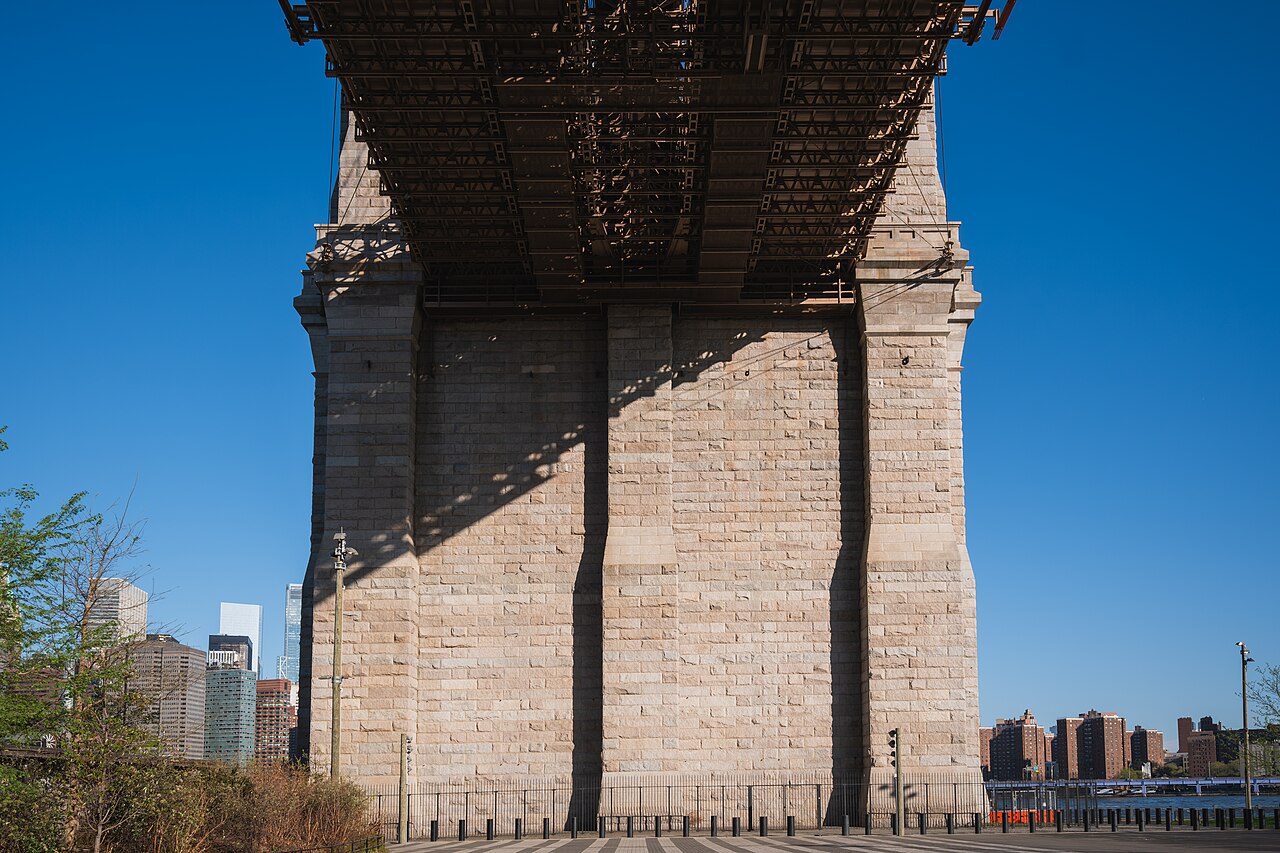
Each side span is reached by an approach ramp. The Brooklyn-side ramp is 971 feet (296 meters) long; the Manhattan-side ramp is 1,567 feet (478 meters) long. The approaches are supported by Renaissance-style masonry arches, with arch openings filled by brick walls.
Lore & Background
Proposals for a bridge connecting Manhattan and Brooklyn were first made in the early 19th century. The project took thirteen years due to controversies and the novelty of the design. It has undergone several renovations, including in the 1950s, 1980s, and 2010s. The bridge is the southernmost of four vehicular bridges connecting Manhattan Island and Long Island (the others being the Williamsburg, Manhattan, and Queensboro Bridges; the Queensboro Bridge connects to Queens, not directly to Long Island, and the Queens-Midtown Tunnel also provides a vehicular connection). Only passenger vehicles, pedestrians, and bicycles are permitted. It has been a major tourist attraction since opening and has been used for stunts, performances, crimes, attacks, and vandalism. The bridge is designated a National Historic Landmark, a New York City landmark, and a National Historic Civil Engineering Landmark.
Reader's Guide
The Brooklyn Bridge is an early example of a steel-wire suspension bridge using a hybrid design combining cable-stayed and suspension elements. Its stone towers are neo-Gothic with pointed arches. The bridge's truss system was designed by John Roebling to be six to eight times as strong as needed, though due to a supplier's fraudulent substitution of inferior wire, it was reappraised as only four times as strong. The bridge includes an elevated pedestrian promenade between the two roadways. The anchorages are trapezoidal limestone structures; the Manhattan anchorage rests on bedrock, the Brooklyn anchorage on clay. The bridge has been renovated multiple times due to gradual deterioration. Its original paint scheme is disputed, with the NYCDOT stating it was 'Brooklyn Bridge Tan' and 'Silver', while other accounts say it was originally entirely 'Rawlins Red'.
Did You Know?
- Due to a supplier's fraudulent substitution of inferior-quality wire, the bridge was reappraised as only four times as strong as necessary, rather than the intended six to eight times.
- The bridge's main span elongates and contracts between 14 and 16 inches due to temperature extremes.
- The elevated pedestrian promenade runs between the two roadways and approximately 10 to 12 feet above them, with iron railings produced by the same foundry that made the United States Capitol dome.
Engineering Pioneering a New Era
The Brooklyn Bridge represented a bold departure from earlier bridge construction, serving as one of the first structures to employ steel wire in a suspension system. Its design blended elements of both cable-stayed and suspension engineering, incorporating both vertical and diagonal suspender cables in a hybrid configuration that was unprecedented at the time. John A. Roebling conceived the truss system to be six to eight times stronger than what he calculated necessary, a margin of safety that reflected the era's limited understanding of aerodynamic forces on long spans. Ironically, a supplier's dishonest substitution of lower-quality wire during initial construction meant the finished structure was reassessed at only four times the required strength. The open truss design, however, naturally reduced aerodynamic vulnerability. The stone towers, rendered in a neo-Gothic style with pointed arches, gave the structure a visual grandeur that complemented its engineering ambition.
A Thirteen-Year Political and Personal Odyssey
The work was overseen by the New York Bridge Company, an entity controlled by the Tammany Hall political machine, which injected layers of controversy into an already complex undertaking. The sheer novelty of the design meant engineers were navigating uncharted territory, with no wind-tunnel testing available to validate their calculations. Washington Roebling, his father John's successor as chief engineer, pushed the design forward with significant contributions, while his wife Emily Warren Roebling, herself an engineer, provided crucial assistance during the project's later phases. The combination of political entanglement, technical uncertainty, and the sheer scale of the endeavor stretched the timeline far beyond initial expectations. When the bridge finally opened, it held the title of the world's longest suspension bridge, a distinction that underscored both the ambition and the difficulty of what had been accomplished.
Adapting to a Changing City
The Brooklyn Bridge was never static; it evolved in step with the city it connects. As Manhattan and Brooklyn grew and traffic demands surged, the original structure could not bear the load alone, prompting the construction of additional bridges and tunnels across the East River. The bridge itself underwent multiple reconfigurations and renovation campaigns in the 1950s, 1980s, and 2010s to address gradual deterioration. Today, only passenger vehicles, pedestrians, and cyclists are permitted on the deck. Beneath the Manhattan approach, a series of brick slopes was repurposed in the late 1980s into the Brooklyn Banks skate park, where support pillars became natural obstacles for skaters, though the site was later closed for storage during bridge work in the mid-2010s.
An Enduring Icon of New York
From its opening day, the Brooklyn Bridge has served as a magnet for visitors and a canvas for public life. It has hosted stunts, performances, and unfortunately also witnessed crimes, attacks, and acts of vandalism over the decades. Its elevated pedestrian promenade, running 18 feet above the two roadways and typically 10 to 17 feet wide, offers views that have made it one of the city's most recognizable landmarks. The iron railings along this walkway were crafted by Janes & Kirtland, a Bronx foundry whose portfolio also included the dome of the United States Capitol and Central Park's Bow Bridge. Today it stands as the southernmost of five vehicular crossings linking Manhattan to Long Island, and it carries the triple distinction of being a National Historic Landmark, a New York City landmark, and a National Historic Civil Engineering Landmark.
Common Misconceptions (Editorial)
Some people believe the bridge connects Manhattan to Long Island directly, but it actually connects Manhattan to the borough of Brooklyn, which is on Long Island. Additionally, while some assume the bridge was designed solely by John A. Roebling, the design work also involved his son Washington Roebling and Emily Warren Roebling.
Why It Matters (Editorial)
The Brooklyn Bridge endures not only as a feat of 19th-century engineering but as a symbol of human persistence, having overcome design controversies, a fraudulent wire scandal, and the personal sacrifices of the Roebling family. Its continued role as a working bridge for pedestrians, cyclists, and vehicles, alongside its status as a national landmark, keeps it a living part of New York City’s identity rather than a static monument.
Gallery
Frequently Asked Questions
Who is The Brooklyn Bridge?
The Brooklyn Bridge is a suspension bridge in New York City that spans the East River, linking the boroughs of Manhattan and Brooklyn. It was officially opened on May 24, 1883, and has since grown into one of the city's most iconic landmarks.
Who created The Brooklyn Bridge?
The bridge was originally designed by John A. Roebling, and after his death his son Washington Roebling carried the design forward. Emily Warren Roebling, Washington's wife, also contributed significantly to the design work that brought the project to completion.
More in Great Bridges 1-22
Spotted an error? Know more?
This is a living reference — every entry is fact-audited, and reader corrections feed straight into our audit queue. Suggest an edit · See this site's audit record