The Golden Gate Bridge
Suspension bridge linking San Francisco and Marin County.

Daniel L. Lu (user:dllu) · CC BY-SA 4.0
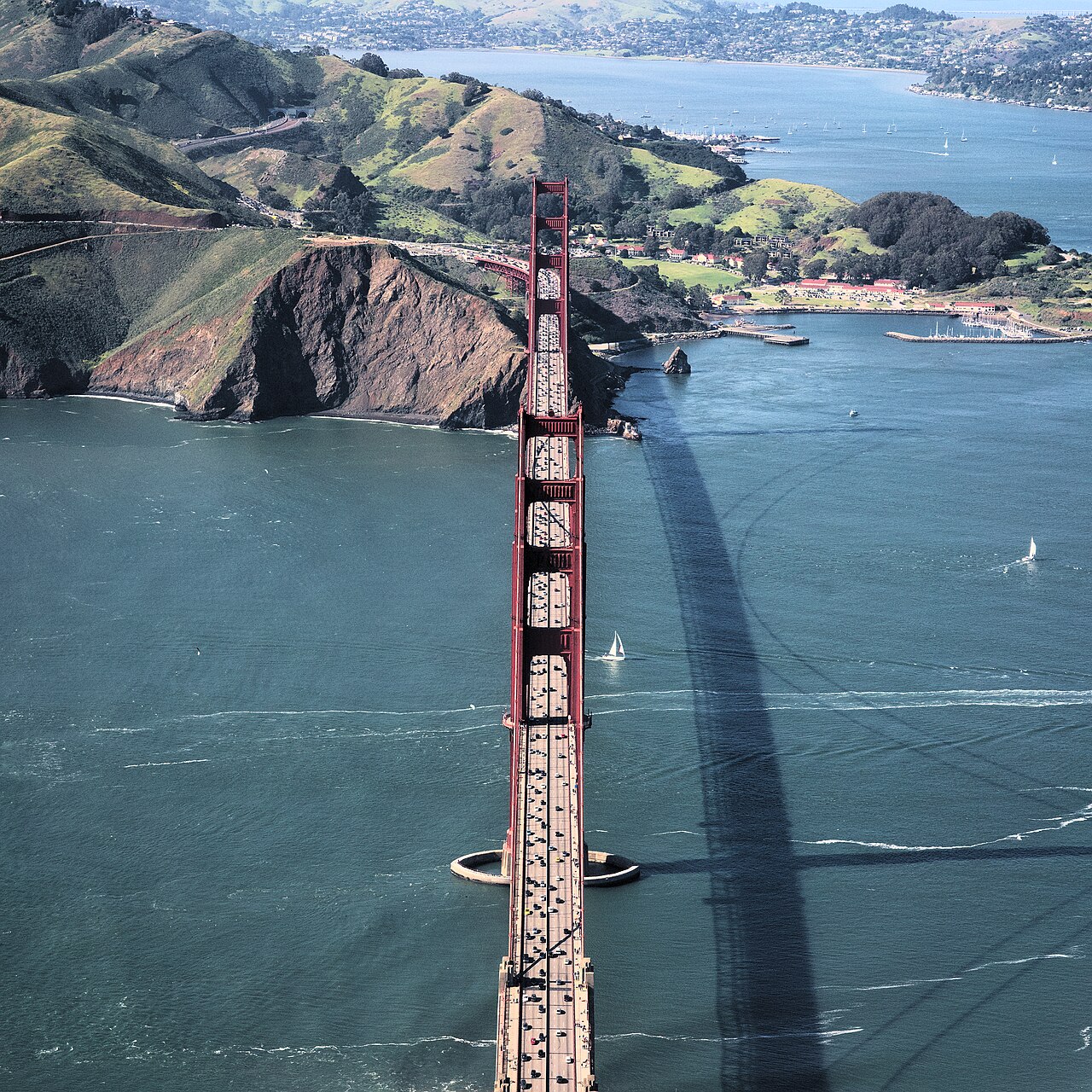
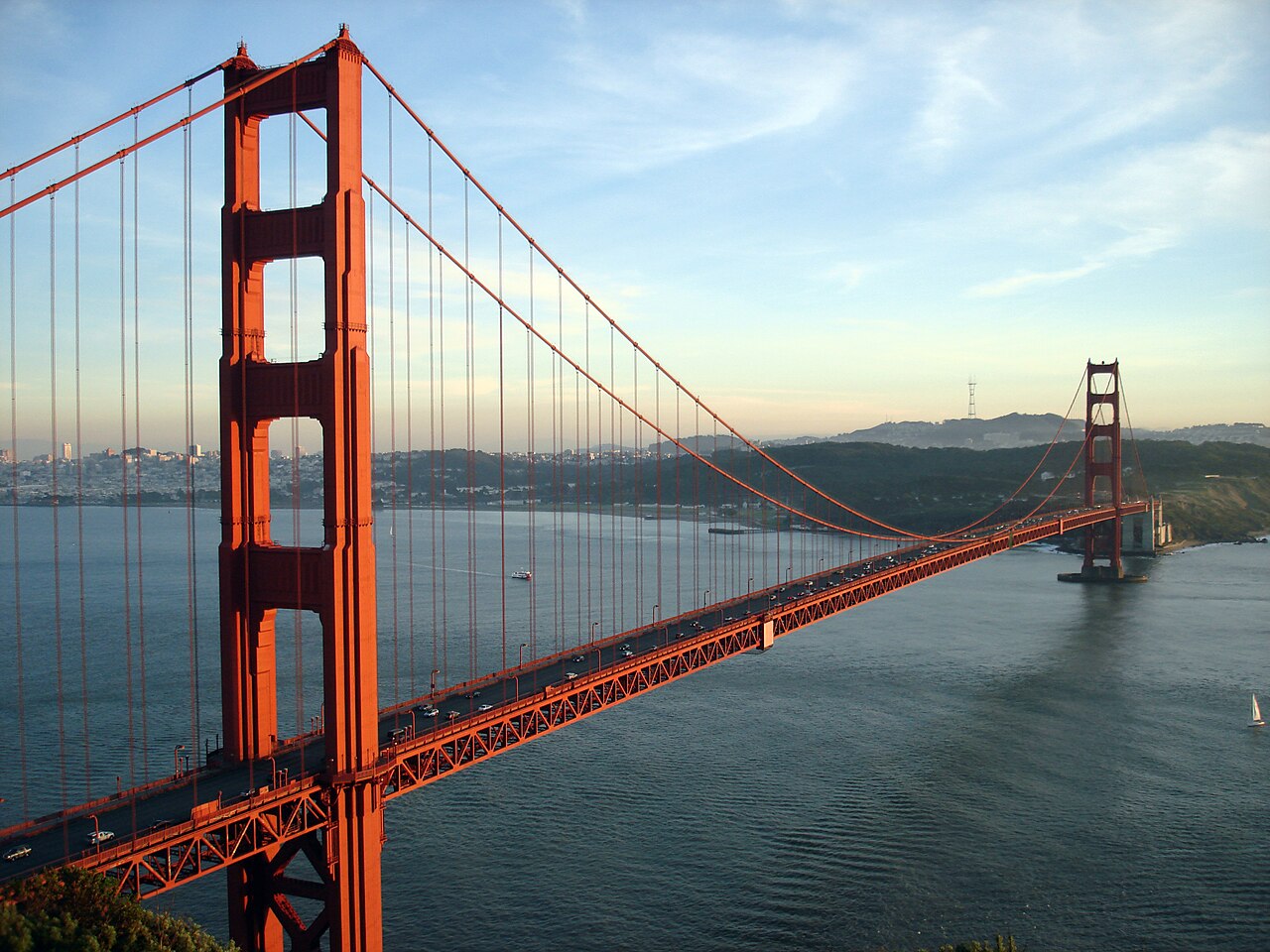
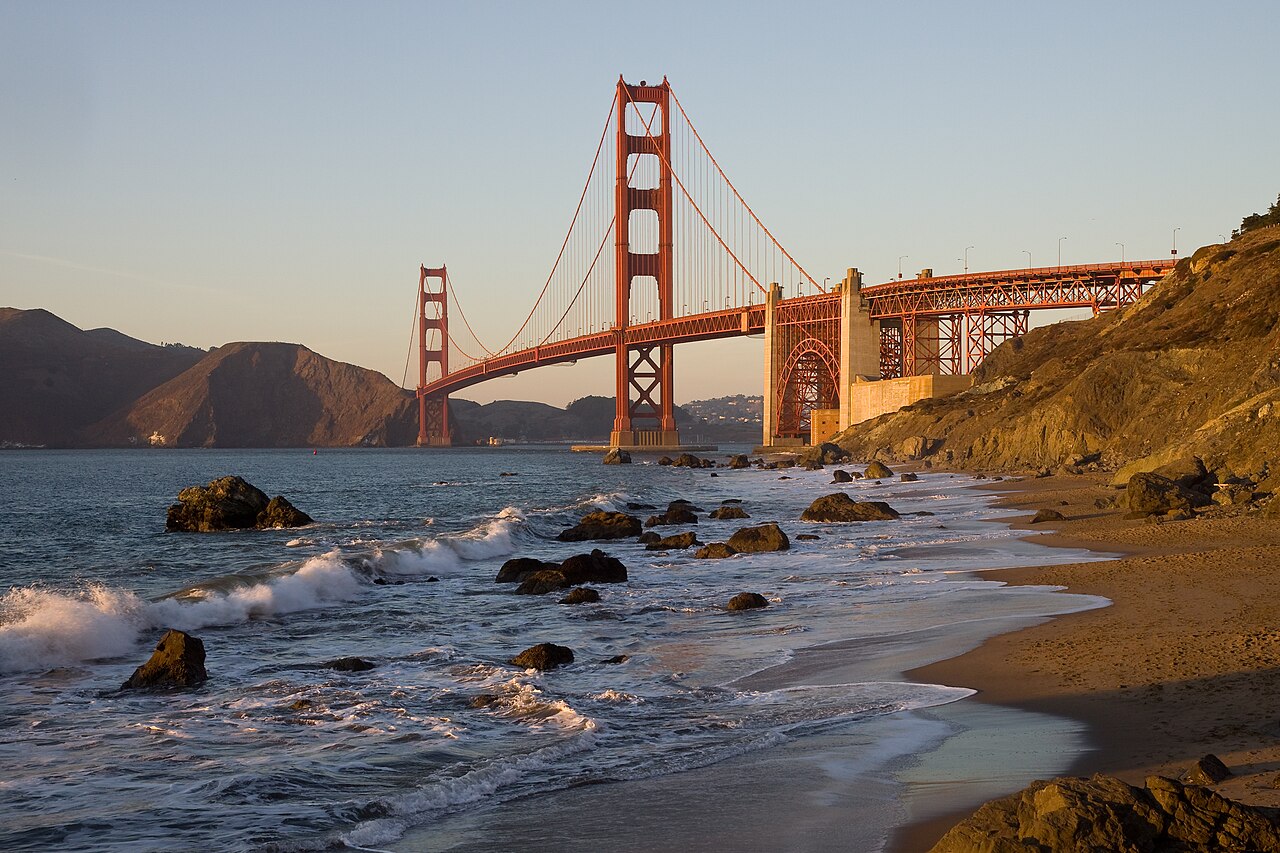
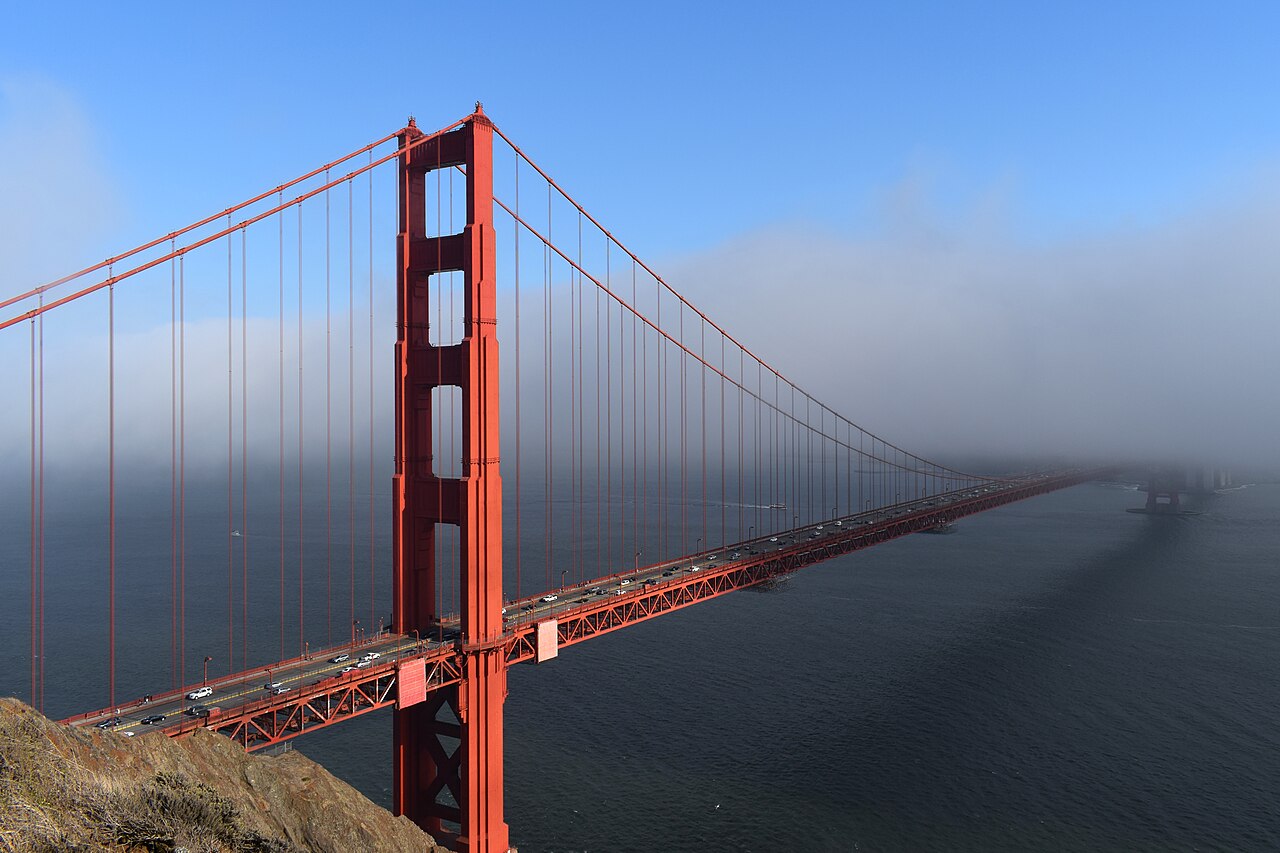
The Golden Gate Bridge is a suspension bridge that crosses the Golden Gate, a strait about one mile wide that connects San Francisco Bay to the Pacific Ocean in California. It connects the northern tip of the San Francisco Peninsula with Marin County, carrying U.S. Route 101 and California State Route 1, as well as pedestrian and bicycle traffic, and is part of U.S. Bicycle Route 95. The American Society of Civil Engineers considers it one of the Wonders of the Modern World, and it is widely recognized as a symbol of both San Francisco and California.
During the late 19th century, the idea of a permanent link between San Francisco and Marin grew popular, but it wasn’t until the early 20th century that it became feasible. Chief engineer Joseph Strauss led the project, with significant design contributions from Leon Moisseiff, Irving Morrow, and Charles Ellis. The bridge opened to the public on May 27, 1937, and has since undergone various retrofits and improvements.
Frommer’s travel guide calls it “possibly the most beautiful, certainly the most photographed, bridge in the world.” At its opening, it was the longest and tallest suspension bridge globally, holding those records until the Verrazzano–Narrows Bridge (1964) surpassed it in length and the Akashi Kaikyo Bridge (1998) in height. Its main span measures 4,200 feet, and its total height is 746 feet.
Before the bridge, the only practical short route between San Francisco and what is now Marin County was by boat across San Francisco Bay. Ferry service began as early as 1820, with regular scheduled trips starting in the 1840s to transport water to San Francisco. In 1867, the Sausalito Land and Ferry Company opened, and in 1920, the Golden Gate Ferry Company took over. This company merged in 1929 with Southern Pacific Railroad’s ferry system, forming Southern Pacific–Golden Gate Ferries, Ltd., the largest ferry operation in the world. Initially for railroad passengers and customers only, Southern Pacific’s automobile ferries became highly profitable and vital to the regional economy. The crossing from Hyde Street Pier in San Francisco to Sausalito Ferry Terminal took about 20 minutes and cost $1.00 per vehicle before 1937, when the price was reduced to compete with the new bridge. The trip from the San Francisco Ferry Building took 27 minutes.
Many wanted a bridge to connect San Francisco to Marin County. San Francisco was the largest American city still primarily served by ferries, and without a permanent link to bay communities, its growth rate lagged behind the national average. Experts argued that a bridge could not be built across the 6,700-foot strait, which had strong, swirling tides and currents, water 372 feet deep at the channel’s center, and frequent strong winds. They also said ferocious winds and blinding fogs would prevent construction and operation.
The proposal that eventually took hold came from a 1916 San Francisco Bulletin article by former engineering student James Wilkins. San Francisco’s city engineer estimated the cost at $100 million, which was considered impractical. He asked bridge engineers if it could be built for less. One respondent was Joseph Strauss, an ambitious engineer and poet who had designed a 55-mile-long railroad bridge across the Bering Strait for his graduate thesis. By then, Strauss had completed about 400 drawbridges, mostly inland, and nothing on this scale. His initial drawings showed a massive cantilever on each side of the strait connected by a central suspension segment, which he promised could be built for $17 million. A suspension-bridge design was chosen, using recent advances in bridge design and metallurgy.
Strauss spent over a decade drumming up support in Northern California. The bridge faced opposition, including lawsuits. The Department of War worried it would interfere with ship traffic, and the U.S. Navy feared a collision or sabotage could block a main harbor entrance. Unions demanded guarantees that local workers would be favored. Southern Pacific Railroad, a powerful business interest, opposed the bridge as competition to its ferry fleet and filed a lawsuit, leading to a mass boycott of the ferry service. In May 1924, Colonel Herbert Deakyne held a second hearing on behalf of the Secretary of War regarding the use of federal land for construction. Deakyne approved transferring the needed land to the “Bridging the Golden Gate Association” and both San Francisco and Marin counties, pending further plans by Strauss. Another ally was the fledgling automobile industry, which supported roads and bridges to boost car demand.
The bridge’s name was first used in 1917 by M.M. O’Shaughnessy, San Francisco’s city engineer, and Strauss. It became official with the 1923 Golden Gate Bridge and Highway District Act, which created a special district to design, build, and finance the bridge. San Francisco and most counties along California’s North Coast joined the district.
- chief_engineer
- Joseph Strauss
- design_contributors
- Leon Moisseiff, Irving Morrow, Charles Ellis
- tallest_suspension_bridge_until
- 1998 (Akashi Kaikyo Bridge)
Lore & Background
Before the bridge was built, the only practical short route between San Francisco and Marin County was by ferry, with regular service beginning in the 1860s. became the largest ferry operation in the world. Many experts said a bridge could not be built across the one-mile-wide strait due to strong tides, deep water, and frequent winds and fog. The idea of a fixed link gained popularity in the late 19th century, but became feasible only in the early 20th century. Joseph Strauss served as chief engineer, with Leon Moisseiff, Irving Morrow, and Charles Ellis making significant contributions to its design.
Reader's Guide
Its construction overcame significant opposition, including litigation from the Southern Pacific Railroad and concerns from the Department of War and U.S. Navy. The bridge's design evolved from Strauss's initial cantilever proposal to a suspension design championed by Moisseiff, with Morrow selecting the International Orange color. Ellis performed much of the technical work but was fired before completion. The bridge has undergone various retrofits and improvements in the decades since. It is described in Frommer's travel guide as 'possibly the most beautiful, certainly the most photographed, bridge in the world.'
Did You Know?
- The name 'Golden Gate' was already in common use for the strait long before the bridge was built.
Engineering Vision and the Team Behind the Span
Yet his background was in movable inland bridges, not cable-suspension structures of this magnitude. Recognizing his limitations, the design responsibility was shared with Leon Moisseiff, Irving Morrow, and Charles Ellis, whose expertise in suspension engineering and architecture shaped the final form. Strauss's earliest sketches called for a hybrid of cantilever arms joined by a central suspension segment, but the team ultimately settled on a pure suspension design, leveraging recent breakthroughs in metallurgy and structural theory.
A Decade of Opposition and the Battle for Approval
The path from concept to construction was anything but straightforward. Strauss countered with a $17 million figure, but winning political and public backing still took more than a decade of campaigning. The Department of War worried the structure would impede maritime traffic, while the Navy feared a single collision or act of sabotage could seal off one of its principal harbors. Labor unions pressed for local hiring guarantees, and the Southern Pacific Railroad, whose ferry fleet stood to lose enormous revenue, filed a lawsuit that triggered a mass boycott of the ferry service. Even so, Humboldt County residents refused to join the district, objecting to the traffic they expected the new crossing to generate.
The Ferry Era and a City Constrained by Water
For over a century, the only practical way to cross from San Francisco to the communities on the northern shore was by boat. The crossing between Hyde Street Pier and Sausalito took roughly 20 minutes and cost one dollar per vehicle. Yet despite this infrastructure, San Francisco remained the largest American city whose residents still depended primarily on boats for regional travel, and the city's population growth lagged behind the national average. The absence of a permanent land link was widely seen as a structural barrier to economic expansion, a reality that gave the bridge project its most powerful argument: a fixed crossing was not a luxury but a necessity for the region's future.
Opening Day, World Records, and Lasting Iconography
In the intervening years the structure has undergone numerous retrofits and improvement projects to maintain its integrity against the harsh marine environment. Today it carries U.S. Bicycle Route 95. The American Society of Civil Engineers has recognized it as one of the Wonders of the Modern World, and travel writers have called it possibly the most beautiful and certainly the most photographed bridge on the planet. Few structures have become as deeply intertwined with the identity of a city and a state as this one-mile-wide span of steel and cable.
Common Misconceptions (Editorial)
Some people believe the name “Golden Gate Bridge” refers to the bridge’s color or its gilded appearance, but the name “Golden Gate” was already in common use for the strait long before the bridge was built. Another misconception is that Joseph Strauss was the sole designer of the bridge; in fact, Leon Moisseiff, Irving Morrow, and Charles Ellis also made significant contributions to its design.
Why It Matters (Editorial)
The Golden Gate Bridge endures not only as a feat of engineering—once the tallest suspension bridge in the world—but as a symbol of human ambition overcoming natural obstacles that experts once deemed insurmountable. It remains an internationally recognized icon of San Francisco and California, representing both the region’s spirit of innovation and its enduring connection between land and sea.
Gallery
Frequently Asked Questions
Why is The Golden Gate Bridge important?
The American Society of Civil Engineers has recognized it as one of the Wonders of the Modern World, and it is widely regarded as one of the most internationally recognized symbols of both San Francisco and California. Chief engineer Joseph Strauss, with design input from Leon Moisseiff, Irving Morrow, and Charles Ellis, produced a structure that redefined the capabilities of long-span suspension design.
More in Great Bridges 1-22
Spotted an error? Know more?
This is a living reference — every entry is fact-audited, and reader corrections feed straight into our audit queue. Suggest an edit · See this site's audit record