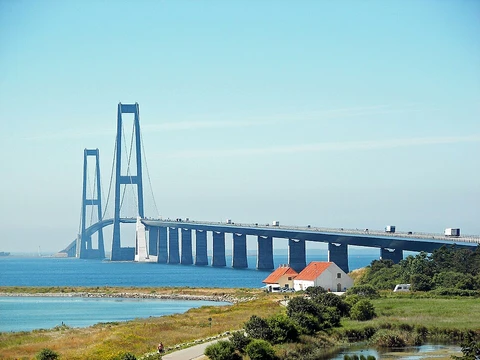
Royal Gorge Bridge
World's highest bridge from 1929 to 2001.

via Wikipedia: Royal Gorge Bridge · see source
The Royal Gorge Bridge, part of the Royal Gorge Bridge and Park, is a tourist attraction near Cañon City, Colorado. The park covers 360 acres along the edges of the Royal Gorge, with the bridge spanning both sides. The bridge sits 955 feet above the Arkansas River. It was the world’s highest bridge from 1929 until 2001, when China’s Liuguanghe Bridge took the record. It also held the title of highest suspension bridge until the Beipan River Guanxing Highway Bridge, also in China, surpassed it in 2003. The bridge is still the highest in the United States and ranked among the top ten highest bridges globally until 2012.
The main span between the towers measures 880 feet, with a total length of 1,260 feet, a width of 18 feet, and towers rising 150 feet. The steel structure is covered by 1,292 wooden planks. Construction took six months, from June to November 1929, costing $350,000 (about $5 million in 2024). In 1931, an incline railway—a funicular—was added beside the bridge to reach the gorge floor. A miniature railroad was built along the gorge edge in the 1950s, and an aerial tram opened in 1969. The bridge underwent renovations in the early 1980s, including new cable anchors, suspension rods, and paint. A Skycoaster attraction, which swings riders over the gorge edge, was added in 2003.
In June 2013, a wildfire destroyed most of the park’s buildings and the aerial tram, and damaged the incline. The bridge suffered only minor damage to its wooden deck, while the Skycoaster was unharmed. The park was rebuilt and partially reopened in August 2014, with a grand reopening in May 2015 featuring new gondolas and a zip-line crossing the gorge east of the bridge.
Construction began on June 5, 1929, and finished in November 1929. The bridge cost $350,000 and was built as a tourist attraction, not for transportation. The road from U.S. Route 50 leads to the bridge and continues on the south side of the gorge, eventually reconnecting with Route 50, but all visitors must enter and exit through the north park gate. Passenger vehicles are not allowed to cross. The road is designated Fremont County Road 3A, starting about 10 miles west of Cañon City. The Royal Gorge Route Railroad runs under the bridge along the gorge floor.
The project was financed by Lon P. Piper, president of the Royal Gorge Bridge and Amusement Company of San Antonio, Texas. He hired George E. Cole as chief engineer. The bridge was completed in about six months with no deaths or serious injuries, and formally opened on December 8, 1929. Piper agreed to a twenty-year lease of the gorge and surrounding land from Cañon City, paying $1,000 yearly (about $14,300 in 2024), with reduced fees of $500 (about $7,200 in 2024) in some hardship years. The final cost was $100,000 over budget (about $1.4 million in 2024).
In 1931, a 3-foot narrow-gauge incline railway was built to the gorge floor through a cleft west of the bridge’s north end. The first suicide occurred later that year when Verlyn Edward Bebb of Pueblo, Colorado, jumped from the bridge. In 1937, a lighting system was installed to illuminate the bridge and gorge walls. After struggling through the Great Depression and World War II, Piper sold the bridge and leasing rights in 1947 to a group of local Colorado businessmen and Clint Murchison, a Texan oil, gas, and real estate magnate. A long-time employee noted Murchison, who died in 1969, never visited the bridge he owned, even after becoming sole owner.
In the 1950s, a lodge was built by the gorge, and the Silver Rock Railway—a 2-foot narrow-gauge train with a Chance Rides miniature C.P. Huntington locomotive—began running along the gorge edge near the bridge. In 1956, Murchison and his Royal Gorge Bridge Company, based in Dallas, agreed to pay the city a percentage of revenue instead of the $1,000 yearly lease fee. This arrangement has proven very favorable for the city, allowing it to lower property taxes significantly, making the rate the lowest in Colorado.
In April 1962, Donald K. MacKenzie fell from the bridge, ruled a suicide by the Fremont County coroner. In 1967, an open bid for leasing rights drew interest from several companies, but Murchison’s company won, signing another twenty-year contract with the city. The aerial tram opened in 1969, crossing the gorge just east of the bridge. After Murchison’s death that year, his sons John and Clint Jr. inherited the bridge and lease. In 1979, John’s wife Lucille Murchison inherited them after his death. The bridge and incline railway were listed on the National Register of Historic Places on September 2, 1983. Official registration papers show that Cañon City had become the owner of the bridge and incline at some point since the 1940s, while still owning the land leased to the Royal Gorge Bridge Company. The bridge underwent major renovations from 1980 to 1984, including new cable anchors, suspension rods, and repainting.
- location
- Near Cañon City, Colorado, United States
- type
- Suspension bridge
- height
- 955 feet (291 m) above the Arkansas River
- main_span
- 880 feet (268 m)
- total_length
- 1,260 feet (384 m)
- width
- 18 feet (5.5 m)
- construction_cost
- $350,000 (equivalent to $5 million in 2024 dollars)
- construction_period
- June to November 1929
Verified Timeline
Lore & Background
The bridge was built between June and November 1929 at a cost of $350,000 (equivalent to $5 million in 2024 dollars), which was $100,000 over budget (equivalent to $1.4 million in 2024 dollars). The project was financed by Lon P. Piper, president of the Royal Gorge Bridge and Amusement Company of San Antonio, Texas. Piper hired George E. Cole as the Chief Engineer and the bridge was completed in about six months with no deaths or serious injuries. The formal opening occurred on December 8, 1929. Piper agreed to a twenty-year lease of the gorge and surrounding land, which is owned by Cañon City, paying a $1,000 yearly fee (equivalent to $14,300 in 2024 dollars) to the city, with a reduced fee of $500 (equivalent to $7,200 in 2024 dollars) in some years of hardship. In 1931, the 3 ft narrow gauge incline railway was built to the bottom of the gorge through a narrow cleft just west of the north end of the bridge. The first suicide occurred later the same year when a man, Verlyn Edward Bebb, from Pueblo, Colorado jumped off the bridge. In 1937, a lighting system was installed to illuminate the bridge and the gorge walls. In 1947, after struggling through the Great Depression and World War II, Piper sold the bridge and leasing rights to a group of local Colorado businessmen and Clint Murchison. A long-time employee stated that Murchison, who died in 1969, never visited the bridge he had bought. In the 1950s, a lodge was built by the gorge and the Silver Rock Railway 2 ft narrow gauge train with a Chance Rides miniature C.P. Huntington locomotive began running along the edge of the gorge near the bridge. In 1956, Murchison and his Royal Gorge Bridge Company agreed to pay the city a percentage of its revenue instead of the $1,000 yearly fee for the lease. The aerial tram was opened in 1969, crossing the gorge just east of the bridge. The bridge underwent significant renovations from 1980 to 1984, with new cable anchors and suspension rods installed and the bridge re-painted, costing over $2.8 million. The Royal Rush Skycoaster was opened on the south side of the gorge in 2003 just east of the bridge.
Reader's Guide
The Royal Gorge Bridge is significant as a historic engineering feat and a major tourist attraction in Colorado. It held the title of the world's highest bridge for over 70 years, from 1929 until 2001, and remains the highest bridge in the United States. Its construction as a tourist attraction, not as a through route for transportation purposes, set it apart from other bridges of its era. The bridge and its surrounding park have evolved over decades, adding attractions such as the Incline Railway, aerial tram, miniature railroad, and Skycoaster. The bridge survived a major wildfire in June 2013 that destroyed most of the park's buildings and the aerial tram, and damaged the Incline, sustaining only slight damage to its wooden deck with approximately 100 of 1292 planks requiring replacement. The park was rebuilt and partially reopened in August 2014, with a grand reopening in May 2015 featuring new gondolas and a new zip-line crossing the gorge on the east side of the bridge. The bridge and the incline railway were listed in the National Register of Historic Places on September 2, 1983. Passenger vehicles are not allowed to cross the bridge.
Did You Know?
- The bridge was built in six months with no deaths or serious injuries.
- The first suicide from the bridge occurred in 1931, by Verlyn Edward Bebb from Pueblo, Colorado.
- Clint Murchison, who bought the bridge in 1947, never visited it, even after becoming sole owner.
- The bridge's wooden deck has 1,292 planks; only about 100 needed replacement after the 2013 wildfire.
- In 1999, the owner of the rail lines through the gorge tried to increase the air rights fee for the bridge from $200 to $750,000 per year.
Common Misconceptions (Editorial)
Some believe the Royal Gorge Bridge is the highest bridge in the world, but it held that record only from 1929 until 2001, when it was surpassed by the Liuguanghe Bridge in China. Others assume the original builder and long-time owner Clint Murchison frequently visited the attraction, but records show Murchison never visited the bridge after buying it in 1947.
Why It Matters (Editorial)
The Royal Gorge Bridge endures as a marvel of rapid, safe engineering—built in just six months with no fatalities—and as a testament to entrepreneurial risk during the Great Depression. Its ongoing operation as a central attraction in Colorado highlights how historic infrastructure can evolve into lasting tourism and community identity, despite being surpassed in global records.
Frequently Asked Questions
Who is Royal Gorge Bridge?
Royal Gorge Bridge is a suspension bridge near Cañon City, Colorado, that spans the Royal Gorge above the Arkansas River. It is the centerpiece of the Royal Gorge Bridge and Park, a 360-acre recreational area built around both ends of the crossing.
What are Royal Gorge Bridge's powers/role?
Its defining trait is an elevation of 955 feet above the river, which makes it the tallest bridge in the United States. From 1929 to 2001 it also held the global title of highest bridge, a record that spanned more than seven decades.
How does Royal Gorge Bridge's story end?
In 2001 China's Liuguanghe Bridge overtook Royal Gorge, ending its 72-year reign as the world's highest crossing. It nonetheless retained the American record and stayed within the global top ten until 2012.
Why is Royal Gorge Bridge important?
When it opened in 1929 it proved a suspension design could conquer a gorge nearly a thousand feet deep, pushing the limits of the era's engineering. Its long-held world record turned it into a lasting symbol of American infrastructure ambition.
What are Royal Gorge Bridge's key stats?
The structure totals 1,260 feet in length with a main span of 880 feet, while its deck is only 18 feet wide. That narrow, high clearance over the Arkansas River is what gives it its iconic vertigo-inducing profile.
More in Great Bridges 1-22
Spotted an error? Know more?
This is a living reference — every entry is fact-audited, and reader corrections feed straight into our audit queue. Suggest an edit · See this site's audit record