
Beat 'em up
A genre of hand-to-hand combat against many opponents.

Sssine21 · CC0
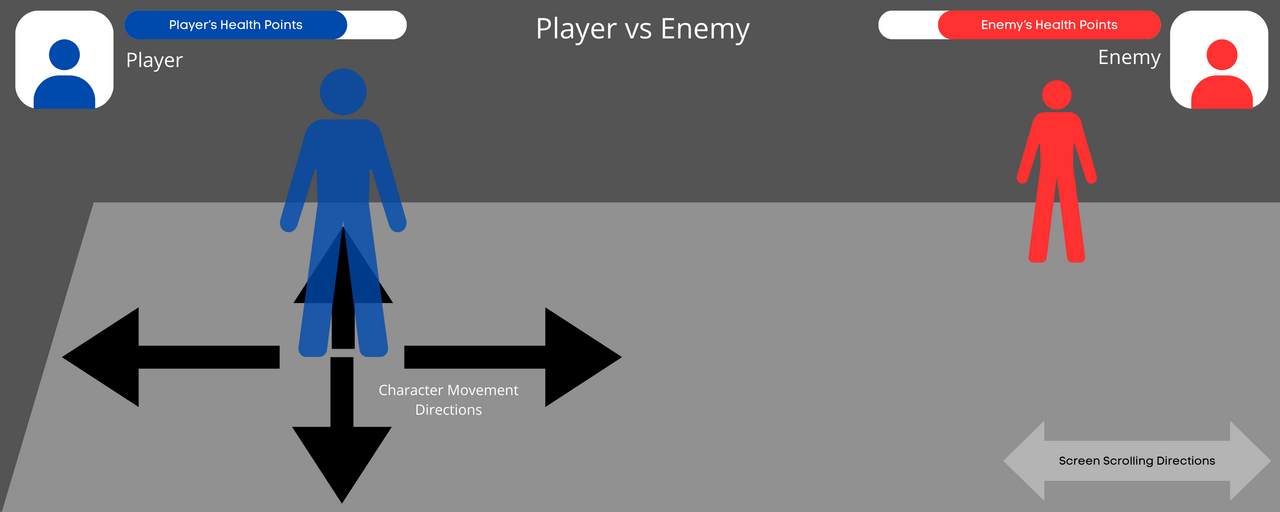
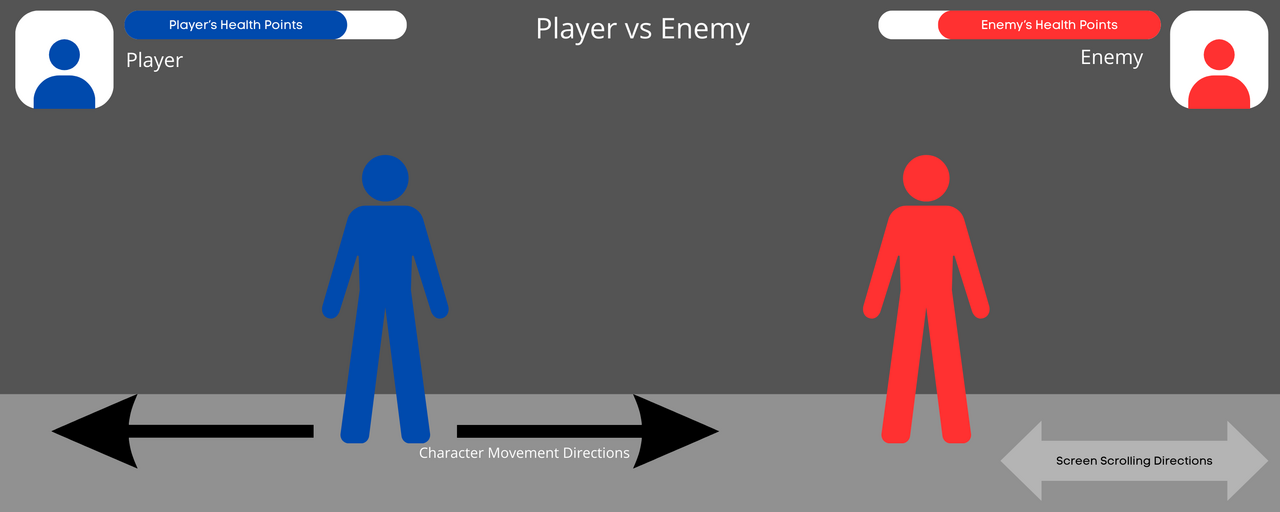
A beat 'em up, also called a brawler or beat 'em all in some regions, is a video game genre centered on hand-to-hand combat against numerous foes. Classic entries use scrolling, two-dimensional levels, while newer titles may offer more open three-dimensional spaces with even larger enemy counts. The gameplay follows arcade traditions: easy to learn but hard to master, with a combat system more elaborate than in other side-scrolling action games. Two-player cooperative play and multiple selectable characters are common features. Most games are set in urban environments and involve crime-fighting or revenge stories, though some adopt historical, science fiction, or fantasy settings.
The genre began with 1984's *Kung-Fu Master*, inspired by Hong Kong martial arts films. *Nekketsu Kōha Kunio-kun* (1986) introduced the belt-scroll format and popularized contemporary city settings; its Western version, *Renegade*, added underworld revenge themes. *Double Dragon* (1987) defined the two-player cooperative mode and continuous belt-scroll layout central to classic beat 'em ups. The genre thrived until *Street Fighter II* (1991) shifted player interest toward one-on-one fighting games. Other classics from this era include *Streets of Rage*, *Final Fight*, *Golden Axe*, and *Teenage Mutant Ninja Turtles*. By the late 1990s, the genre declined with the rise of 3D polygon technology.
In the 2000s, a sub-genre of 3D hack-and-slash games (also called "character action games") emerged, adapting the beat 'em up formula to large 3D environments. Popular franchises include *God Hand*, *Devil May Cry*, *Dynasty Warriors*, *God of War*, and *Bayonetta*. Since the 2010s, traditional 2D beat 'em ups have seen a revival, with hits like *Dungeon Fighter Online*, *Dragon's Crown*, *Streets of Rage 4*, and *Teenage Mutant Ninja Turtles: Shredder's Revenge*.
A beat 'em up is a type of action game where the player fights many enemies using unarmed combat or melee weapons. The player moves through a level section by section, defeating groups of enemies to advance, with a boss fight typically ending each level. Arcade versions are often very difficult, encouraging more spending. The genre is related to but distinct from fighting games, which focus on one-on-one matches rather than scrolling levels and multiple foes. However, terminology is loose; some commentators conflate the two.
- First game
- Kung-Fu Master (1984)
- Key early title
- Nekketsu Kōha Kunio-kun (1986)
- Defining game
- Double Dragon (1987)
- Peak period
- 1987 to 1991
- Sub genre emerged
- 3D hack-and-slash (2000s)
- Resurgence period
- 2010s
Lore & Background
The first beat 'em up was 1984's Kung-Fu Master, based on Hong Kong martial arts films. 1986's Nekketsu Kōha Kunio-kun introduced the belt scroll format and popularized contemporary urban settings, while its Western version Renegade introduced underworld revenge themes. The genre saw high popularity between Double Dragon (1987), which defined two-player cooperative mode and continuous belt scroll format, and 1991's Street Fighter II, which drew gamers toward one-on-one fighting games. Other classics from this time include Streets of Rage, Final Fight, Golden Axe, and Teenage Mutant Ninja Turtles.
Reader's Guide
The beat 'em up genre has left a lasting legacy on video game design, particularly in cooperative play and combat systems. Its influence is seen in the 3D hack-and-slash sub-genre (also called character action games) that emerged in the 2000s, with franchises like God Hand, Devil May Cry, Dynasty Warriors, God of War, and Bayonetta adapting the formula to large-scale 3D environments. Since the 2010s, traditional 2D beat 'em ups have seen a resurgence with titles such as Dungeon Fighter Online, Dragon's Crown, Streets of Rage 4, and Teenage Mutant Ninja Turtles: Shredder's Revenge. The genre's simple-to-learn but difficult-to-master gameplay, combined with its focus on cooperative play, has made it a enduring staple of arcade and home gaming. In the UK, the term 'beat 'em up' was historically used broadly to include fighting games, with distinctions like 'scrolling beat 'em up' and 'one on one beat 'em up' used by magazines such as Mean Machines and Computer & Video Games.
Origins & the Golden Age
The beat 'em up genre traces its roots to 1984, when Irem released Kung-Fu Master, a title inspired by the wave of Hong Kong martial arts cinema that was sweeping global audiences. That early entry established the core premise: a lone hero wading through waves of opponents in close-quarters combat. Two years later, Nekketsu Kōha Kunio-kun reshaped the formula by introducing the continuous belt-scroll structure that would become the genre's visual signature, while also shifting the setting from ancient temples to gritty modern cityscapes. Its Western rebrand, Renegade, further cemented the underworld-revenge narrative that would define the genre's storytelling. The true golden era arrived with Double Dragon in 1987, which locked in the two-player cooperative experience and the seamless horizontal scrolling that players still associate with classic brawlers. Between that landmark and the 1991 release of Street Fighter II, the genre produced a remarkable run of titles—Streets of Rage, Final Fight, Golden Axe, and the Teenage Mutant Ninja Turtles games—before the fighting-game craze pulled audiences in a different direction.
Combat Philosophy & Design Language
What sets a beat 'em up apart from other action genres is its deliberate tension between accessibility and depth. The control scheme is intentionally minimal—often just two attack buttons—yet those buttons unlock rapid combo strings, aerial strikes, and grappling maneuvers that reward practice. This easy-to-pick-up, hard-to-perfect philosophy mirrors classic arcade design, where difficulty was partly a business model: the harder the game, the more coins players fed the cabinet. The level structure reinforces this rhythm. Players advance horizontally through a scrolling stage, clearing identical waves of enemies before facing a significantly tougher boss at the end. Multiple selectable protagonists, each with distinct strengths, weaknesses, and signature moves, add strategic variety without complicating the interface. Cooperative play, a tradition dating back to Double Dragon, remains a defining pillar; the genre embraces two-player teamwork more naturally than almost any other. Meanwhile, the narrative backdrop leans heavily on vigilante justice and revenge plots set against urban backdrops, though historical and fantasy settings also appear throughout the catalog.
The 3D Shift & Sub-genre Diversification
The late 1990s brought a seismic shift as 3D polygon technology reshaped the entire video game landscape, and the beat 'em up genre felt the disruption acutely. The flat, sprite-based scrolling stages that had defined the format for over a decade suddenly seemed dated, and the genre's popularity waned as developers and players gravitated toward new visual paradigms. Yet the underlying design philosophy proved remarkably adaptable. In the 2000s, a new sub-genre of 3D hack-and-slash titles—sometimes called character action games—took the core brawler formula and transplanted it into vast, open three-dimensional arenas. Franchises like God of War, Devil May Cry, Dynasty Warriors, God Hand, and Bayonetta carried forward the spirit of mowing down hordes of enemies while preserving the genre's signature simplicity of controls. On the 2D side, the taxonomy remained rich: the earliest single-plane side-scrolling format, established by Kung-Fu Master, gave way to more complex scrolling variants seen in titles like My Hero, The Ninja Warriors, and Splatterhouse. The genre's DNA, in other words, proved flexible enough to survive a complete technological revolution.
Resurgence & Lasting Cultural Footprint
After nearly two decades of relative quiet, the traditional 2D beat 'em up staged a remarkable comeback in the 2010s. Titles like Streets of Rage 4, Teenage Mutant Ninja Turtles: Shredder's Revenge, Dragon's Crown, and the massively popular Dungeon Fighter Online demonstrated that the genre's core appeal—satisfying melee combat, cooperative play, and the visceral thrill of clearing a screen of enemies—had never truly faded. This revival also highlighted an ongoing creative dialogue between brawlers and one-on-one fighting games. Though the two are mechanically distinct, they have long cross-pollinated in terms of visual style, character design, and combat feel, and some titles even blend both gameplay modes within a single package. The genre's cultural footprint extends beyond the games themselves: in the UK press of the 1980s and 1990s, publications like Mean Machines and C+VG used beat 'em up as an umbrella term for virtually any combat-focused game, distinguishing scrolling brawlers from one-on-one fighters only by a prefix. That loose, inclusive usage speaks to how deeply the brawler concept had permeated gaming vocabulary. The genre's resilience, from a 1984 arcade cabinet to a 2020s digital storefront, testifies to the enduring satisfaction of a well-timed punch.
Gallery
Frequently Asked Questions
What is a beat 'em up game?
A beat 'em up is a video game genre built around close-quarters fighting against waves of enemies, typically in side-scrolling levels. The combat systems are deeper than other side-scrollers, drawing from arcade traditions where simplicity meets depth. Many titles support two-player co-op and let you pick from several playable characters.
What was the first beat 'em up game?
Kung-Fu Master, released in 1984, is generally credited as the earliest entry in the genre. It established the core loop of punching through hordes of opponents in a scrolling environment.
Which game is considered the defining beat 'em up?
Double Dragon (1987) is widely regarded as the title that cemented the genre's identity. Its combination of fluid combo-based combat, a two-player co-op mode, and a crime-fighting urban setting set the template that dozens of sequels and imitators followed.
When were beat 'em ups most popular?
The genre hit its commercial and creative peak between 1987 and 1991, a window that produced a flood of arcade and console brawlers. After that window closed, the format gradually lost mainstream traction before seeing a revival in the 2010s.
How did 3D change the beat 'em up genre?
In the 2000s, the genre split off into a 3D hack-and-slash sub-genre that traded tight two-dimensional stages for more open, three-dimensional arenas with even larger enemy counts. This shift let developers emphasize spectacle and crowd control over the precise, frame-by-frame combat of earlier titles.
More in Beat 'em ups 1-24
Spotted an error? Know more?
Reader corrections go straight into our review queue. Suggest an edit · How this site is sourced