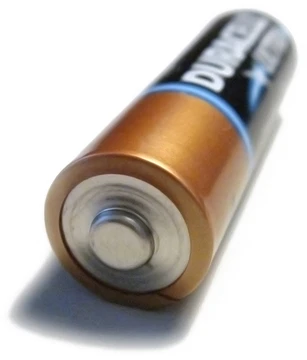
Dry cell
A paste-electrolyte battery enabling portable devices without spillage.
Last updated
A dry cell is a type of electric battery that uses an electrolyte in the form of a paste rather than a free liquid, making it less susceptible to leakage and suitable for portable electrical devices. Unlike wet cell batteries, a dry cell can operate in any orientation without spilling, which made it the first convenient battery for the masses and enabled practical portable electrical equipment.
Quick Facts
- Inventor
- Carl Gassner
- Year of invention
- 1886
- Voltage
- 1.5 volts
- First mass produced model
- Columbia dry cell (1896, National Carbon Company)
- Other inventors
- Sakizō Yai (1887, Japan), Wilhelm Hellesen (1887, patent 1890)
Facts from the source article.
Lore & Background
The dry cell was developed in 1886 by the German scientist Carl Gassner, following the earlier wet zinc–carbon batteries of Georges Leclanché (1866). Gassner obtained a German patent (No. 37,758) on a variant of the Leclanché cell, mixing ammonium chloride with Plaster of Paris to create a paste, adding a small amount of zinc chloride to extend shelf life. The manganese dioxide cathode was dipped in this paste, and both were sealed in a zinc shell that also served as the anode.
In November 1887, Gassner received a US patent for the same device. A dry battery was also invented in Japan during the Meiji Era in 1887 by Sakizō Yai, but because Yai lacked funds to file a patent, the first Japanese patent holder for a battery was Takahashi Ichisaburo. Wilhelm Hellesen also invented a dry battery in 1887 and obtained a patent in 1890.
Unlike previous wet cells, Gassner's dry cell is more solid, requires no maintenance, does not spill, and can be used in any orientation. It provides a potential of 1.5 volts.
The first mass-produced model was the Columbia dry cell, marketed by the National Carbon Company in 1896. The NCC improved Gassner's design by replacing the plaster of Paris with coiled cardboard, which left more space for the cathode and made assembly easier. The zinc–carbon cell (as it became known) is still manufactured today.
A standard dry cell comprises a zinc anode (usually a cylindrical pot), a carbon cathode in the form of a central rod, and an electrolyte of ammonium chloride paste next to the zinc anode. The remaining space between the electrolyte and carbon cathode contains a second paste of ammonium chloride and manganese dioxide, which acts as a depolariser. In some designs marketed as 'heavy duty', the ammonium chloride is replaced with zinc chloride.
Reader's Guide
The dry cell's significance lies in its transformation of portable power. By immobilizing the electrolyte as a paste, it eliminated the spillage and fragility of wet cells, which were typically glass containers with open tops requiring careful handling. This made the dry cell the first truly convenient battery for the masses, enabling portable electrical devices to become practical. The Columbia dry cell, introduced in 1896 by the National Carbon Company, marked the beginning of mass production and widespread consumer use.
The design's legacy continues in the zinc–carbon cell, which is still manufactured today. While wet cells persisted for high-drain applications such as starting internal combustion engines (because inhibiting electrolyte flow tends to reduce current capability), the dry cell established the standard for portable, orientation-independent power. Its nominal voltage of 1.5 volts became a benchmark shared with later alkaline cells, both using the same zinc–manganese dioxide combination. The dry cell also laid the groundwork for the distinction between primary (non-rechargeable) and secondary (rechargeable) cells, with the zinc–carbon cell remaining a primary cell type alongside later developments like alkaline, lithium, mercury, and silver-oxide cells.
More in Battery Types
Sources
Compiled from Wikipedia and the sources listed below. Text from Wikipedia is available under CC BY-SA 4.0; this entry is adapted from it.
- Wikipedia: Dry cell (CC BY-SA 4.0).
Spotted an error? Know more?
Reader corrections go straight into our review queue. Suggest an edit · How this site is sourced