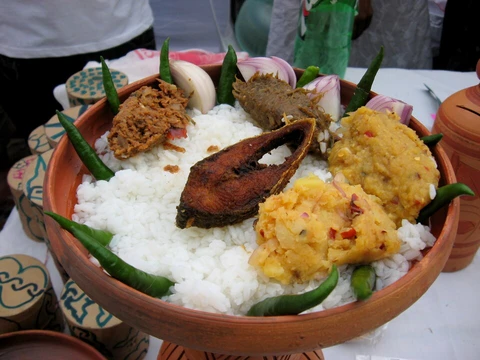
Korma
A Mughlai-influenced braised curry from the Indian subcontinent.

Korma is a curry dish originating in the Indian subcontinent, influenced by Mughlai cuisine. It consists of meat or vegetables braised with yogurt, water or stock, and spices to produce a thick sauce or gravy, with less intense flavors and more aromatic fragrances than other meat dishes.
Quick Facts
- Place Of Origin
- Mughal Empire
- Region
- India / Pakistan / Bangladesh / Iran / Afghanistan
- Associated Cuisine
- Mughal cuisine
- Served
- Hot
- Main Ingredient
- meat, yogurt
Facts from the source article.
Lore & Background
Korma stems from Mughlai cuisine of the Indian subcontinent. Kormas were prepared in the Mughal court kitchens; early references to korma-like dishes appear in 16th-century Mughal texts such as the Ain-i-Akbari, predating the reign of Shah Alam. During the 18th century, cooks in the Mughal court enriched the Persian-style stew with almonds, garlic, spices, and yoghurt. In Hyderabad in 1832, a 'korma' variety of pilau included thinly-sliced meat with rice.
Indian cooks in the 19th century prepared curries for their British masters simplified and adjusted to Anglo-Indian taste. A quarama from Lucknow contained ghee, yoghurt, cream, crushed almonds, cloves, cardamom, and saffron; whereas an 1869 Anglo-Indian quorema or korma had no cream, almonds, or saffron, but added coriander, ginger, and black peppercorns. The English name is an anglicisation of the Hindi-Urdu qormā, meaning 'braising'.
Reader's Guide
Korma is significant as a dish that evolved from Mughlai court cuisine into a staple across the Indian subcontinent and beyond, adapting to local tastes and ingredients. In the modern Indian subcontinent, it is eaten in various contexts: at Muslim wedding banquets, in the traditional wazwan, and in tora dishes sent to others' homes. It is among the most popular dishes in Pakistan, commonly eaten at lunch and at feasts ending Ramadan fasts. In the United Kingdom, a typical korma served in curry houses is a mildly spiced dish with a thick sauce, often featuring almonds, cashews, or coconut, and has repeatedly been cited as among the most popular curries. In the United States, a dish called chicken korma was introduced with the 1954 publication of Myra Waldo's Round-the-World Cookbook, modified to suit American tastes. The dish's variations include navratan korma (vegetarian, with nine vegetables), Indonesian korma (cooked with coconut milk and tamarind), and British korma (mildly spiced). Its legacy lies in its adaptability across cultures while retaining its core braising technique.
Did You Know?
- In Indonesia, korma is traditionally cooked with coconut milk instead of yoghurt.
- In the United Kingdom, chicken korma has repeatedly been cited as among the most popular curries.
More in Bangladeshi cuisine 1-24
Spotted an error? Know more?
Reader corrections go straight into our review queue. Suggest an edit · How this site is sourced