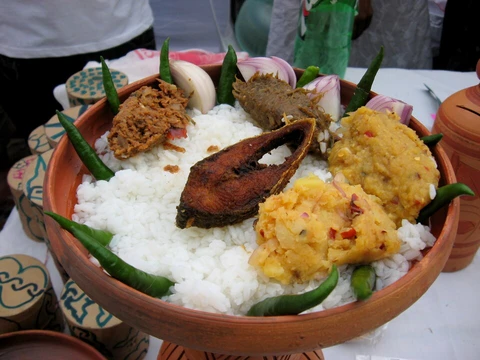
Bengali cuisine
Bengali cuisine blends diverse history, rice, fish, and rich sweets.

Bengali cuisine comes from the region of Bengal, which today covers most of Bangladesh, the Indian state of West Bengal, the eastern part of Jharkhand called Manbhum, and the Barak valley area of Assam. The region’s history and climate have shaped its food. The cooking is known for using strong flavors like mustard oil and for its wide range of sweets and desserts. Rice is the main staple, and fish has traditionally been the most common source of protein. Freshwater fish are preferred over saltwater fish, though barramundi (known locally as bhetki) is also common. Meat is eaten often, with chicken and mutton being the most popular choices; beef is common among Muslims. Still, meat of any kind is consumed far less than fish in Bangladesh. Lentils have become a more important part of the diet in recent years. Many food traditions are tied to religious and social events, such as adda, Poila Boishakh, Eid, and Durga Puja.
Muslims conquered Bengal in the early 13th century (c. 1204), when the Delhi Sultanate under Bakhtiyar Khalji swept in, bringing Persian and Arabic cooking with them. Dishes like korma and bhuna were once only for royal courts, but over time—especially through urban centers and later colonial-era influences—these recipes spread to lower and middle classes. This influence grew during the British Raj, when Kolkata became a refuge for exiled Nawabs, including the family of Tipu Sultan from Mysore and Wajid Ali Shah, the ousted Nawab of Awadh. These exiles brought hundreds of cooks and masalchis (spice mixers). As their wealth and royal support faded, they mixed into the local population. These cooks knew a wide range of spices (especially jafran and mace), used ghee heavily, and marinated meat with yogurt and chili. In Bangladesh, this food is now common for everyone, while in West Bengal it remains a staple for both ordinary people and professional chefs, who have created new dishes like chaap (ribs slow-cooked on a tawa) and rezala (meat in a thin yogurt and cardamom gravy), alongside later street-food inventions like the kathi roll (kebabs wrapped in flatbread, a mid-20th-century Kolkata creation).
- Region
- Bengal (Bangladesh, West Bengal, Manbhum, Barak valley)
- Staple
- Rice
- Common protein
- Fish (freshwater preferred), chicken, mutton
- Key fat
- Mustard oil
- Notable influence
- Mughal, Bengali Hindu widows, Partition, Chinese diaspora
- Known for
- Varied flavours, confectioneries, desserts, street foods
Lore & Background
Muslims conquered Bengal in the early 13th century (c. 1204), when the Delhi Sultanate under Bakhtiyar Khalji swept in, bringing Persian and Arabic cuisine. Dishes such as korma and bhuna once served in higher courts gradually spread to lower and middle classes through urban centers and later colonial-era influences, not directly by Mughal cooks during the Mughal period. During the British Raj, exiled Nawabs like Tipu Sultan's family and Wajid Ali Shah brought hundreds of cooks and masalchis to Kolkata, introducing spices like jafran and mace, extensive use of ghee, and marinating meat with yoghurt and chilli. In Bangladesh, this food became common fare; in West Bengal, it remained a staple, with innovations such as chaap and rezala, while the kathi roll is a mid-20th-century Kolkata street-food invention, not a Mughal-era innovation. The Mughals popularized mutton and certain cooking techniques, but did not introduce beef (already consumed by some communities) or venison (not a common pre-Mughal meat) into mainstream Bengali cuisine.
In Bengali Hindu tradition, widows were barred from eating meat, fish, and 'heating' foods like shallot and garlic, but gi
Reader's Guide
Bengali cuisine's significance lies in its synthesis of diverse historical influences—Mughal, Hindu widow traditions, colonial, and Chinese—into a distinct regional style. The Mughal introduction of Persian and Arabic dishes, along with spices and dairy, transformed both savory and sweet preparations. The innovations of Bengali Hindu widows, working under strict dietary restrictions, created a vegetarian repertoire that became integral to the cuisine. The Partition reshaped eating habits along religious lines, reinforcing differences between Bangladesh and West Bengal. Kolkata's multicultural environment, including a Chinese diaspora and Odia cooks, further diversified the cuisine, leading to popular street foods like phuchka and Indian Chinese dishes. The cuisine's emphasis on rice, freshwater fish, mustard oil, and a wide range of sweets—from Mishti doi to Roshmolai—reflects its regional identity. Mezban feasts in Chittagong highlight communal traditions centered on beef and rice. Overall, Bengali cuisine demonstrates how historical events, religious practices, and migration patterns can create a complex, evolving culinary heritage.
Did You Know?
- Freshwater fish are preferred to marine fish in Bengali cuisine, though barramundi (bhetki) is also common.
- Bengali Hindu widows were barred from eating meat, fish, and 'heating' foods like shallot and garlic, leading them to create new meals using only vegetables and cheap spices.
- The Mughals brought mutton and beef into mainstream Bengali cuisine, along with already known meats like chicken and venison.
- Kolkata's Chinese diaspora, originally Cantonese tradesmen and sailors, created Indian Chinese cuisine using local ingredients, now available at almost every street corner.
Historical Layers and Foreign Influences
Bangladeshi cuisine carries the imprint of centuries of political and cultural exchange. When Dhaka became the capital of East Bengal, Persian, Turkish, and Arabic culinary traditions began to seep into local cooking. The Nawabs of Dhaka were the primary vectors for Mughlai cuisine, introducing lavish meat-and-dairy preparations—kebabs, stuffed breads, kacchi biriyani, patisapta—that for many centuries remained the privilege of the wealthy. Only as Bangladesh's economy expanded did these dishes become accessible to a broader population. Before chili peppers arrived from the Americas in the sixteenth century, cooks relied on black pepper and chui jhal for heat. The Partition of India also left a culinary footprint: Dhakaiya paratha, a multi-layered bread, traveled to Kolkata in the hands of Bengali immigrants and took root there. Even today, Kashmiri tea and korma remain fixtures of Eid celebrations and weddings, testifying to how deeply Mughlai and Central Asian threads are woven into the national food identity.
A Mosaic of Regional Kitchens
Far from being a single monolithic tradition, Bangladeshi cuisine shifts dramatically from one region to the next. In Chittagong, curries run hot and beef-forward; Kala bhuna blackens beef shoulder until dark and tender, while Durus kura simmers a whole chicken in thick broth. The nearby Hill Tracts offer a completely different palette: Chakma cooks build flavor with sidol, a fermented shrimp-and-fish paste, and forage for wild mushrooms and ginger flowers, while Marma communities work with nappi, a dried-fish paste, and brew rice beer. In Greater Mymensingh, the focus turns to dairy—doi yogurt paired with puffed rice, and Monda, a sweet yogurt patty first made in Muktagachhar in 1824. Northern Bangladesh leans on its dairy farms for yogurt made from evaporated milk, and Biral Upazila bakes large Koi fish in banana leaves. Sylhet distinguishes itself through citrus: hatkora, thoikor, Adajamir, and the nearly extinct Ashkul Lebu, whose juice goes into Tenga. Each zone reflects its own geography, climate, and ethnic makeup.
Rice, Fish, and the Riverine Table
At the heart of Bangladeshi cooking sit two ingredients: rice and fish. The country's tropical monsoon climate and its network of rivers make this pairing almost inevitable, and it anchors every meal from the simplest household plate to the grandest feast. Fish is the most common source of protein, and the coastal and riverine waters supply an extraordinary range—from silver pomfret and Bombay duck in Chittagong to barramundi and giant tiger prawns from the Bay of Bengal. Shutki, the cured and dried form of loita, is a pungent regional delicacy, while churi ribbonfish is dried and then cooked with chili and onions. Beyond these two pillars, Bangladeshi cooking draws on roughly 250 plant-based ingredients. Mustard oil was the traditional cooking fat long before soybean oil arrived, and in the south, piper chaba—a fiery, aromatic spice whose peeled stems and roots are added to meat and fish—predates the chili itself. Barisal's coastal kitchens add coconut, and the sheer variety of rice preparations, from Morog pulao to Akhni biriyani, shows how a single grain can be transformed endlessly.
Feasts, Faith, and Communal Rhythms
Food in Bangladesh is inseparable from community and ritual. In Chittagong, the Mezban is a communal feast where beef curries like Mejbani Gosht signal prosperity, and the Hindu community of the city organizes its own annual Mezban through the Chittagong Parishad, centering fish and vegetable curries instead. In Old Dhaka, Chowk Bazaar—a centuries-old food market—becomes the focal point for Iftar meals during Ramadan, when the city gathers to break its fast after sunset. The Garo people of Mymensingh brew their own liquor at home and cook with soda and bamboo, while the Santal communities of Rajshahi prepare hadia, an alcoholic drink from rice, and distill liquor from palm tree resin for ritual ceremonies. Even the Garo table is distinctive, featuring pork, eel, and turtle meat. These practices—whether a wedding korma, a Sylheti Tenga made from the juice of a nearly extinct citrus, or a hill-tribe dish baked in banana leaves in a mud oven—show that Bangladeshi cuisine is as much about who gathers around the plate as about what is on it.
Frequently Asked Questions
Who is Bengali cuisine?
Bengali cuisine is the culinary tradition rooted in the Bengal region, which today stretches across Bangladesh, India's West Bengal, the Manbhum part of Jharkhand, and Assam's Barak Valley. It's recognized for bold mustard-oil flavors, rice as the everyday staple, and a dessert culture so expansive it feels like a category of its own.
What are Bengali cuisine's signature 'powers'?
Its most recognizable strengths are the heavy reliance on mustard oil for cooking, a deep preference for freshwater fish as the default protein, and an almost endless lineup of confections and sweets. Mughal-influenced preparations and a vibrant street-food scene round out its toolkit.
How did Bengali cuisine's backstory unfold?
The tradition was layered over centuries by Mughal court cooking, the dietary practices of Bengali Hindu widows, the social upheaval of Partition, and contributions from the Chinese diaspora. Each of those forces left a permanent fingerprint on what people on both sides of the border still cook today.
What's the deal with fish in Bengali cuisine?
Fish serves as the traditional protein backbone, with freshwater species strongly favored over their saltwater counterparts. The barramundi known locally as bhetki is a well-loved exception, while chicken and mutton also appear regularly on the table.
Why is Bengali cuisine important to food fans?
It stands out as one of South Asia's most flavor-diverse traditions, where a single meal can swing from a spiced fish curry to a delicate layered sweet without breaking stride. Its reach extends well beyond the Bengal region, shaping menus in diaspora kitchens across the globe.
More in Bangladeshi cuisine 1-24
Spotted an error? Know more?
Reader corrections go straight into our review queue. Suggest an edit · How this site is sourced