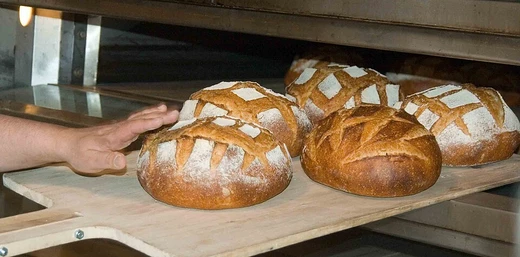
Sourdough
Ancient leavening agent using wild yeast and lactobacillus.

Wikipedia / Wikimedia Commons
Sourdough is a leavening agent made from naturally occurring yeast and lactobacillus bacteria. The term refers to bread baked with this agent, while the agent itself is called a starter. The fermentation process creates lactic acid, which gives the bread its characteristic sour flavor and helps it stay fresh longer.
Sourdough is among the oldest and most widespread forms of bread leavening. For most of human history, it was the standard method, until barm from beer brewing replaced it in the Middle Ages. Barm was later supplanted in the late 19th and early 20th centuries by industrially produced baker’s yeast. According to the *Encyclopedia of Food Microbiology*, one of the oldest known sourdough breads dates to 3700 BC and was found in Switzerland, but the practice likely began with agriculture in the Fertile Crescent and Egypt thousands of years earlier. Pliny the Elder described several sourdough leavening methods. Sourdough remained common in Europe until barm took over, and after 1871, purpose-cultured yeast became widespread.
French bakers brought sourdough techniques to Northern California during the Gold Rush, and it remains part of San Francisco’s culture—the city’s NFL mascot is named Sourdough Sam. Although sourdough is often linked to 1849 prospectors, they more commonly used commercial yeast or baking soda. The famous San Francisco sourdough is a white bread with a strong sour taste. Its starter contains a specific strain of *Lactobacillus*, now called *Fructilactobacillus sanfranciscensis*, along with the yeast *Kasachstania humilis*.
The sourdough tradition also traveled to Alaska and the Yukon during the Klondike Gold Rush of 1898. Conventional leavening agents were unreliable in those harsh conditions. Miners and settlers often carried a pouch of starter around their neck or on a belt, guarding it from freezing. Freezing does not kill a starter, but excessive heat does. Experienced old-timers became known as “sourdoughs,” a term still used for Alaskan or Klondike veterans. This nickname was immortalized in Robert Service’s *Songs of a Sourdough*.
In English-speaking countries, where wheat bread is common, sourdough is no longer the standard leavening method. It was gradually replaced by barm and later by cultured yeasts after Louis Pasteur’s germ theory was accepted. Though commercial bakeries largely abandoned sourdough in the 20th century, it has seen a revival among artisan bakers and, more recently, in industrial bakeries. In places without a legal definition of sourdough bread, some products marketed as sourdough are leavened with baker’s yeast or chemical agents instead of, or in addition to, a live starter. The Real Bread Campaign calls such breads “sourfaux” and advises against most modern breads due to these techniques and additives like baking soda and baking powder, which may be linked to celiac disease.
To make sourdough, a pre-ferment called a starter (also known as the chief, chef, head, mother, or sponge) is used. This is a live mixture of flour and water containing wild yeast and lactobacilli. The starter’s purpose is to produce vigorous leavening and develop flavor. Starters vary in hydration—the ratio of water to flour—and can be a liquid batter or a stiff dough. To create a starter, flour and water are mixed and left in a warm place for a week or two. When wheat flour meets water, the enzyme amylase breaks down starch into glucose and maltose, which the natural yeast can metabolize. With time, warmth, and regular refreshments (adding fresh flour and water), a stable culture develops. This culture causes dough to rise. The bacteria ferment starches the yeast cannot, producing by-products like maltose, which the yeast then uses to generate carbon dioxide gas, leavening the dough.
As the starter ferments, sometimes for days, its volume is increased by periodic additions of flour and water—called refreshments or feedings. If fed regularly, the starter remains active. The ratio of fermented starter to fresh flour and water, known as the refreshment ratio, is critical for development and maintenance. Higher ratios lead to greater microbial stability. In San Francisco sourdough, this ratio is 40% of the total weight, roughly equivalent to 67% of the new dough’s weight. A high refreshment ratio keeps the pH of the refreshed dough relatively low.
- field
- Food microbiology, breadmaking
- known_for
- Ancient leavening agent; basis of San Francisco sourdough; associated with Klondike gold prospectors
Lore & Background
Sourdough is one of the most ancient and popular forms of leavening bread. It was the standard method of breadmaking for most of human history until the Middle Ages, when it was replaced by barm. The Encyclopedia of Food Microbiology states that one of the oldest sourdough breads dates from 3700 BC and was excavated in Switzerland, but the origin likely relates to the origin of agriculture in the Fertile Crescent and Egypt several thousand years earlier. Pliny the Elder described several methods of sourdough leavening.
French bakers brought sourdough techniques to Northern California during the California Gold Rush, and it remains part of San Francisco culture. The strain of Lactobacillus in sourdough starters is named Fructilactobacillus sanfranciscensis, alongside the sourdough yeast Kasachstania humilis. The sourdough tradition was carried into Alaska and the Yukon Territory during the Klondike Gold Rush of 1898, where conventional leavenings were less reliable. Experienced miners carried a pouch of starter, fiercely guarded from freezing, though freezing does not kill a starter; excessive heat does. Old hands came to be called 'sourdoughs,' a term still applied to any Alaskan or Klondike old-timer.
In English-speaking countries, sourdough is no longer the standard method for bread leavening, having been replaced first by barm, then by cultured yeasts. It has undergone a revival among artisan bakers and in industrial bakeries. In countries with no legal definition of sourdough bread, some products marketed as such are leavened using baker's yeast or chemical raising agents; the term 'sourfaux' has been applied to such breads by the Real Bread Campaign.
Reader's Guide
Sourdough's significance lies in its role as one of the oldest and most widespread leavening methods in human history, predating commercial yeast by millennia. Its legacy is preserved in regional traditions such as San Francisco sourdough, which relies on specific microbial strains like Fructilactobacillus sanfranciscensis and Kasachstania humilis. The starter culture, a live mixture of flour and water containing wild yeast and lactobacilli, must be regularly refreshed with flour and water to remain active. The ratio of fermented starter to fresh flour and water, called the refreshment ratio, is critical for microbial stability. A drier, cooler starter produces more acetic acid and a sourer loaf, while a wetter, warmer starter yields more lactic acid. The sourdough tradition also became emblematic of the Klondike Gold Rush, where miners carried starter pouches and were nicknamed 'sourdoughs.' In modern times, sourdough has seen a revival among artisan bakers, though some commercial products labeled as sourdough may use baker's yeast or chemical leavening agents, a practice criticized by the Real Bread Campaign.
Did You Know?
- One of the oldest sourdough breads dates from 3700 BC and was excavated in Switzerland.
- The strain of Lactobacillus in San Francisco sourdough starters is named Fructilactobacillus sanfranciscensis.
- Freezing does not kill a sourdough starter; excessive heat does.
- The term 'sourdough' was applied to old-timers in Alaska and the Klondike during the Gold Rush.
More in Baking 1-24
Spotted an error? Know more?
This is a living reference — every entry is fact-audited, and reader corrections feed straight into our audit queue. Suggest an edit · See this site's audit record