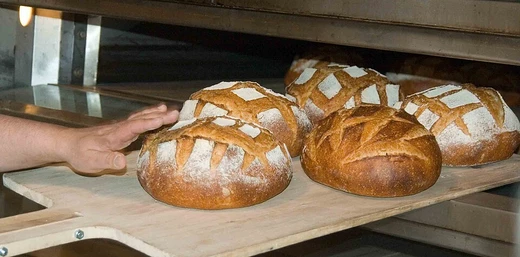
Pita
Yeast-leavened round flatbread common in the Mediterranean and Middle East.

Pita, also known as Greek bread, Arabic bread, Syrian bread, Lebanese bread, and pocket bread, is a family of yeast-leavened round flatbreads baked from wheat flour. It is common in the Mediterranean, Middle East, and neighboring areas, and includes the widely known version with an interior pocket. The bread has ancient roots, with evidence of flatbreads made from wild cereal grains by the Natufian people in what is now Jordan around 14,500 years ago. During the Neolithic period, about 10,000 years ago, wheat and barley were among the first domesticated crops in the Fertile Crescent. By 4,000 years ago, bread was central to societies like the Babylonian culture of Mesopotamia, where the earliest known written bread-making recipes originate, and pita-like flatbreads cooked in a tannur (tandoor) were a dietary staple, similar to modern tandoor bread, taboon bread, and laffa. However, food historians note that the steam-puffed, two-layer "pocket pita" does not appear in ancient texts or medieval Arab cookbooks and was likely a later innovation. Most pita is baked at high temperatures, turning water in the dough into steam and causing the bread to puff up and form a pocket; when cooled, the layers remain separated, allowing the bread to be opened. Pita is traditionally served fresh from a wood-fired oven, ideally on the same day. Commercially, modern production lines bake thousands of pitas per hour at very high temperatures for about one minute, then air-cool them before shipping or freezing. Culinary uses include scooping sauces or dips like hummus, wrapping kebabs, gyros, or falafel, and being cut and baked into crispy chips. In the United Kingdom, the term specifically refers to pocket versions used for barbecues as a souvlaki wrap.
- type
- Flatbread
- origin
- Near East (prehistoric flatbreads)
- also_known_as
- Greek bread, Arabic bread, Syrian bread, Lebanese bread, pocket bread
- main_ingredient
- Wheat flour
Lore & Background
Pita is a family of yeast-leavened round flatbreads made from wheat flour, common across the Mediterranean, Middle East, and neighboring regions. Its defining characteristic is the interior pocket that forms during high-temperature baking (450–475 °F), when water in the dough turns to steam and puffs the bread; upon cooling, the two layers remain separated, allowing the bread to be opened. However, pocketless versions also exist. The bread is traditionally served fresh from a wood-fired oven and is best consumed the same day. Commercially, pita is produced on automated lines using much hotter ovens (800–900 °F), baking each piece for about one minute, then air-cooling before shipping or freezing. Pita is used to scoop dips like hummus, wrap kebabs, gyros, sabich, or falafel, and can be baked into crispy chips. In Turkish cuisine, the word *pide* refers to three styles: a flatbread similar to the Greek and Arab versions, a pizza-like dish with toppings, and Ramazan pidesi. Cypriot pita is rounder and fluffier, baked on a cast-iron skillet. In Greece, *pita* generally means “pastry” for pies and cakes, while the flatbread wrap is used almost exclusively for souvlaki or gyros. Druze pita is filled with labneh and topped with olive oil and za’atar. The bread has roots in prehistoric flatbreads of the Near East, with evidence from about 14,500 years ago among the Natufian people in present-day Jordan. Ancient wheat and barley were domesticated in the Neolithic period around 10,000 years ago in the Fertile Crescent. By 4,000 years ago, pita-like flatbreads cooked in a *tinûru* (tannur or tandoor) were a basic element of Babylonian diet, similar to modern tandoor bread, taboon bread, and laffa. However, food historians note no record of the steam-puffed pocket pita in ancient texts or medieval Arab cookbooks, suggesting it is a later development.
Reader's Guide
Pita is significant as a staple bread across the Mediterranean, Middle East, and neighboring areas, with a history stretching back to prehistoric flatbreads. Its most distinctive feature is the interior pocket formed when the dough is baked at high temperatures, causing steam to puff it up. This pocket makes pita versatile for scooping sauces or dips like hummus, or wrapping kebabs, gyros, and falafel. The bread is traditionally served fresh from a wood-fired oven and is best eaten the same day. Modern commercial production uses advanced automatic lines, baking thousands of pitas per hour at much higher temperatures. The term 'pita' can refer to various flatbreads in different cultures; in Greece, 'pita' often means 'pastry' and is used for cakes and pies, while the flatbread wrap is used for souvlaki. In Turkish cuisine, 'pide' can refer to a flatbread, a pizza-like dish, or Ramazan pidesi. In the Balkans, local styles are known as lepinja or somun, while 'pita' itself means 'pie'. The bread's adaptability and long history make it a foundational element in many cuisines.
Did You Know?
- In Greek, 'pita' (πίτα) by default refers to the thicker, pocketless Greek pita, while the thinner khubz-style pita is called 'aravikí pita' (Arabic pastry).
- In Turkish cuisine, the word 'pide' may refer to three different styles of bread: a flatbread, a pizza-like dish called içli pide, and Ramazan pidesi.
More in Baking 1-24
Spotted an error? Know more?
This is a living reference — every entry is fact-audited, and reader corrections feed straight into our audit queue. Suggest an edit · See this site's audit record