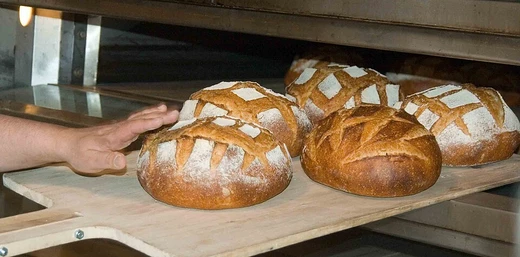
Focaccia
Flat leavened Italian bread with ancient Roman origins.

Wikipedia / Wikimedia Commons
Focaccia is a flat leavened oven-baked Italian bread, similar to a flatbread called pizza bianca in Roman cuisine. Its etymology traces to ancient Rome's *panis focacius*, a flatbread baked on the hearth, with the word derived from the Latin *focus* ('hearth, place for baking'). The basic recipe is thought by some to have originated with the Etruscans, but today it is widely associated with Ligurian cuisine, and outside Liguria the word usually refers to Genoese variants. The first known use of the word *focaccia* dates to the 14th century. In publications outside Italy, it is sometimes considered a variant of pizza, though a key difference is that focaccia is left to rise after being flattened, whereas pizza is baked immediately. The Genoese version is marked by finger-sized holes, or "dimples," on its surface; it is brushed or sprinkled with olive oil, coarse salt, and sometimes water before its final rise. In Genoa, focaccia is eaten in the morning for breakfast or during the day, often dipped in milk or cappuccino while still warm and moist. Along the Ligurian coast, countless variations exist, ranging from a biscuit-hard type to a soft, oily version made with corn flour. One notable example from Recco, near Genoa, sandwiches soft cheese between two paper-thin layers of dough. In northwest Italy, a sweet variant is sprinkled with sugar and may include raisins or honey. Northeast Italy features an Easter version based on eggs, sugar, and butter. In Rimini, a sweet focaccia topped with raisins, almonds, walnuts, and pine nuts is traditionally eaten in November for All Souls' Day. In Apulia, the dough incorporates potatoes and is topped with tomatoes, olives, and fresh herbs like oregano. In South Tyrol and the Austrian village of Krimml, a traditional Easter gift from godparents to godchildren is made slightly thinner in the center to hold dyed eggs. Rosemary is the most common herb used to flavor focaccia, but sage is also used. The bread may be savory or sweet, baked or sometimes fried, and can be served as an antipasto, table bread, snack, or used for sandwiches, sometimes accompanied by prosciutto.
- type
- Flat leavened oven-baked bread
- origin
- Italy (associated with Ligurian cuisine; ancient Roman roots)
- first_attestation
- 14th century
- key_ingredients
- Olive oil, coarse salt, water (basic); varies by region
- known_for
- Finger-sized dimples on surface; eaten at breakfast in Genoa; countless regional variants
Lore & Background
Focaccia's history reaches back to ancient Rome, where panis focacius was a flatbread baked on the hearth. The word itself comes from the Latin focus, meaning 'hearth' or 'place for baking.' While some believe the basic recipe originated with the Etruscans, focaccia is now most strongly tied to Ligurian cuisine, particularly the Genoese variant. The first written record of the word focaccia dates to the 14th century. Outside Italy, focaccia is sometimes considered a variant of pizza, but a key difference is that focaccia is left to rise after being flattened, whereas pizza is baked immediately.
Reader's Guide
Focaccia's significance lies in its deep roots in Italian culinary tradition and its remarkable regional diversity. In Liguria, the Genoese version (focaccia genovese) is defined by its finger-sized dimples and is eaten at breakfast, often dipped in milk or cappuccino. Along the Ligurian coast, variations range from the hard, biscuit-like focaccia secca to the soft, oily Voltri version, and the cheese-filled focaccia di Recco. Beyond Liguria, sweet variants appear in northwest Italy (focaccia dolce) and for Easter in the northeast (focaccia veneta). In Apulia, potatoes are incorporated into the dough, and toppings include tomatoes, olives, and oregano. In South Tyrol and Austria, Osterfochaz is a traditional Easter gift. Focaccia al rosmarino, topped with rosemary, is widely served as antipasto, table bread, or snack. The bread's adaptability—savory or sweet, baked or fried—and its role in regional identity make it a staple of Italian bread culture.
Did You Know?
- The word focaccia derives from the Latin focus, meaning 'hearth, place for baking.'
- In Genoa, focaccia is eaten at breakfast, often dipped in milk or cappuccino.
- Focaccia is left to rise after being flattened, while pizza is baked immediately.
- Focaccia di Recco features prescinsêua cheese sandwiched between two layers of paper-thin dough.
More in Baking 1-24
Spotted an error? Know more?
This is a living reference — every entry is fact-audited, and reader corrections feed straight into our audit queue. Suggest an edit · See this site's audit record