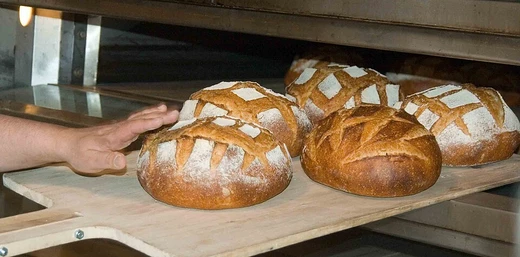
Croissant
A crescent-shaped, buttery, flaky Viennoiserie pastry.

Wikipedia / Wikimedia Commons
A croissant is a crescent-shaped Viennoiserie, made from a laminated yeast dough that falls somewhere between bread and puff pastry. Its buttery, flaky texture comes from a technique called laminating, where dough is layered with butter, rolled, and folded several times before being rolled thin. The shape is inspired by the Austrian kipferl, but the modern croissant uses a yeast-leavened laminated dough instead of the kipferl’s brioche dough—a shift that happened in early 20th-century France. The name comes from its crescent form.
The kipferl itself dates back to at least the 13th century in Austria, appearing in various shapes, plain or filled. In 1838 or 1839, Austrian artillery officer August Zang opened a Viennese bakery in Paris, serving kipferl and Vienna loaf. It became popular and inspired French imitators, giving rise to the concept of viennoiserie. The French version took the crescent shape and the name croissant, which became globally recognizable. The earliest known recipe for the present-day croissant appeared in 1905, though the name croissant was listed among “fantasy or luxury breads” as early as 1853. By 1869, croissants were a breakfast staple, and Charles Dickens mentioned them in 1872. The laminated dough technique itself was described in a late 17th-century French cookbook, but it wasn’t linked to the croissant until the 20th century. The first recipe matching the modern croissant—in shape, texture, and taste—was published in 1906, and a 1915 book by chef Sylvain Claudius Goy is sometimes credited with the earliest such recipe, using a laminated yeast dough called pâte feuilletée levée.
In the late 1970s, factory-made frozen preformed dough turned croissants into a fast food that could be baked fresh by unskilled labor. The chain La Croissanterie was a French response to American-style fast food, and by 2008, 30–40% of croissants sold in French bakeries and patisseries came from frozen dough. Croissants are common in continental breakfasts across Europe.
Culinary legends about the croissant’s origin—often confusing it with the kipferl—are widespread but lack contemporary evidence. One story claims it was invented to celebrate the defeat of the Umayyads at the Battle of Tours in 732, with the shape representing the Islamic crescent. Another says it was created in Buda or Vienna in 1683 to mark the defeat of the Ottomans, with bakers hearing tunneling and raising the alarm. These tales appear to stem from 20th-century writer Alfred Gottschalk.
- type
- Viennoiserie pastry
- origin
- France (developed from Austrian kipferl)
- key_ingredients
- Laminated yeast dough, butter
- earliest_known_recipe
- 1905 (present-day croissant); 1906 (Colombié's Nouvelle Encyclopédie culinaire)
- associated_person
- August Zang (Austrian officer who opened Viennese bakery in Paris, 1838 or 1839)
- common_uses
- Breakfast, continental breakfast, fast food
Lore & Background
The kipferl, an Austrian crescent-shaped pastry, can be dated back to at least the 13th century in Austria. In either 1838 or 1839, an Austrian artillery officer, August Zang, founded a Viennese bakery at 92, rue de Richelieu in Paris, serving Viennese specialties including the kipferl. The French version was named for its crescent (croissant) shape. The earliest known recipe for the present-day croissant appears in 1905, though the name appears among 'fantasy or luxury breads' in 1853. Sylvain Claudius Goy's 1915 book La Cuisine Anglo-Americaine contains a croissant recipe using a laminated yeast dough known as pâte feuilletée levée.
Reader's Guide
The croissant's significance lies in its evolution from the Austrian kipferl into a distinct French Viennoiserie, achieved by replacing brioche dough with a yeast-leavened laminated dough in the early 20th century. Its development was accelerated by August Zang's Viennese bakery in Paris, which popularized the kipferl and inspired French imitators. By the late 1970s, factory-made frozen dough made croissants a fast food that could be baked by unskilled labor, with 30–40% of croissants sold in French bakeries in 2008 baked from frozen dough. The croissant is a common part of a continental breakfast in many European countries. Culinary legends, unsupported by contemporary sources, link its crescent shape to the defeat of the Umayyads at the Battle of Tours (732) or to the 1683 siege of Vienna, but these are not historically verified.
Did You Know?
- The croissant's dough is layered with butter, rolled and folded several times in a technique called laminating, resulting in a flaky texture similar to puff pastry.
- The earliest known recipe for the present-day croissant appears in 1905, though the name 'croissant' appears among 'fantasy or luxury breads' in 1853.
- In the late 1970s, factory-made frozen dough turned croissants into a fast food that could be freshly baked by unskilled labor.
- The Islamic State attempted to ban croissants during the Syrian civil war due to legends linking the shape to the defeat of Ottoman forces.
More in Baking 1-24
Spotted an error? Know more?
This is a living reference — every entry is fact-audited, and reader corrections feed straight into our audit queue. Suggest an edit · See this site's audit record