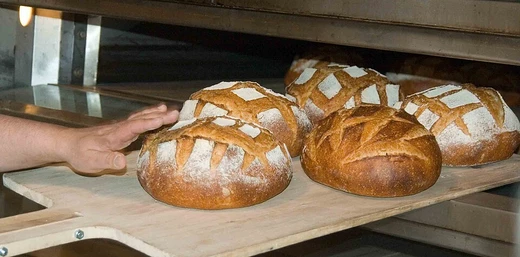
Ciabatta
Italian white bread created in 1982 as a baguette alternative.

Wikipedia / Wikimedia Commons
Ciabatta is an Italian white bread, shaped somewhat like a flattened, elongated oval, that was first made in 1982 by a baker in Adria, Veneto. It was developed as an Italian alternative to the increasingly popular French baguette. The bread is known for its large, irregular holes, which come from a very wet dough made with strong, high-gluten flour. Its name comes from the Italian word for "carpet slipper," referring to its flat shape.
The original recipe was created by Arnaldo Cavallari, who called it *ciabatta polesana* after his home region of Polesine. By 1999, his company, Molini Adriesi, had licensed the recipe to bakers in eleven countries. Cavallari and other Italian bakers were worried that French baguette sandwiches were hurting their businesses, so they spent weeks experimenting with traditional bread recipes to create a sandwich bread of their own. The result was a soft, wet dough.
Many Italian regions now have their own versions. Around Lake Como, ciabatta has a crisp crust and a light, porous crumb. In Tuscany, Umbria, and Marche, it ranges from a firm crust and dense crumb to a crisper crust and more open texture. In Rome, it is often seasoned with marjoram. New variations keep appearing: whole-wheat ciabatta is called *ciabatta integrale*, and when milk is added to the dough, it becomes *ciabatta al latte*.
Outside Italy, ciabatta reached the United Kingdom in 1985 through Marks & Spencer, and the United States in 1987 via Orlando Bakery, a Cleveland firm.
- field
- Bread
- nationality
- Italian
- known_for
- Italian alternative to French baguettes, large holes, high hydration dough
- created
- 1982
- creator
- Arnaldo Cavallari
- place_of_origin
- Adria, Veneto, Italy
Lore & Background
Ciabatta bread was first produced in 1982 by Arnaldo Cavallari, who called the bread ciabatta polesana after Polesine, the area he lived in. The recipe was subsequently licensed by Cavallari's company, Molini Adriesi, to bakers in 11 countries by 1999. Cavallari and other bakers in Italy were concerned by the popularity of sandwiches made from baguettes imported from France, which were endangering their businesses, and so set about trying to create an Italian alternative with which to make sandwiches. The recipe for ciabatta came about after several weeks of trying variations of traditional bread recipes and consists of a soft, wet dough made with high gluten flour.
Reader's Guide
Ciabatta's significance lies in its creation as a direct Italian response to the French baguette, addressing a commercial threat to Italian bakeries in the early 1980s. Its name, meaning 'carpet slipper' in Italian, reflects its flat, oval shape. The bread's high hydration dough and strong flour produce its characteristic large holes and soft, porous texture. Regional variations have emerged across Italy, from the crisp-crusted ciabatta of Lake Como to the firmer versions in Tuscany, Umbria, and Marche, and the marjoram-seasoned bread in Rome. Whole-wheat and milk-added variations (ciabatta integrale and ciabatta al latte) have also developed. Internationally, ciabatta was introduced to the United Kingdom in 1985 by Marks & Spencer and to the United States in 1987 by Orlando Bakery. Its legacy includes widespread adoption and adaptation, making it a staple in many countries.
Did You Know?
- Ciabatta means 'carpet slipper' in Italian.
- It was created in 1982 by Arnaldo Cavallari in Adria, Veneto.
- The recipe was licensed to bakers in 11 countries by 1999.
- Ciabatta was introduced to the UK in 1985 by Marks & Spencer.
More in Baking 1-24
Spotted an error? Know more?
This is a living reference — every entry is fact-audited, and reader corrections feed straight into our audit queue. Suggest an edit · See this site's audit record