Brioche
A rich French Viennoiserie with high egg and butter content.

Wikipedia / Wikimedia Commons
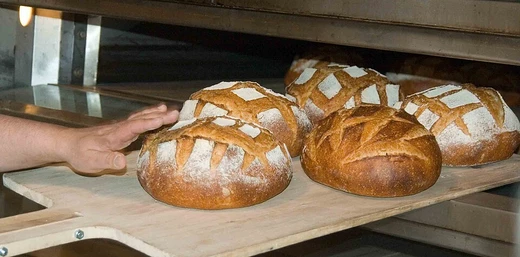
Brioche is a French Viennoiserie known for its rich, tender crumb, a result of its high egg and butter content. Chef Joël Robuchon called it "light and slightly puffy, more or less fine, according to the proportion of butter and eggs." Its crust is dark, golden, and flaky, often highlighted by an egg wash applied after proofing.
As a Viennoiserie, brioche includes eggs, butter, a liquid (such as milk, water, cream, or sometimes brandy), and occasionally sugar. Along with pain aux raisins, it belongs to the non-laminated subgroup of Viennoiseries, and these are commonly eaten at breakfast or as a snack. Brioche is often baked with added fruit or chocolate chips, served alone or as a dessert base, with many regional variations in ingredients, fillings, or toppings.
Brioche takes many forms and is used in both sweet and savory dishes. It can be served plain or filled, as in coulibiac, or with savory fillings like fillet of beef en croute, foie gras, sausage, or cervelat lyonnais. Sweet fillings include fresh fruits, vanilla cream, or jam. Stale brioche can be topped with frangipane, and it is also commonly used for hamburgers.
The most classic form is the brioche à tête, shaped and baked in a fluted round tin, with a large dough ball topped by a smaller one to form the head. Brioche mousseline is a loaf made in a standard loaf pan, where two rows of small dough pieces are placed in the pan instead of two separate pieces. After proofing in the pan, the pieces fuse, and during baking they rise further, creating an attractive pattern. Brioche can also be made as an ordinary loaf without rolling it into balls.
Brioche dough contains flour, eggs, butter, liquid (milk, water, cream, and sometimes brandy), leavening (yeast or sourdough), salt, and sometimes sugar. A common flour-to-butter ratio is 2:1, but historically, different levels of richness have existed simultaneously: a "rich man's brioche" with a 3:2 ratio, and a cheaper version with a 4:1 ratio. The Roux Brothers used a specific ratio of butter to flour.
The usual preparation method involves making the dough, letting it rise to double its volume at room temperature, then punching it down and letting it rise again in the refrigerator for a period determined by the recipe. This retarding develops flavor and stiffens the dough, making it easier to shape. After shaping and final proofing, the dough is typically brushed with an egg wash and baked until the crust browns and the interior reaches a certain temperature. The first rise for small rolls takes 1 to 1.5 hours; for larger brioche, the time is extended until the loaves double.
The first recorded use of the word "brioche" in French dates from 1404. It appears in Cotgrave's 1611 dictionary, described as a kind of spiced bread, with its origin given as Norman. In France, it evolved from the church's blessed bread (pain bénit), which gradually became richer with butter, eggs, and later sugar, until it became savory brioche. In the 17th century, a poorer version using only 3 eggs and 250 grams of butter per kilogram of flour was introduced. The terms "pain bénit" and "brioche" were sometimes used interchangeably; a 17th-century recipe titled "Pain bénit, & brioches" describes a lighter, cheaper blessed bread and a more delicate version called "Cousin," which used more butter, cheese, and eggs. Sourdough and brewer's yeast remained common into the following century, and by the 18th century, blessed bread was increasingly replaced by brioche, with those from Gisors and Gournay—major butter markets—being most highly regarded. For the wealthy from the time of Louis XIV onward, butter was the secret to making brioches. In Gisors, market days could see up to 250 or 300 kilograms of brioche produced, made with a dough prepared the evening before using flour, yeast, eggs, and butter, kept in a terrine until baking. Jean-Jacques Rousseau, in his *Confessions*, relates that "a great princess" advised that peasants who had no bread should eat brioche, a saying commonly misattributed to Queen Marie-Antoinette.
The etymology of "brioche" is now widely accepted to derive from the Old French verb *brier*, a Norman dialectal form of *broyer*, meaning to work the dough with a *brie* or *broyon* (a sort of rolling pin).
- origin
- French
- first recorded use in French
- 1404
- field
- Cuisine
- known for
- Rich, tender crumb; dark, golden, flaky crust; used in both sweet and savory dishes
- common flour-to-butter ratio
- 2:1
- typical baking temperature
- 230 °C (446 °F)
Lore & Background
Brioche is considered a Viennoiserie for its inclusion of eggs, butter, liquid (milk, water, cream, and sometimes brandy) and occasionally sugar. Along with pain au lait and pain aux raisins, it forms the non-laminated subgroup of Viennoiserie. Brioche is often baked with additions of fruit or chocolate chips and served on its own or as the basis of a dessert, with many regional variations in added ingredients, fillings, or toppings.
The first recorded use of the word in French dates from 1404. It is attested in 1611 in Cotgrave's A Dictionarie of the French and English Tongues, where it is described as 'a rowle, or bunne, of spiced bread' and its origin given as Norman. In France, it developed as 'a sort of bread improved since antiquity by generations of bakers, then of pastry-makers ... with some butter, some eggs, sugar coming later ... it developed from the blessed bread [pain bénit] of the church which gradually became of better quality, more and more costly, less and less bread; until becoming savory brioche.'
Although there has been much debate about the etymology of the word and, thus, the recipe's origins, it is now widely accepted that it is derived from the Old French verb brier, a Norman dialectal form of broyer, to work the dough with a broye or brie (a sort of wooden roller for kneading); the suffix -oche is a generic deverbal suffix. Pain brié is a Norman bread whose dense dough was formerly worked with this instrument.
Reader's Guide
Brioche has numerous uses in cuisine and can take on various forms, served plain or filled, as coulibiac, or with many other different savory fillings, such as fillet of beef en croute, foie gras, sausage, or cervelat lyonnais. Brioche can also be served with sweet fillings, especially fresh fruits, vanilla cream, or jam. Stale brioche can be topped with frangipane to make bostock. Brioche is commonly used for hamburgers.
Brioche à tête or parisienne is perhaps the most classically recognized form: it is formed and baked in a fluted round, flared tin; a large ball of dough is placed on the bottom and topped with a smaller ball of dough to form the head (tête). Brioche de Nanterre is a loaf of brioche made in a standard loaf pan. Instead of shaping two pieces of dough and baking them together, two rows of small pieces are placed in the pan. Loaves are then proofed (allowed to rise) in the pan, fusing the pieces. The dough balls rise further during the baking process and form an attractive pattern.
Brioche dough contains flour, eggs, butter, liquid (milk, water, cream, and sometimes brandy), leavening (yeast or sourdough), salt, and sometimes sugar. A common flour-to-butter ratio is 2:1, but historically, brioche of varying degrees of richness (from the 'rich man's brioche' with a flour-to-butter ratio of 3:2 to the cheaper pain brioché with a ratio of 4:1) have existed at the same time. The Roux Brothers used a ratio of 700 g (1.5 lb) butter to 1 kg (2.2 lb) flour.
Did You Know?
- The first recorded use of the word 'brioche' in French dates from 1404.
- Brioche is often baked with additions of fruit or chocolate chips.
- Stale brioche can be topped with frangipane to make bostock.
- The saying 'Qu'ils mangent de la brioche' is commonly misattributed to Queen Marie-Antoinette.
More in Baking 1-24
Spotted an error? Know more?
This is a living reference — every entry is fact-audited, and reader corrections feed straight into our audit queue. Suggest an edit · See this site's audit record