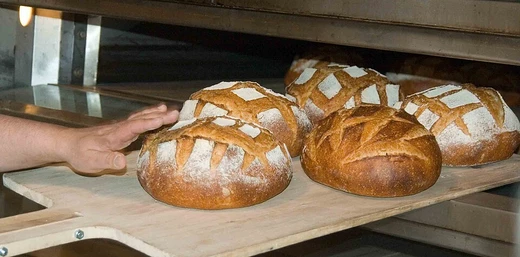
Bread
One of the oldest prepared foods, essential across cultures.

Wikipedia / Wikimedia Commons
Bread is a baked staple, typically a mixture of water and flour, often with yeast. It has been a fundamental part of human diets across recorded history, especially in Europe and the Middle East, and holds significance in both religious ceremonies and everyday culture. As one of the oldest prepared foods, its importance dates back to the beginnings of agriculture.
Leavening—the process that creates gas bubbles to lighten bread—can come from several sources: naturally occurring microbes (as in sourdough), chemical agents like baking soda, industrially produced yeast, or high-pressure aeration. Bread can also be unleavened. In mass production, additives are frequently used to improve flavor, texture, color, shelf life, nutrition, and manufacturing efficiency.
The word "bread" entered English around the year 1200, related to Old Norse and other Germanic languages, originally meaning a bit, crumb, or morsel. The Old English term was *brēd*.
The earliest evidence of bread-making comes from a 14,500-year-old site in northeastern Jordan. Starch residue on rocks from 30,000 years ago in Europe and Australia suggests even earlier practices, possibly involving cooking starch from plant roots into a primitive flatbread. With the Neolithic age around 10,000 BC, grains became the primary ingredient. Since yeast spores are everywhere, including on grain surfaces, any dough left to rest will naturally ferment. An early leavened bread was made in southern Mesopotamia by 6000 BC, and the Sumerians used ash in their dough. The Egyptians later refined the process, adding yeast around 3000 BC. Other ancient methods included using barm (foam from beer), a fermenting paste of grape juice and flour, or a piece of saved dough from the previous day as a sourdough starter. The ancient Egyptians, Greeks, and Romans viewed advanced baking as a mark of civilization. In 1961, the Chorleywood bread process was developed, using intense mechanical mixing to drastically shorten fermentation and production time. This method, which works with lower-protein grain, is now common in large factories, enabling quick, low-cost bread, though its nutritional value has faced criticism.
Bread is a staple in the Middle East, Central Asia, North Africa, Europe, and European-derived cultures, contrasting with rice or noodle staples in parts of Asia. It is usually made from wheat-flour dough, cultured with yeast, allowed to rise, and baked. The carbon dioxide and ethanol from fermentation create the bread's air pockets. Common wheat, high in gluten, is the most used grain, contributing more to the global food supply than any other single food. Other wheat species (spelt, emmer, einkorn, kamut) and non-wheat cereals (rye, barley, maize, oats, sorghum, millet, rice) are also used, though non-wheat grains, except rye, are often mixed with wheat flour due to their lower gluten content. Gluten-free breads use flours from almonds, rice, sorghum, corn, legumes, or tubers like cassava. Because they lack gluten, these doughs may not hold their shape, resulting in a dense crumb; additives like xanthan gum, guar gum, HPMC, corn starch, or eggs are used to compensate.
In wheat, phenolic compounds, mainly insoluble bound ferulic acid, are found in the hulls and are relevant to fungal resistance. Rye bread contains phenolic acids and ferulic acid dehydrodimers. Commercial breads with flaxseed contain three natural phenolic glucosides. The proteins glutenin and gliadin are functional in wheat bread: glutenin forms interconnected networks via disulfide bonds, giving bread its elastic nature, while gliadin binds weakly to this network via intrachain bonds. Structurally, bread is an elastic-plastic foam, similar to styrofoam.
- type
- Food product
- earliest_evidence
- 14,500-year-old Natufian site in Jordan
- earliest_leavened_bread
- 6000 BC in southern Mesopotamia
- primary_grain
- Common or bread wheat
- key_proteins
- Glutenin and gliadin
- modern_process
- Chorleywood bread process (1961)
Lore & Background
Bread is one of the oldest prepared foods, with evidence from 30,000 years ago in Europe and Australia showing starch residue on rocks used for pounding plants. The oldest evidence of bread-making comes from a 14,500-year-old Natufian site in Jordan's northeastern desert. Around 10,000 BC, with the dawn of the Neolithic age and the spread of agriculture, grains became the mainstay of making bread. An early leavened bread was baked as early as 6000 BC in southern Mesopotamia, cradle of the Sumerian civilization, who may have passed on the knowledge to the Egyptians around 3000 BC. The Egyptians refined the process and started adding yeast to the flour.
Reader's Guide
Bread is the staple food of the Middle East, Central Asia, North Africa, Europe, and European-derived cultures, in contrast to parts of South and East Asia where rice or noodles are staple. It is usually made from wheat-flour dough cultured with yeast, allowed to rise, and baked. Common or bread wheat is the most common grain due to its high gluten levels, which give dough sponginess and elasticity. Bread is also made from other wheat species and non-wheat cereals, often in combination with wheat flour due to lower gluten content. Gluten-free breads use flours from almonds, rice, sorghum, corn, legumes, or tubers, with additives like xanthan gum to compensate for lack of gluten. Bread can be served at many temperatures, eaten with the hands, spread with butter, dipped into liquids, topped with spreads, or used for sandwiches. It is also used as an ingredient in breadcrumbs, croutons, and stuffing. Acrylamide, a neurotoxic and carcinogenic compound, has been found in bread crusts heated above 120 °C. A study found that industrially produced bread with short rising times has high FODMAP carbohydrates causing flatulence, while longer rising times (four hours) break down most FODMAPs and improve tolerance.
Did You Know?
- The oldest evidence of bread-making comes from a 14,500-year-old Natufian site in Jordan.
- The Chorleywood bread process, developed in 1961, uses intense mechanical working to reduce fermentation time.
- Acrylamide, found in bread crusts heated above 120 °C, is neurotoxic and carcinogenic.
- A long rising time of four hours can break down 90% of FODMAP carbohydrates that cause discomfort.
More in Baking 1-24
Spotted an error? Know more?
This is a living reference — every entry is fact-audited, and reader corrections feed straight into our audit queue. Suggest an edit · See this site's audit record