Eris (dwarf planet)
Dwarf planet whose discovery redefined the Solar System's planetary lineup.

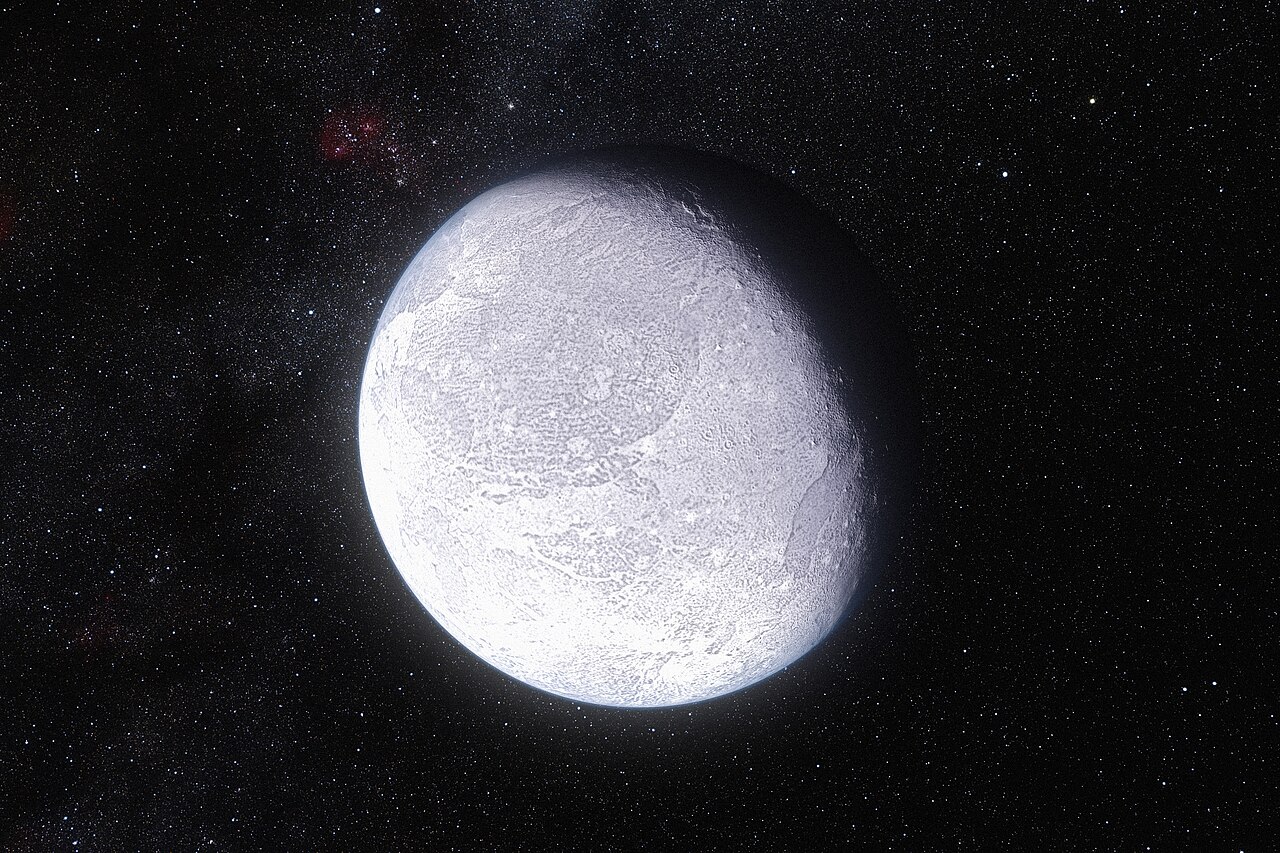
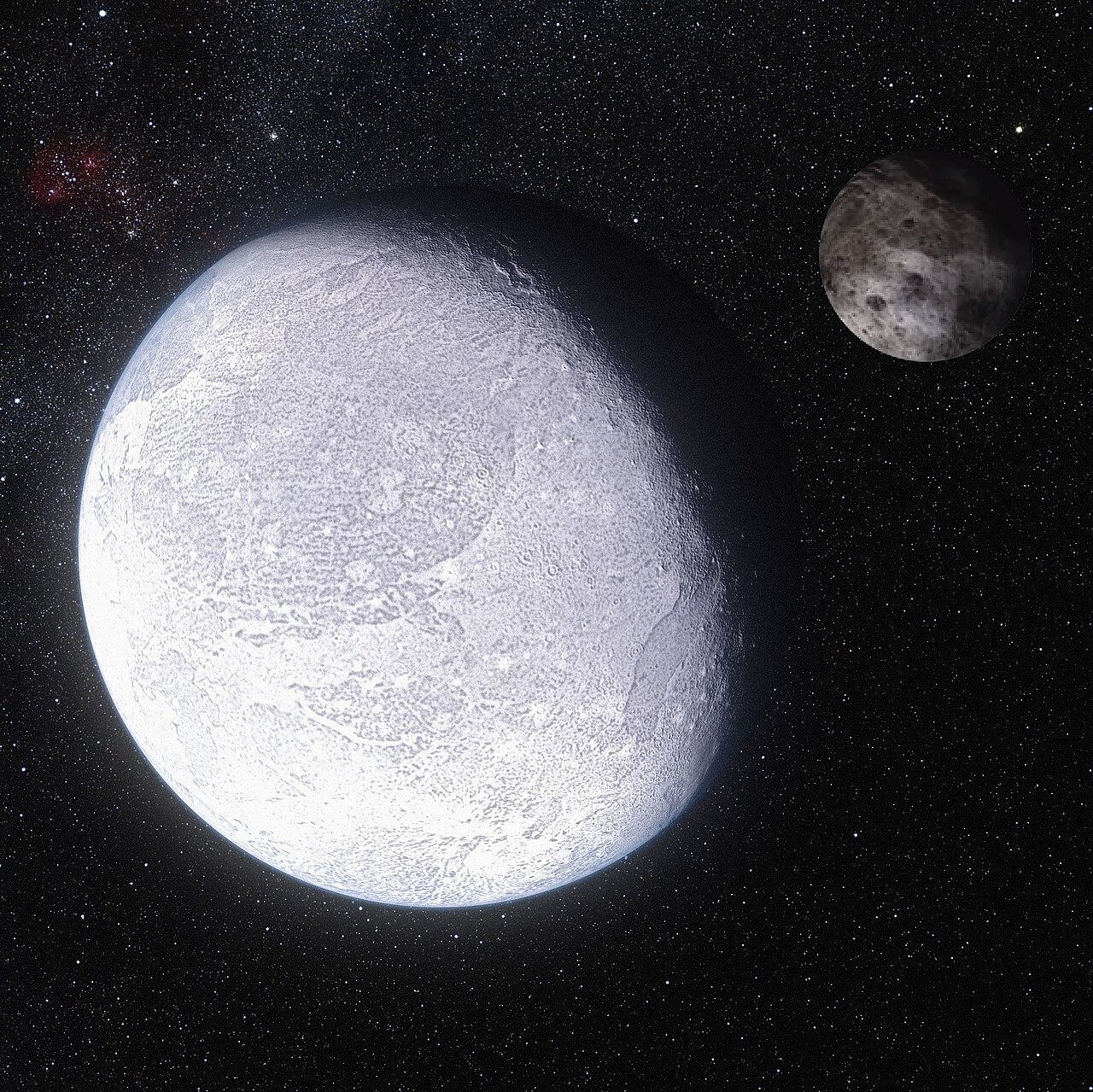
ESO/L. Calçada and Nick Risinger (skysurvey.org) · CC BY 4.0
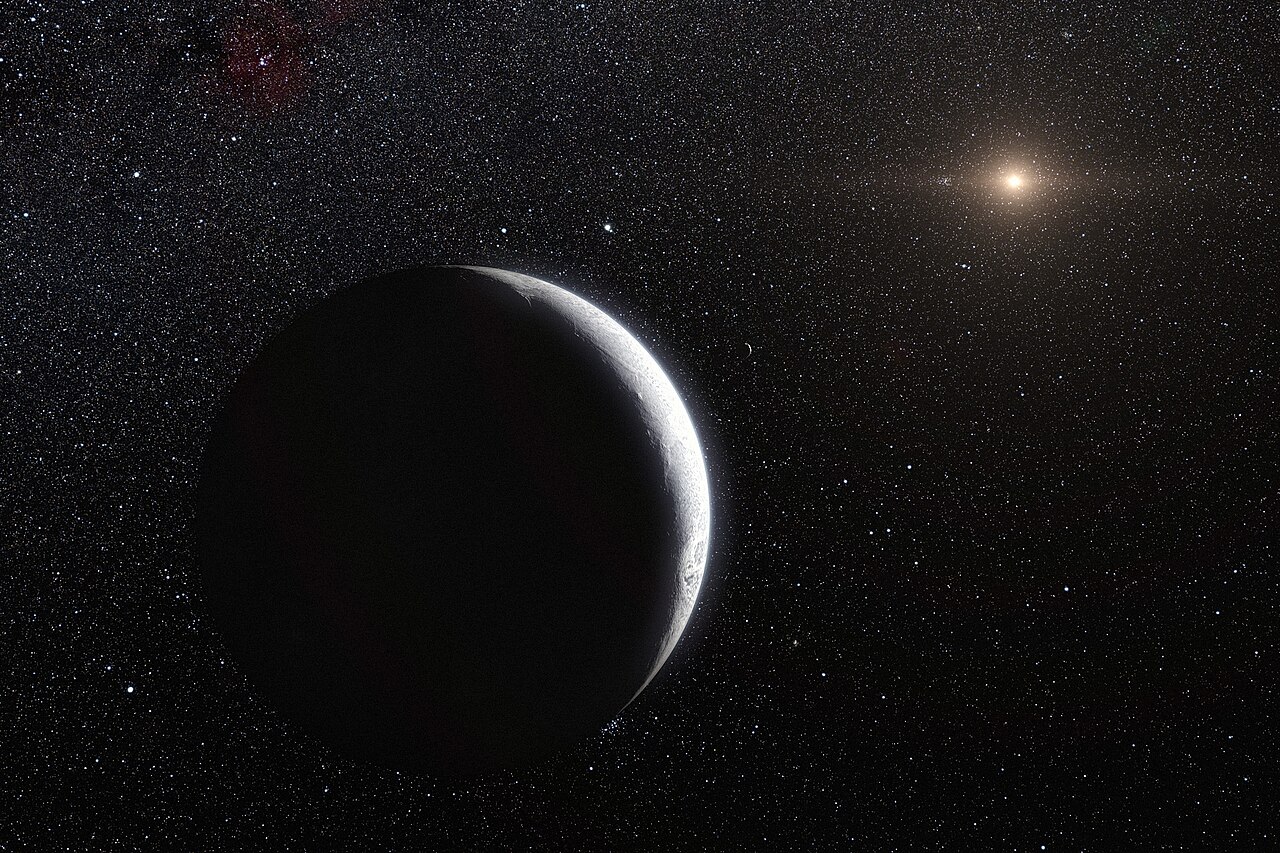
Eris (minor-planet designation 136199) holds the title of the most massive dwarf planet we know of, and it's the second largest by size. This icy world lives way out in the scattered disk, a region of the Solar System beyond Neptune, following a highly stretched, oval-shaped orbit. A team from Palomar Observatory, led by Mike Brown, spotted it in January 2005, with confirmation coming later that year. Its official name, chosen in September 2006, comes from the Greco-Roman goddess of strife and discord. Among all objects orbiting the Sun, Eris ranks as the ninth most massive, and if you count moons, it's the sixteenth most massive in the entire Solar System. It also holds the distinction of being the biggest Solar System object never visited by a spacecraft. Measurements put its diameter at 2,326 ± 12 kilometers (1,445 ± 7 miles). Its mass is about 0.28% of Earth's, and it's 27% heavier than Pluto—though Pluto is slightly bigger in volume. The surface areas of both Eris and Pluto are roughly the size of Russia or South America.
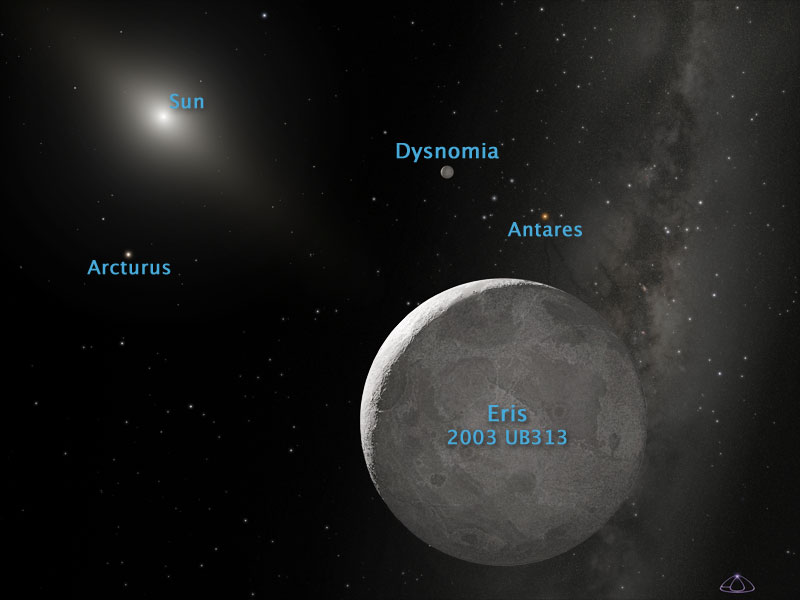
Eris has one confirmed moon, Dysnomia, and there's a possibility of another, much larger one lurking around. Back in February 2016, Eris sat 96.3 AU (14.41 billion kilometers, or 8.95 billion miles) from the Sun—more than three times farther out than Neptune or Pluto. Until the discoveries of 2018 AG37 and 2018 VG18 in 2018, Eris and Dysnomia were the most distant known natural objects in the Solar System, aside from long-period comets.
Because Eris initially appeared larger than Pluto, NASA briefly called it the Solar System's tenth planet. That, along with the likelihood of finding more similarly sized objects, pushed the International Astronomical Union (IAU) to finally define what a planet is. Under the definition approved on August 24, 2006, Eris, Pluto, and Ceres became "dwarf planets," shrinking the official planet count back to eight—the same number as before Pluto's 1930 discovery. Observations of a stellar occultation by Eris in 2010 later showed it's slightly smaller than Pluto, which New Horizons measured in July 2015 at a mean diameter of 2,377 ± 4 kilometers (1,477 ± 2 miles).
**Discovery**
Eris was found by the team of Mike Brown, Chad Trujillo, and David Rabinowitz on January 5, 2005, from images taken on October 21, 2003. The discovery was announced on July 29, 2005—the same day as Makemake and two days after Haumea—partly because of events that later sparked controversy over Haumea. The team had been systematically scanning for large objects in the outer Solar System for years, having already discovered other big TNOs like the dwarf planets Quaoar, Orcus, and Sedna.
Routine observations on October 21, 2003, using the 1.2-meter Samuel Oschin Schmidt telescope at Palomar Observatory, California, didn't immediately reveal Eris because it moved so slowly across the sky. The team's automatic image-searching software filtered out anything moving slower than 1.5 arcseconds per hour to cut down on false positives. After Sedna was discovered in 2003 moving at 1.75 arcsec/h, the team reanalyzed their old data with a lower motion threshold, manually sorting through previously ignored images. In January 2005, that reanalysis uncovered Eris's slow drift against the background stars.
Follow-up observations helped pin down Eris's orbit and distance. The team had planned to hold off announcing Eris and Makemake until more data came in, but they went public on July 29 after another large TNO they were tracking—Haumea—was controversially announced on July 27 by a different team in Spain. Precovery images of Eris have been traced back to September 3, 1954.
Additional observations released in October 2005 revealed a moon, later named Dysnomia. Studying Dysnomia's orbit let scientists calculate Eris's mass, which in June 2007 came out to (1.66±0.02)×10²² kg—27%±2% greater than Pluto's.
**Name**
Eris takes its name from the Greek goddess Eris (Greek Ἔρις), who personifies strife and discord. The Caltech team proposed the name on September 6, 2006, and it was officially assigned on September 13, 2006, after an unusually long period when the object was simply called 2003 UB313—a provisional designation automatically given by the IAU under minor-planet naming rules.
The name Eris has two competing pronunciations: one with a "long" e and one with a "short" e, similar to the two ways people say "era." The more common English form, used by Brown and his students, has a short e with disyllabic laxing. But the classical English pronunciation of the goddess uses a long e. The Greek and Latin oblique stem is Erid-, seen in Italian Eride and Russian Эрида Erida, so the English adjective is Eridian.
**Xena**
Because it wasn't clear whether Eris would be classified as a planet or a minor planet—each with its own naming rules—the decision on its official name had to wait until after the IAU's August 24, 2006 ruling. In the meantime, the public came to know it as Xena. "Xena" was an informal nickname used internally by the discovery team, inspired by the title character of the TV show *Xena: Warrior Princess*. The team had reportedly saved the nickname "Xena" for the first object they found that was bigger than Pluto. According to Brown, they chose it because it started with an X (like planet "X"), sounded mythological, and they were trying to include more female deities (like Sedna). He also noted that the show was still on the air at the time, which shows how long they'd been searching.
- mass
- 0.28% of Earth's mass, 27% greater than Pluto's
- known_for
- Most massive dwarf planet; its discovery prompted the IAU planet definition
- moon
- Dysnomia (one confirmed large moon)
Verified Timeline
Lore & Background
The object was informally called 'Xena' by the discovery team, inspired by the title character of the television series Xena: Warrior Princess. The discovery team had reportedly saved the nickname 'Xena' for the first body they discovered that was larger than Pluto. Brown initially wanted to call the object 'Lila', after a concept in Hindu mythology, but dropped it after a breach of protocol. Brown had also considered Persephone, but that name was already used for a minor planet, 399 Persephone. The name Eris was proposed by the Caltech team on September 6, 2006, and assigned on September 13, 2006. Brown noted, 'Eris caused strife and discord by causing quarrels among people, and that's what this one has done too.' The name has two competing pronunciations, with a 'long' or 'short' e, and the adjective in English is Eridian.
Reader's Guide
Eris's significance lies in its role as a catalyst for redefining what constitutes a planet. Because Eris appeared to be larger than Pluto, NASA initially described it as the Solar System's tenth planet. This, along with the prospect of other objects of similar size being discovered in the future, motivated the International Astronomical Union (IAU) to define the term planet for the first time. Under the IAU definition approved on August 24, 2006, Eris, Pluto and Ceres are 'dwarf planets', reducing the number of known planets in the Solar System to eight, the same as before Pluto's discovery in 1930. Observations of a stellar occultation by Eris in 2010 showed that it was slightly smaller than Pluto, which was measured by New Horizons as having a mean diameter of 2,377 ± 4 kilometres (1,477 ± 2 mi) in July 2015. Eris is the ninth-most massive known object orbiting the Sun and the sixteenth-most massive in the Solar System (counting moons). It is also the largest-known object in the Solar System that has not been visited by a spacecraft. With the exception of long-period comets, Eris and its moon Dysnomia were the most distant known natural objects in the Solar System until the discovery of 2018 AG37 and 2018 VG18 in 2018.
Did You Know?
- Eris is the largest-known object in the Solar System that has not been visited by a spacecraft.
- Eris's surface area is comparable to that of Russia or South America.
- The discovery team nicknamed Eris 'Xena' after the television series Xena: Warrior Princess.
- Precovery images of Eris have been identified back to September 3, 1954.
- Eris and its moon Dysnomia were the most distant known natural objects in the Solar System until the discovery of 2018 AG37 and 2018 VG18 in 2018.
The Slow-Motion Discovery
In the autumn of 2003, a team at Palomar Observatory in California—Mike Brown, Chad Trujillo, and David Rabinowitz—routinely pointed the 1.2-metre Samuel Oschin Schmidt telescope at the night sky, capturing images that would sit unremarked in their archives for over a year. Their automated software, designed to filter out false positives, discarded anything drifting slower than 1.5 arcseconds per hour against the starfield. Eris, moving at a glacial pace, slipped right through that net. It was only when Sedna's discovery in 2003 revealed an object at 1.75 arcseconds per hour that the team lowered their threshold and re-examined old frames by eye. In January 2005, Eris's faint, slow trail finally emerged. The announcement came on July 29, 2005—coinciding with Makemake's reveal and landing just two days after a rival Spanish team claimed Haumea. Precovery images trace Eris's path back to September 3, 1954, a half-century before anyone recognized it.
The Planet That Broke the Rules
When Eris first appeared in the public eye, its apparent size—seemingly exceeding that of Pluto—prompted NASA to label it the Solar System's tenth planet. That single designation sent shockwaves through the astronomical community. The prospect of yet more comparable objects lurking in the outer dark made the existing, informal notion of a planet untenable. The International Astronomical Union was forced to craft a formal definition for the first time, and on August 24, 2006, they voted to classify Eris, Pluto, and Ceres as dwarf planets, shrinking the official roster back to eight worlds—the same count that had held before Pluto's 1930 discovery. The irony was sharp: the very object that seemed to dethrone Pluto ended up demoting it alongside itself. A 2010 stellar occultation confirmed Eris was in fact slightly smaller than Pluto, and New Horizons' July 2015 flyby pinned Pluto's mean diameter at 2,377 ± 4 kilometres, compared with Eris's 2,326 ± 12.
A Distant World and Its Companion
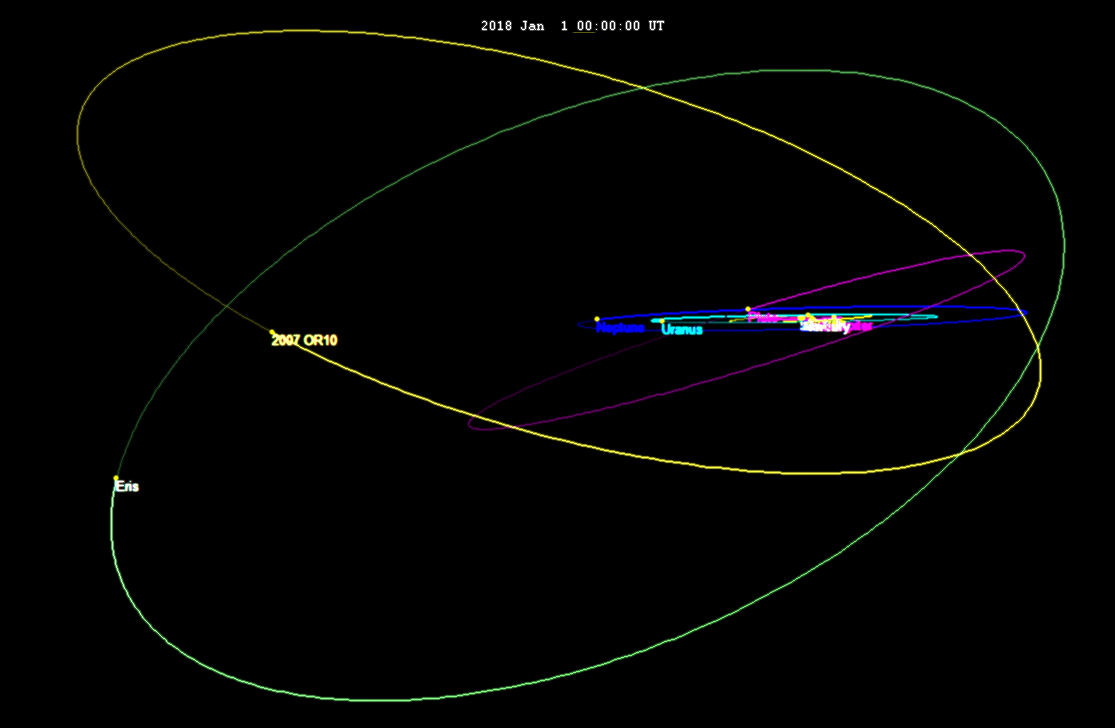
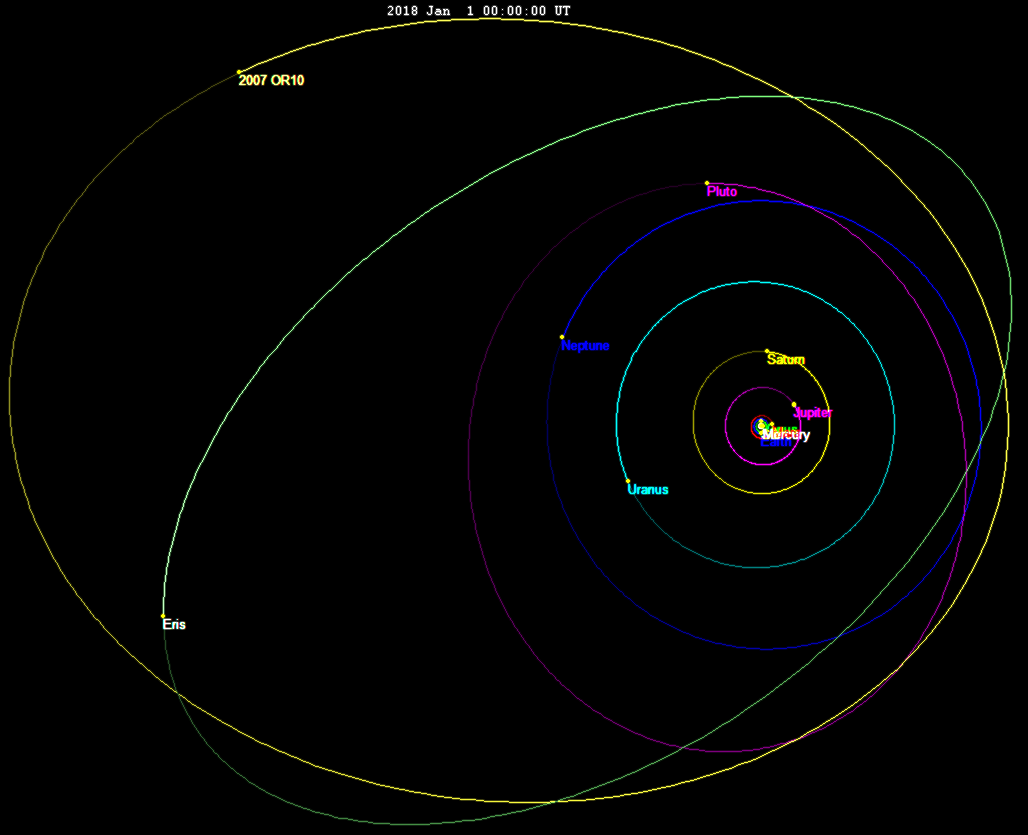
Eris orbits the Sun in a highly eccentric path that carries it far beyond the familiar planetary neighborhood. Classified as a scattered-disk trans-Neptunian object, it reached 96.3 astronomical units from the Sun in February 2016—more than triple the distance of Neptune or Pluto. For a time, Eris and its confirmed moon Dysnomia held the record as the most distant known natural objects in the Solar System, a title only relinquished in 2018 when 2018 AG37 and 2018 VG18 were identified. Despite its remoteness, Eris is no minor body: it is the most massive known dwarf planet, weighing in at 0.28 percent of Earth's mass and roughly 27 percent heavier than Pluto, even though Pluto edges it out slightly in volume. Its surface area rivals that of Russia or South America. Scientists suspect a second, potentially larger moon may orbit the system. To date, Eris remains the largest known object in the Solar System that no spacecraft has ever visited.
From Xena to the Goddess of Strife
For nearly two years, the object carried the bland provisional label 2003 UB313 while the astronomical community debated its classification. Behind the scenes, the discovery team had a more colorful nickname. Brown has explained that Xena—borrowed from the television warrior-princess series—was reserved for the first body they found that outshone Pluto. It began with X, evoked mythology, and fit their desire to feature more female deities alongside names like Sedna. The name was accidentally leaked when a New York Times reporter, a college friend of Brown's, asked what the team called it among themselves. Once the IAU's August 2006 ruling settled the planet question, the Caltech team formally proposed the Greek goddess Eris, personification of strife and discord, on September 6, 2006; the IAU assigned it on September 13. Pronunciation remains contested—some favor a short e, as Brown and his students do, while others prefer a long one. The English adjective, drawn from the Greek and Latin oblique stem, is Eridian.
Gallery
Frequently Asked Questions
Why is Eris more massive than Pluto?
Eris holds about 27% more mass than Pluto, making it the heaviest confirmed dwarf planet we have catalogued. Although its diameter is only slightly larger, its greater density pushes its total mass to roughly 0.28% of Earth's.
More in Astronomy 1-24
Spotted an error? Know more?
This is a living reference — every entry is fact-audited, and reader corrections feed straight into our audit queue. Suggest an edit · See this site's audit record