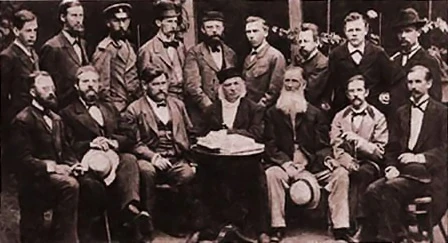
Henrietta Swan Leavitt
Discovered the period-luminosity relation for Cepheid variable stars.

via Wikipedia: List of women astronomers · see source
Henrietta Swan Leavitt was an American astronomer whose work fundamentally altered humanity’s grasp of the cosmos. Born in Lancaster, Massachusetts, to a Congregational church minister and his wife, she was a descendant of an early Puritan settler. Leavitt attended Oberlin College for two years before transferring to Radcliffe College, where she earned a bachelor’s degree in 1892. Her studies included classical Greek, philosophy, analytic geometry, and calculus, and she took a single astronomy course in her final year. After college, she began as a volunteer assistant at the Harvard College Observatory, working as a “human computer.” Under director Edward Charles Pickering, she was hired to measure and catalog the brightness of stars from photographic plates. Women at the observatory were not permitted to operate telescopes. Leavitt obtained graduate credits for her work but never completed the degree due to chronic illness. She left the observatory for trips to Europe and a stint as an art assistant, during which she contracted an illness that caused progressive hearing loss, eventually leaving her deaf. Returning in 1903, she was initially unpaid due to her financial independence, later earning 30 cents an hour. Pickering assigned her to study variable stars in the Magellanic Clouds using plates from Peru. She identified 1,777 variable stars and, in 1908, noted that brighter variables had longer periods. In a 1912 paper, she graphed the magnitude versus the logarithm of the period for 25 Cepheid variables in the Small Magellanic Cloud, establishing the period-luminosity relationship. Her key insight was that all stars in that cloud are roughly the same distance from Earth, so the apparent brightness differences reflected true differences in luminosity. This relationship, once calibrated by parallax measurements of nearby Cepheids, became the first reliable standard candle for measuring vast cosmic distances. Edwin Hubble later used Leavitt’s Law to prove that nebulae like Andromeda were separate galaxies, settling the Great Debate, and then combined it with redshifts to show the universe is expanding.
- field
- Astronomy
- nationality
- American
- known_for
- Discovery of the period-luminosity relationship for Cepheid variables (Leavitt's
Quick Facts
- Birth Date
- 1868-07-04
- Birth Place
- Lancaster, Massachusetts, U.S.
- Death Date
- 1921-12-12
- Death Place
- Cambridge, Massachusetts, U.S.
- Field
- Astronomy
- Workplaces
- Harvard University, Oberlin College
- Education
- Oberlin College · Society for the Collegiate Instruction of Women (BS)
- Known For
- Leavitt's Law: the period-luminosity relationship for Cepheid variables
Facts from the source article.
Lore & Background
Henrietta Swan Leavitt was born in Lancaster, Massachusetts, the daughter of a Congregational church minister. Leavitt suffered from progressive hearing loss and gradually became deaf. She determined that a straight line could be drawn showing a simple relation between the brightness of the Cepheid variables and their periods. Leavitt also developed the Harvard Standard for photographic measurements, a logarithmic scale ordering stars by brightness.
Reader's Guide
Leavitt’s work at the Harvard College Observatory involved measuring photographic plates to catalog the brightness and positions of stars, a task typical of the “human computers” employed there. While studying variable stars in the Small Magellanic Cloud, she identified hundreds of such stars and noticed that those with longer periods appeared brighter. In a later paper, she plotted the relationship between the logarithm of a star’s period and its magnitude for a sample of Cepheid variables, establishing a clear pattern. Her key insight was that all stars in the Small Magellanic Cloud are roughly the same distance from Earth, so the observed brightness differences reflected true differences in luminosity. This period-luminosity relation, later called Leavitt’s Law, became the first standard candle for measuring vast distances. Previously, astronomers relied on stellar parallax, which only worked for a few hundred light-years. After Leavitt’s death, Edwin Hubble applied her law to Cepheids in nebulae like Andromeda, finding them far too distant to be part of the Milky Way, thus proving these were separate galaxies. He later combined Leavitt’s Law with galactic redshifts to demonstrate that the universe is expanding. Leavitt’s discovery fundamentally shifted the understanding of the universe’s scale and nature, enabling modern cosmology.
Did You Know?
- Henrietta Swan Leavitt was the daughter of a Congregational church minister.
- Leavitt suffered from progressive hearing loss and gradually became deaf.
- She developed the Harvard Standard for photographic measurements, a logarithmic scale ordering stars by brightness.
- Leavitt determined that a straight line could be drawn showing a simple relation between the brightness of Cepheid variables and their periods.
- Hubble used Leavitt's Law together with galactic redshifts to establish that the universe is expanding.
Frequently Asked Questions
What is Henrietta Swan Leavitt's most famous discovery?
She identified the period-luminosity relationship in Cepheid variable stars—now called Leavitt's Law—which revealed that a Cepheid's pulsation period directly correlates with its intrinsic brightness. This relationship became the essential tool for measuring enormous distances across the cosmos.
Why is Henrietta Swan Leavitt important?
Her method for gauging astronomical distances fundamentally reshaped humanity's understanding of the universe's scale and structure. Without her work, later breakthroughs such as determining the true size of the Milky Way and confirming cosmic expansion would have been far more difficult to achieve.
What field did Henrietta Swan Leavitt work in?
She was an astronomer specializing in the study of variable stars, particularly Cepheids, at the Harvard College Observatory. Her research sat at the intersection of observational astronomy and the emerging discipline of astrophysics.
More in Astronomers And Astrophysicists 1-24
Spotted an error? Know more?
This is a living reference — every entry is fact-audited, and reader corrections feed straight into our audit queue. Suggest an edit · See this site's audit record