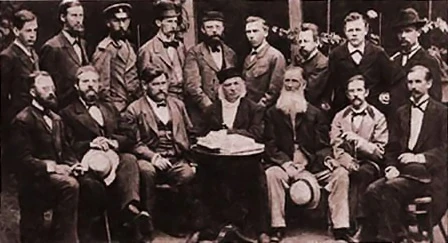
Giovanni Domenico Cassini

Giovanni Domenico Cassini, an Italian-French mathematician, astronomer, astrologer, and engineer, was born in Perinaldo, near Imperia, in the County of Nice, part of the Savoyard state. He began his career in Italy in 1648 at the Panzano Observatory near Bologna, working with the amateur astronomer Marquis Cornelio Malvasia, and completed his education under scientists Giovanni Battista Riccioli and Francesco Maria Grimaldi. In 1650, he was appointed principal chair of astronomy at the University of Bologna. While there, he observed a comet and wrote a book on it, and also served as a hydraulic engineer for the senate of Bologna, later becoming inspector of fortifications for Pope Alexander VII and director of waterways in the papal states. At the San Petronio Basilica, Cassini convinced church officials to install an improved sundial meridian line, using a pinhole gnomon 66.8 meters high to project a large image of the Sun onto the floor. By measuring the changing diameter of the Sun’s disk over a year, he concluded the variations were consistent with Johannes Kepler’s heliocentric theory that Earth orbits the Sun in an elliptical path. In 1669, Cassini moved to France at the invitation of Colbert, with the Pope’s reluctant assent, to help establish the Paris Observatory, which opened in 1671. He became a French citizen in 1673 and married Geneviève de Laistre, with whom he had two sons; his younger son, Jacques, succeeded him as astronomer. Cassini served Louis XIV as astronomer and astrologer for the remaining 41 years of his life, focusing primarily on astronomy. He discovered four satellites of Saturn—Iapetus, Rhea, Tethys, and Dione—and noted the division in Saturn’s rings later called the Cassini Division. He also observed surface markings on Mars, determined the rotation periods of Mars and Jupiter, and shared credit for discovering Jupiter’s Great Red Spot. In 1672, he and colleague Jean Richer made simultaneous observations of Mars from Paris and Cayenne, using parallax to calculate Mars’s distance from Earth, which enabled the first estimation of the Solar System’s dimensions. Cassini created the first scientific map of the Moon and began the project of producing a topographic map of France. He went blind in 1711 and died in Paris in 1712. The Cassini space probe, launched in 1997, was named after him.
- field
- Mathematics, astronomy, astrology, engineering
- nationality
- Italian-French
- known_for
- Discovery of four satellites of Saturn, Cassini Division, first scientific map o
Lore & Background
Giovanni Domenico Cassini, later known as Jean-Dominique Cassini, was an Italian-French mathematician, astronomer, astrologer, and engineer. Born in Perinaldo, near Imperia, in what was then the County of Nice, part of the Savoyard state, he began his career in Italy at the Panzano Observatory near Bologna, completing his education under Giovanni Battista Riccioli and Francesco Maria Grimaldi. He later became principal chair of astronomy at the University of Bologna. Cassini observed and published surface markings on Mars, determined the rotation periods of Mars and Jupiter, and discovered four satellites of Saturn: Iapetus and Rhea in 1671 and 1672, and Tethys and Dione in 1684. He correctly attributed Iapetus’s brightness variations to dark material on one hemisphere. In 1675, he noted the division in Saturn’s rings now called the Cassini Division. He also shares credit with Robert Hooke for discovering the Great Red Spot on Jupiter and was the first to observe differential rotation within Jupiter’s atmosphere. In 1672, he coordinated simultaneous observations of Mars with Jean Richer in Cayenne to compute its distance via parallax, enabling the first estimation of the Solar System’s dimensions. In France, he helped establish the Paris Observatory, becoming its director for life, and used his longitude method to produce the first accurate topographic map of France. He also created the first scientific map of the Moon.
Reader's Guide
Giovanni Domenico Cassini’s career began in Italy, where he worked at an observatory near Bologna under a wealthy amateur astronomer and completed his education under Riccioli and Grimaldi. He later held the principal chair of astronomy at the University of Bologna, observed a comet, and served as a hydraulic engineer and inspector of fortifications. At the San Petronio Basilica, he created an improved sundial meridian line, using a pinhole gnomon 66.8 meters from the floor to project the Sun’s image. Measuring the changing diameter of the solar disk over a year, he found the variations consistent with Kepler’s heliocentric theory of an elliptical Earth orbit. In France, he helped establish the Paris Observatory and became its director. His method of determining longitude was used to measure France’s size, revealing it smaller than thought. Cassini observed surface markings on Mars, determined the rotation periods of Mars and Jupiter, and discovered four Saturnian satellites: Iapetus, Rhea, Tethys, and Dione. He correctly attributed Iapetus’s brightness variations to dark material on one hemisphere. He also noted the division in Saturn’s rings, now called the Cassini Division, and observed differential rotation in Jupiter’s atmosphere. With Jean Richer, he used simultaneous Mars observations from Paris and Cayenne to compute parallax, yielding the first absolute scale of the Solar System. Cassini also began the topographic mapping of France and produced the first scientific map of the Moon.
Did You Know?
- He shared credit with Robert Hooke for the discovery of the Great Red Spot on Jupiter.
A Name Woven into French Astronomy
The Cassini surname stands out in any survey of French astronomical history, appearing not once but multiple times across the generations recorded in the nation's roster of notable contributors to the field. César-François Cassini de Thury, Dominique comte de Cassini, and Jacques Cassini each hold their own line among the distinguished names listed, clustered together in the C section of an alphabetically organized registry. This repetition of a single family name signals something remarkable: a lineage that sustained its presence in the highest echelons of French observational science across what must have been many decades. In a list that also features luminaries like Pierre-Simon Laplace, Joseph-Louis Lagrange, and Urbain Le Verrier, the Cassini entry is not a footnote but a recurring thread, suggesting that the family's contributions were not a single flash of brilliance but a sustained, multi-generational commitment to the study of the heavens and the mechanisms that govern them.
Generations at the Observatory
What strikes the reader most about the Cassini entries in the French astronomical register is their sheer numerical presence. Where most surnames appear only once—Arago, Flammarion, Messier, Charlois—the Cassini name recurs with César-François Cassini de Thury, Dominique comte de Cassini, and Jacques Cassini each claiming a separate line. This pattern implies a family tradition in which the study of celestial mechanics and observation was passed from one generation to the next, each member adding their own chapter to an ongoing scientific narrative. The inclusion of the title comte before one name hints at aristocratic standing, while the full patronymic de Thury attached to another suggests a specific territorial or noble identification. Together, these three entries paint a picture of a household in which astronomy was not merely a profession but an inherited vocation, one that persisted through the shifting political and social landscapes of France across successive eras of the republic and the crown.
Criteria of Distinction
The roster from which the Cassini family members are drawn is not a casual directory. Its stated purpose is to catalogue French astronomers, astrophysicists, and other notable figures who have made genuine contributions to the field. The qualifying bar is high: individuals must have won major prizes or awards, developed or invented widely used techniques or technologies within astronomy, or served as directors of major observatories or heads of space-based telescope projects. That three members of the Cassini lineage each clear this threshold speaks to the depth and breadth of their collective output. They were not merely observers recording positions of stars; they were, by the list's own criteria, architects of new methods, holders of institutional leadership, or recipients of the highest professional recognition. The fact that the family spans multiple entries rather than a single one reinforces that their impact was cumulative, each generation building upon and extending the work of the last in a tradition that the broader French astronomical community has seen fit to memorialize collectively.
Among the Titans of French Science
To place the Cassini name alongside the other entries in this register is to acknowledge a company of extraordinary caliber. The list moves from Abba Mari ben Eligdor at the top through to Charles Wolf at the bottom, encompassing figures like Camille Flammarion, Pierre Gassendi, Nicolas-Louis de Lacaille, and the legendary Pierre-Simon Laplace. It includes women such as Marie-Jeanne de Lalande, Nicole-Reine Lepaute, and Catherine Cesarsky, as well as pioneers of spectroscopy, planetary observation, and celestial mechanics. The Cassini entries sit within this constellation of names, neither isolated nor exceptional in their placement but fully integrated into a tradition that stretches from medieval scholars like Pope Sylvester II to modern astrophysicists. The broader context of the list—its references to the Astronomical Society of the Pacific and its cross-links to lists of women astronomers and Russian astrophysicists—frames the Cassini contribution as part of a global, interdisciplinary, and deeply historical conversation about the nature of the cosmos and humanity's place within it.
Frequently Asked Questions
Who is Giovanni Domenico Cassini?
Giovanni Domenico Cassini was an Italian-born astronomer, mathematician, and engineer who later became a French citizen. He lived from 1625 to 1712 and is best remembered for his groundbreaking observations of Saturn and its ring system.
What are Giovanni Domenico Cassini's major discoveries?
Cassini identified four moons orbiting Saturn and noticed a distinct gap in the planet's rings that still bears his name. He also produced the first scientifically accurate map of the Moon's surface.
What is the Cassini Division?
The Cassini Division is a prominent gap in Saturn's ring system that Cassini first observed in the late 1600s. It separates the brighter A ring from the C ring and remains one of the most recognizable features in Saturn's rings.
What did Cassini contribute to cartography?
He was the first member of his family to begin the massive project of creating a topographic map of France. He also crafted the first scientific map of the Moon, setting a new standard for celestial cartography.
Why is Giovanni Domenico Cassini important in astronomy history?
His discoveries of Saturn's moons and the ring division fundamentally changed humanity's understanding of the solar system. His work on lunar mapping and French topography also bridged pure astronomy with practical surveying science.
More in Astronomers And Astrophysicists 1-24
Spotted an error? Know more?
This is a living reference — every entry is fact-audited, and reader corrections feed straight into our audit queue. Suggest an edit · See this site's audit record