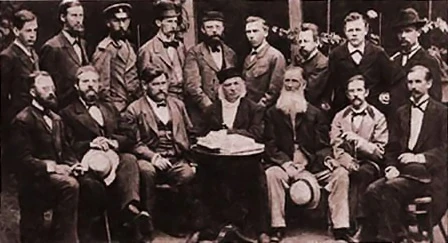
Heinrich Wilhelm Matthias Olbers
German astronomer who discovered asteroids and formulated Olbers's paradox.

Heinrich Wilhelm Matthias Olbers was a German astronomer and physician. Born in Arbergen, now part of Bremen, he studied medicine at the University of Göttingen, where he also studied mathematics. In 1779, while caring for a sick fellow student, he developed a new method for calculating the orbits of comets, which became the first satisfactory technique for this purpose and marked a significant advance in the field. After completing his medical degree in 1780, he practiced medicine in Bremen, devoting his nights to astronomy from an observatory he built in the upper floor of his home.
In 1800, Olbers was invited to join a group of astronomers known as the "celestial police," which sought to discover new planets. On 28 March 1802, he discovered and named the asteroid Pallas, and on 29 March 1807, he discovered the asteroid Vesta, allowing Carl Friedrich Gauss to name it. At the time, these objects were referred to as planets, as the term "asteroid" had not yet been coined. Olbers proposed that the asteroid belt was the remnant of a destroyed planet, though the current scientific view attributes its formation to tidal effects from Jupiter. On 6 March 1815, he discovered a periodic comet now named 13P/Olbers. He is also known for Olbers's paradox, which he described in 1823 and reformulated in 1826, arguing that the darkness of the night sky contradicts the idea of an infinite, eternal, static universe.
Olbers recognized the talent of the young Friedrich Wilhelm Bessel, arranging for the publication of Bessel's treatise on Halley's Comet in 1804. He was elected a Fellow of the Royal Society in 1804, a corresponding member of the Royal Institute of the Netherlands in 1809, a Foreign Honorary Member of the American Academy of Arts and Sciences in 1822, and a foreign member of the Royal Swedish Academy of Sciences in 1827. He represented his fellow citizens at the baptism of Napoleon II in 1811 and served in the corps législatif in Paris from 1812 to 1813. Olbers died in Bremen at age 81, survived by one son from two marriages.
- field
- Astronomy
- nationality
- German
- known_for
- Discovery of asteroids Pallas and Vesta; method for calculating cometary orbits; Olbers's paradox
Lore & Background
Heinrich Wilhelm Matthias Olbers was a German astronomer who devised the first reliable method for calculating cometary orbits. This breakthrough occurred in 1779 while he was still a medical student at Göttingen, where he also studied mathematics. After becoming a physician in 1780, he practiced medicine in Bremen by day and conducted astronomical observations at night from an observatory he built in the upper floor of his home. In 1802, he discovered the asteroid Pallas, and five years later, in 1807, he discovered the asteroid Vesta, allowing Carl Friedrich Gauss to name it. At the time, these objects were considered full planets. Olbers theorized that the asteroid belt was the remains of a destroyed planet, a view now largely replaced by the explanation that Jupiter’s tidal forces prevented planet formation there. In 1815, he discovered a periodic comet later designated 13P/Olbers. He is also remembered for Olbers’s paradox, which argues that the darkness of the night sky contradicts the idea of an infinite, eternal, static universe. Olbers was elected a Fellow of the Royal Society in 1804 and received other international honors. He served as a deputy at the baptism of Napoleon II in 1811 and was a member of the corps législatif in Paris from 1812 to 1813. He died in Bremen at age 81, was twice married, and was survived by one son.
Reader's Guide
Heinrich Wilhelm Matthias Olbers made lasting contributions to astronomy through both observational discoveries and theoretical insights. His discoveries of the asteroids Pallas and Vesta expanded knowledge of the Solar System and led to his hypothesis that the asteroid belt originated from a destroyed planet, a view later superseded by the understanding of Jupiter's tidal effects. His work also supported the career of Friedrich Wilhelm Bessel, whose treatise on Halley's Comet Olbers recognized and helped publish. The naming of a periodic comet, a minor planet, a lunar crater, and an albedo feature on Vesta after him reflects his enduring legacy. A statue in Bremen commemorates his contributions.
Frequently Asked Questions
What asteroids did Olbers discover?
Olbers identified two of the earliest known asteroids: Pallas and Vesta. These findings earned him a lasting place in the history of minor-planet discovery.
What is Olbers's paradox?
It is the question of why the night sky looks dark if the universe were truly infinite and uniformly filled with stars. Olbers raised this puzzle, and it has since become a cornerstone problem in cosmology.
What did Olbers contribute to cometary orbit calculations?
He devised a practical, streamlined method for computing the orbits of comets. This made it far easier for other observers to track cometary paths without resorting to lengthy, cumbersome calculations.
Why is Olbers considered important in the history of astronomy?
His legacy covers several fronts at once: discovering major asteroids, simplifying orbital mechanics, and posing a paradox that still shapes how we think about the structure of the universe. He bridged hands-on observation with deep theoretical questions.
More in Astronomers And Astrophysicists 1-24
Spotted an error? Know more?
This is a living reference — every entry is fact-audited, and reader corrections feed straight into our audit queue. Suggest an edit · See this site's audit record