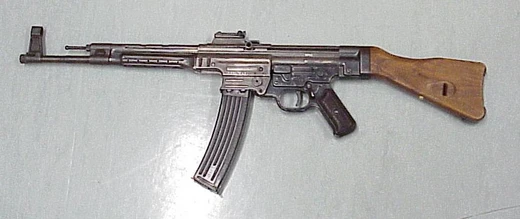
Excalibur rifle
Indian assault rifle derived from the INSAS, with improved reliability.

The Excalibur is an assault rifle based on the INSAS rifle, which is the standard firearm of the Indian Armed Forces and, to a lesser extent, the Indian Police Service. It features several upgrades over the INSAS and was intended to become the Indian Army’s main assault rifle, but in September 2016 the Army opened a tender for a replacement. The weapon is produced by the Ordnance Factory Board at Rifle Factory Ishapore. Development of the Excalibur began in 2004. A prototype used a direct gas-tapping angle to lower recoil and offered automatic and single-shot firing modes, dropping the three-round burst of the INSAS. It had a folding stock and a standard Picatinny rail. By September 2015, the prototype had passed water and mud tests that four foreign rifles in the tender competition had failed. Around 200 rifles were being manufactured at that time, with formal trials expected in late 2015. The Modified INSAS Rifle (MIR), based on the Excalibur, experienced two stoppages after 24,000 rounds, close to the Army’s requirement of one stoppage. Another prototype, the AR-2, was being prepared to fire 7.62×39mm ammunition. The final design included Picatinny rails on the upper receiver and an improved polycarbonate magazine. The Indian Army used the INSAS from the late 1990s, including during the Kargil War, but the rifle faced reliability problems such as cracking polymer magazines in cold weather, oil spraying into the user’s eyes, and unintended automatic fire when set to three-round burst. The Excalibur was displayed at the Defence Services Asia convention from April 21 to 24, 2008. In November 2011, the Indian Army sent a request for proposal to 34 vendors for 65,678 multi-calibre assault rifles worth about ₹2,500 crore, with a license to manufacture roughly 100,000 more in India, totaling an estimated ₹5,500 crore. Similar tenders for a carbine and a light machine gun were also issued. On June 15, 2015, the Army informed manufacturers that the tender was withdrawn. In July 2015, reports indicated that the INSAS might be replaced by the MIR, based on the Excalibur, a decision supported by General Dalbir Singh, who favored an indigenous rifle. After canceling the tender, the Army pursued the Excalibur, developed by the ARDE, as a replacement.
Quick Facts
- Origin
- India
- Is Ranged
- Yes
- Service
- 2017
- Design Date
- 2004
- Manufacturer
- Rifle Factory Ishapore
- Production Date
- 2012–present
- Number
- 20,000+
- Weight
- 3.81 kg (without magazine) / 4.03 kg (with full magazine)
- Length
- 895 mm
- Part Length
- 400 mm
- Cartridge
- 5.56×45mm NATO
- Action
- Gas-operated, rotating bolt
Facts from the source article.
Lore & Background
Design of the Excalibur assault rifle first started in 2004. The prototype incorporated a direct gas-tapping angle to reduce recoil and offered automatic and single shot modes, dropping the three-round burst mode of the INSAS. It featured a folding butt and a standard Picatinny rail. By September 2015, the rifle had passed water and mud tests that four foreign rifles in a tender competition had failed; it was reported that 200 rifles were being manufactured and that the prototype would undergo formal trials in late 2015. The Indian Army had used the INSAS rifle from the late 1990s, seeing action during the Kargil War, but the INSAS was plagued with reliability issues including cracking polymer magazines in cold weather, oil spraying into the user's eyes, and the rifle going into automatic mode when set on three-round burst. The Excalibur was shown at the Defence Services Asia convention from April 21 to 24, 2008. In November 2011, the Indian Army sent a request for proposal to 34 vendors for 65,678 multi-calibre assault rifles, but the tender was retracted in June 2015. In July 2015, it was reported that the INSAS might be replaced by the Modified INSAS rifle (MIR), based on the Excalibur, a decision taken by General Dalbir Singh. After cancelling the tender, the Army decided to pursue the Excalibur as a replacement. On 3 July 2016, Indian media reported that the Army had rejected the Excalibur for its standard issue as it did not match requirements. In September 2016, the Army launched a tender for 185,000 7.62×51mm-caliber assault rifles, but in October 2016 announced that Excalibur rifles would be adopted as an interim assault rifle until a suitable replacement was found. In June 2017, the Excalibur was announced to have failed tests due to concerns about quality control and ineffective firepower.
Reader's Guide
The Excalibur represents a significant attempt by India to develop an indigenous replacement for the INSAS rifle, addressing the INSAS's well-documented reliability problems. Its design incorporated lessons learned from the INSAS, such as eliminating the problematic three-round burst mode and adding a Picatinny rail for modern accessories. The rifle's development and testing occurred alongside a complex procurement process in which the Indian Army issued and then retracted a large tender for multi-calibre rifles, ultimately deciding to pursue the Excalibur before rejecting it for standard issue in 2016. Despite failing to become the Army's primary rifle, the Excalibur was adopted as an interim weapon and saw limited procurement by several Indian state police forces, including Assam, Chhattisgarh, Karnataka, Manipur, and West Bengal. Its legacy is mixed: it demonstrated indigenous design capability but failed to meet the Army's standards, leading to a new tender for 7.62×51mm rifles. The Excalibur also saw use by the non-state group People's Liberation Army of Manipur, indicating its presence beyond official channels.
Did You Know?
- The Indian Army adopted the Excalibur as an interim assault rifle in October 2016.
- The Excalibur was announced to have failed tests in June 2017 due to quality control and ineffective firepower.
More in Assault Rifles, Part 2 1-24
Spotted an error? Know more?
Reader corrections go straight into our review queue. Suggest an edit · How this site is sourced