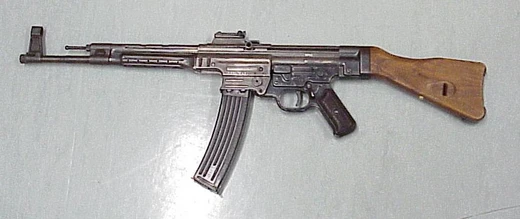
CETME Model L
Spanish 5.56mm assault rifle replacing the CETME Model C.

The CETME Model L is a Spanish assault rifle chambered in 5.56×45mm NATO, developed in the late 1970s by the state-owned research institute CETME in Madrid. It borrows heavily from the design of the earlier CETME Model 58 battle rifle. After successful trials between 1981 and 1982, serial production was approved in 1984 at the Empresa Nacional Santa Bárbara factory. The Model L replaced the 7.62mm CETME Model C in Spanish Army service, with the first rifles delivered in 1987 following orders for roughly 60,000 units.
The rifle operates via roller-delayed blowback, using a two-piece bolt with a bolt head and a locking piece. Two cylindrical rollers in the bolt head are cammed inward during unlocking, driving the bolt carrier rearward at a higher speed than the bolt itself. The bolt remains closed until the bullet exits the barrel and chamber pressure drops to a safe level. The extractor is on the bolt, while the ejector sits inside the trigger housing, lifted by a spring and timed by the recoiling bolt carrier. The hammer-fired weapon has a fire control lever on the left side of the receiver, above the pistol grip, serving as both safety and selector. Settings are "S" (safe), "T" (semi-automatic), and "R" (fully automatic). Early production rifles also had a burst option, later dropped. The Model L fires from a closed bolt and uses NATO-standard 5.56×45mm ammunition with the 62-grain SS109 projectile. Ammunition made by INI (a state factory) was dirtier and produced higher chamber pressure than standard NATO rounds, causing reliability issues; hard primers also contributed. During NATO exercises, foreign units were often warned not to use Spanish ammo in gas-operated rifles.
The barrel has six right-hand grooves with a 1:178 mm twist rate and is fitted with a three-prong or later "birdcage" flash suppressor, both capable of launching rifle grenades. A knife-type bayonet can be mounted. The fixed stock, pistol grip, and handguard are made of high-strength lightweight plastic. The rifle disassembles into the receiver, stock, pistol grip and trigger group, handguard, bolt, bolt carrier, and recoil mechanism. Early handguards were square in section and covered from the magazine well to the front sight, but retained heat poorly. They were later replaced by round, half-length handguards made of thicker plastic over a full-length stamped steel support.
Quick Facts
- Origin
- Spain
- Is Ranged
- Yes
- Service
- 1987–present
- Used By
- Spain, Malawi, Ukraine
- Designer
- CETME
- Design Date
- 1981
- Production Date
- 1986–1991
- Variants
- Model LC, Model LV
- Weight
- 3.4 kg (Model L) / 3.55 kg
- Length
- 925 mm (Model L) / 860 mm stock extended / 665 mm stock collapsed (Model LC)
- Part Length
- 400 mm (Model L) / 320 mm (Model LC)
- Cartridge
- 5.56×45mm NATO
Facts from the source article.
Lore & Background
The CETME Model L is a selective fire, roller-delayed blowback firearm with a semi-rigid two-piece bolt mechanism. During unlocking, two cylindrical rollers in the bolt head are cammed inward against the barrel extension, propelling the bolt carrier rearward faster than the bolt head, which remains closed until chamber pressure drops. The weapon fires from a closed bolt and uses the NATO-standard 5.56×45mm cartridge with the 62-grain SS109 projectile. The safety and fire selector lever on the left side of the receiver has three settings: 'S' (safe), 'T' (semi-automatic), and 'R' (fully automatic); initial production rifles also had a burst selector option that was abandoned.
The rifle's barrel features a 3-prong flash suppressor (later a 'birdcage' style), both designed to launch rifle grenades. The fixed stock, pistol grip, and handguard are made of high-strength lightweight plastic. Early handguards were square in section and caused heat retention problems, leading to a round 'half length' handguard of thicker plastic over a full-length stamped steel support piece. Most military rifles received the new handguard, but Guardia Civil rifles retained the squared version. The rifle feeds from standard NATO STANAG magazines, but issued steel magazines had thick walls that caused misfeeds and stuck magazines; soldiers often sought out other STANAG magazines from surplus stores or from US troops during NATO exercises.
The Model L is equipped with adjustable iron sights: a forward post (thin or thick version) and a flip-up rear sight with 200 and 400 m settings (early models had a rotating drum rear sight with 100, 200, 300, and 400 m apertures). The Model LV marksman variant uses a fixed STANAG mount for a 4-power ENOSA scope; an alternate version for the Spanish Marines uses a dovetail mount for the British SUSAT scope. A carbine variant, the Model LC, has a short barrel and collapsible metal stock but cannot use a bayonet or rifle grenades.
Reader's Guide
The CETME Model L represents the Spanish military's transition from the 7.62mm CETME Model C to the NATO-standard 5.56×45mm cartridge, a shift that aligned with broader alliance trends in the 1980s. Its roller-delayed blowback mechanism, inherited from earlier CETME designs, offered a proven operating principle, though the rifle faced notable reliability issues. These problems stemmed partly from Spanish-made INI ammunition, which produced higher chamber pressure and had hard primers, and partly from the issued steel magazines, which were prone to misfeeds and could not be discarded despite being intended as expendable. Spanish soldiers often circumvented these issues by using non-issued STANAG magazines from other NATO forces. The Model L served as the standard Spanish Army rifle from 1987 until it was largely replaced from 1999 onward by a license-built variant of the Heckler & Koch G36E. Its variants—the LC carbine and the LV marksman—addressed specific roles, and the rifle has seen use by Spain, Malawi, and Ukraine. In the United States, the CETME L is available as a civilian legal firearm through MarColMar Firearms LLC, using original parts sets with new US-made receivers and barrels.
Did You Know?
- The CETME Model L was developed at the state-owned CETME establishment in Madrid.
- The rifle's issued steel magazines were supposed to be expendable at 25 pesetas each, but soldiers were forbidden to discard them.
- Spanish soldiers at NATO exercises often searched for discarded US magazines to replace their own problematic ones.
- The Model LC carbine cannot mount a bayonet or launch rifle grenades.
Frequently Asked Questions
What is the CETME Model L?
It is a Spanish 5.56×45mm NATO assault rifle developed by the state-owned CETME research institute in Madrid during the late 1970s. Its design is a direct evolution of the earlier CETME Model 58 battle rifle, adapted to the smaller NATO cartridge.
How does the CETME Model L's action work?
It fires via a roller-delayed blowback system built around a two-piece bolt, a mechanism carried over from CETME's 7.62mm lineage. The rifle feeds from standard 30-round STANAG magazines, with 12-round box magazines also available as an option.
Why did Spain replace the CETME Model C with the Model L?
The switch to 5.56×45mm NATO brought Spain in line with allied interoperability standards, retiring the older 7.62mm Model C. After successful trials in 1981–82, serial production was green-lit in 1984 at the Empresa Nacional Santa Bárbara plant, and the first roughly 60,000 rifles reached the army in 1987.
What variants of the CETME Model L were produced?
CETME offered a shorter Model LC carbine, a Model LV marksman configuration, and an LV/S variant alongside the standard Model L. All share the same roller-delayed blowback action and 5.56mm chambering.
What are the CETME Model L's key barrel and sight specs?
The barrel carries six right-hand grooves with a 1:7-inch (178 mm) twist rate, suited to the SS109 5.56mm round. Sights consist of a forward post and a flip-up rear aperture with 200 m and 400 m graduations.
More in Assault Rifles, Part 2 1-24
Spotted an error? Know more?
Reader corrections go straight into our review queue. Suggest an edit · How this site is sourced