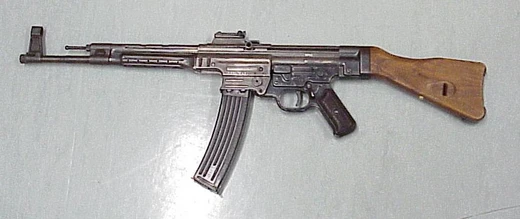
ArmaLite AR-18
A stamped-steel 5.56mm rifle that influenced later military designs.

The ArmaLite AR-18 is a gas-operated rifle chambered for 5.56×45mm NATO ammunition. Designed in 1963 at ArmaLite in California by Arthur Miller, Eugene Stoner, George Sullivan, and Charles Dorchester, it was intended as an alternative to the Colt AR-15 design, a variant of which had just been selected by the U.S. military as the M16. Although never adopted as the standard service rifle of any nation, its production license was sold to companies in Japan and the United Kingdom, and it is said to have influenced many later weapons.
Quick Facts
- Origin
- United States
- Is Ranged
- YES
- Wars
- Communist insurgency in Malaysia / Lebanese Civil War / The Troubles / Mexican drug war
- Designer
- Arthur Miller / Eugene Stoner (AR-16)
- Design Date
- 1963
- Manufacturer
- ArmaLite (U.S.) / Howa (Japan) / Elisco Tool / Eagle Arms (Philippines) / Sterling Armaments Company (UK)
- Production Date
- 1969–1985
- Weight
- 6.7 lb (empty) / 7.18 lb (loaded w/20 rd. magazine)
- Length
- 38 in
- Part Length
- 18.25 in (6-groove rifling)
- Cartridge
- 5.56×45mm NATO
- Action
- Short-stroke piston, rotating bolt
Facts from the source article.
Lore & Background
The AR-18 emerged from ArmaLite's need to develop a 5.56mm rifle that did not infringe on Colt's license for the AR-15, after the U.S. military adopted the AR-15 as the M16. Its design was a scaled-down version of the earlier AR-16, a 7.62mm NATO rifle that Eugene Stoner had created as a low-cost alternative for smaller nations. The AR-16 itself had evolved from the AR-12, changing from a direct-impingement system to a short-stroke gas piston after ArmaLite sold the DI system rights to Colt. Only three examples of the AR-16 were built. With Stoner gone, Arthur Miller led the scaling-down project, and the resulting AR-18 appeared in 1963; Miller received U.S. patent 3,246,567 for the rifle in 1969.
The AR-18 used stamped and welded sheet metal construction, a method pioneered by the Germans in World War II and later adopted for the Soviet AKM, but still uncommon in Western military rifles in the early 1960s. This construction faced criticism compared to the finer tolerances of the AR-15, but the rifle proved reliable and accurate up to 460 metres. Its simple design promised reduced production costs and allowed license production on less advanced machinery. The action employed a short-stroke gas piston above the barrel, a bolt with seven locking lugs, and two metal guide rods with return springs. The cocking handle reciprocated with the bolt carrier, and its slot had a spring-loaded cover. The side-folding stock was noted as less than adequately rigid. Magazines were of a proprietary design, initially incompatible with AR-15 magazines, though later Sterling steel magazines could feed from an AR-15.
Reader's Guide
The AR-18's significance lies primarily in its influence on later weapons rather than its own adoption. Although it never became a standard service rifle for any nation, its production license was sold to companies in Japan and the United Kingdom, and it is said to have influenced designs such as the British SA80, the Singaporean SAR-80 and SR-88, the Belgian FN F2000, the Japanese Howa Type 89, and the German Heckler & Koch G36. The rifle's stamped steel construction, while criticized at the time, proved to be a cost-effective manufacturing method that allowed local production on less advanced machinery, reducing dependence on foreign manufacturers. A semi-automatic version, the AR-180, was later produced for the civilian market. The AR-18's design incorporated several clever touches, such as the bolt guide rod assembly that also served as the latch holding the upper and lower receivers together. Its compact design allowed the use of a side-folding stock, though the hinging mechanism was less than adequately rigid. The rifle's legacy is thus more as a design influence and a proof-of-concept for affordable, license-produced military rifles than as a frontline service weapon.
Did You Know?
- The AR-18 was designed by Arthur Miller, Eugene Stoner, George Sullivan, and Charles Dorchester in 1963.
- Only three examples of its predecessor, the AR-16, were ever built.
- The AR-18's stamped steel construction was still uncommon in Western military rifles in the early 1960s.
- A semi-automatic version for the civilian market was known as the AR-180.
Frequently Asked Questions
What is the ArmaLite AR-18?
The ArmaLite AR-18 is a 5.56×45mm NATO assault rifle developed in 1963 at ArmaLite's California facility as a direct competitor to the Colt AR-15 design that had just been selected as the U.S. M16. It features a stamped-steel body and a short-stroke gas-piston operating system.
Who designed the ArmaLite AR-18?
The rifle was the collaborative work of four ArmaLite engineers—Arthur Miller, Eugene Stoner, George Sullivan, and Charles Dorchester—who put the design together in 1963.
How does the AR-18's action differ from the M16?
Instead of the M16's direct-impingement gas system, the AR-18 cycles through a short-stroke gas piston, which keeps hot combustion gases away from the bolt and generally simplifies cleaning. This piston-driven layout is one of the design's most frequently cited mechanical distinctions.
Was the ArmaLite AR-18 ever adopted by a national military?
No country selected it as its standard-issue service rifle, though production licenses were sold to manufacturers in Japan and the United Kingdom. Despite the lack of a formal adoption, the design is widely regarded as having shaped several later military firearms.
What are the AR-18's range and weight figures?
The rifle is rated for an effective range of roughly 460 metres (about 500 yards) and, based on its AR-16 predecessor, weighs approximately 8.75 pounds when empty.
More in Assault Rifles, Part 2 1-24
Spotted an error? Know more?
Reader corrections go straight into our review queue. Suggest an edit · How this site is sourced