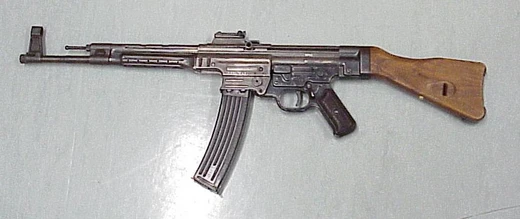
ArmaLite AR-15
Parent of the M16 and Colt AR-15 rifle families.

The ArmaLite AR-15 is a gas-operated assault rifle that was produced in the United States from 1959 to 1964. It was created in 1956 by the American firearms company ArmaLite, building on the design of their earlier AR-10 rifle. The weapon was intended to be lightweight and to use a new, fast-moving, small-caliber round that would let soldiers carry more ammunition. Because of financial problems and a lack of workers and production capacity, ArmaLite sold the rights to the AR-15 to Colt in 1959. Colt made changes, most notably moving the charging handle from under the carrying handle—as it was on the AR-10—to the back of the receiver. Colt called this version the Colt 601, but it still bore ArmaLite markings due to a contract with ArmaLite and Fairchild Aircraft Co. Colt then marketed the redesigned rifle to military forces worldwide. The U.S. military adopted it in January 1962, and it was officially designated the M16 rifle in December 1963, entering production and service in 1964. Colt kept using the AR-15 trademark for its semi-automatic-only rifles sold to civilians and law enforcement, known as the Colt AR-15. The ArmaLite AR-15 is the basis for many later Colt AR-15 and M16 variants.
Quick Facts
- Service
- 1962–1963
- Wars
- Vietnam War / Indonesia–Malaysia confrontationUsed by Indonesian forces.
- Designer
- Eugene Stoner (AR-10) · L. James Sullivan · Bob Fremont
- Length
- 39 in
- Action
- Gas-operated, closed rotating bolt, Stoner bolt and carrier piston
- Origin
- United States
- Is Ranged
- Yes
- Design Date
- 1956
- Manufacturer
- ArmaLite / Colt's Manufacturing Company
- Production Date
- 1959–1964
- Weight
- 6.55 lb unloaded / 7.30 lb with 20-round magazine
- Part Length
- 20 in
Facts from the source article.
Lore & Background
After World War II, the United States military sought a single automatic rifle to replace several existing weapons. Early experiments with select-fire M1 Garands proved disappointing, and the .30 Carbine round used in the M2 Carbine was found under-powered during the Korean War. American weapons designers recommended a small-caliber, high-velocity cartridge, but senior commanders insisted on a powerful .30 caliber round, leading to the 7.62×51mm NATO cartridge and the adoption of the M14 rifle. However, early confrontations between the AK-47 and the M14 in the Vietnam War showed the M14 uncontrollable in full-auto and that soldiers could not carry enough ammunition to maintain fire superiority. The M2 Carbine was outclassed by the AK-47. The Army was forced to reconsider a 1957 request for a .223 caliber select-fire rifle weighing 6 lb when loaded. This request led to a scaled-down version of the ArmaLite AR-10, called the ArmaLite AR-15. In 1958, ArmaLite submitted ten AR-15s for testing, which found that a five to seven man team armed with AR-15s had the same firepower as an 11-man team with M14s, and soldiers could carry three times more ammunition. The AR-15 was also found three times more reliable than the M14. However, General Maxwell Taylor vetoed the AR-15 in favor of the M14. In 1959, ArmaLite, frustrated with lack of results and suffering financial difficulties, sold its rights to the AR-10 and AR-15 to Colt.
Reader's Guide
The ArmaLite AR-15 is notable as the direct parent of the M16 rifle and the civilian Colt AR-15 line. After Colt acquired the rights, the rifle was redesigned for mass production and rebranded as the Colt ArmaLite AR-15 Model 01. Colt marketed the rifle to military services worldwide, and it was eventually adopted by the U.S. military in January 1962, later designated the M16 rifle in December 1963, entering production and service in 1964. The AR-15's development was driven by the need for a lightweight, small-caliber rifle that allowed infantrymen to carry more ammunition, a lesson learned from the limitations of the M14 and M2 Carbine in Vietnam. The 5.56 mm cartridge's wounding effects, initially attributed to tumbling, were later understood to result from bullet fragmentation due to velocity and construction. The AR-15's legacy is defined by its role as the basis for the M16, which became the standard U.S. service rifle, and for the widespread civilian AR-15 platform, which Colt continued to produce as a semi-automatic-only rifle for civilian and law-enforcement customers.
Did You Know?
- The ArmaLite AR-15 was based on the earlier AR-10 rifle.
- ArmaLite sold its rights to the AR-15 to Colt in 1959 due to financial difficulties.
- The AR-15 was found to be three times more reliable than the M14 rifle in 1958 tests.
- The 5.56 mm cartridge's devastating wounds in Vietnam were caused by bullet fragmentation, not tumbling.
Frequently Asked Questions
What is the ArmaLite AR-15?
The ArmaLite AR-15 is a lightweight, gas-operated assault rifle that was manufactured in the United States between 1959 and 1964. It was designed by the American firearms company ArmaLite in 1956 as an evolution of their earlier AR-10 platform.
What cartridge does the ArmaLite AR-15 use and why was that significant?
It fires the 5.56 mm (.223 caliber) round, a fast-moving small-caliber cartridge chosen so that infantrymen could carry substantially more ammunition than with larger rounds. This lightweight, high-velocity approach became a defining feature of modern military small arms.
Why did ArmaLite stop making the AR-15?
ArmaLite ran into serious financial difficulties and simply lacked the workforce and production capacity to keep the rifle in its own factory. In 1959 the company sold the AR-15 rights to Colt, which then modified the design—most notably relocating the charging handle from beneath the carrying handle.
Why is the ArmaLite AR-15 considered important in firearms history?
It is the direct ancestor of both the M16 and the Colt AR-15 rifle families, making it the foundational platform for one of the most widely used military and civilian rifle lineages in the world. Without ArmaLite's 1956 design, the entire .223/5.56 assault-rifle ecosystem that followed would not exist.
Who designed the ArmaLite AR-15 and what came before it?
The rifle was created by the ArmaLite company in 1956, building directly on the lessons and design elements of their earlier AR-10 rifle. ArmaLite served as both the original designer and the first manufacturer before the rights transferred to Colt.
More in Assault Rifles, Part 2 1-24
Spotted an error? Know more?
Reader corrections go straight into our review queue. Suggest an edit · How this site is sourced