The Little Mermaid (1989 film)
A 1989 animated film that revived Disney feature animation.

Original: The Walt Disney Company Vector: TheWanderingTraders · Public domain
The 1989 American animated musical fantasy film *The Little Mermaid* was written and directed by John Musker and Ron Clements, with production by Musker and Howard Ashman. Ashman also co-wrote the songs with composer Alan Menken. Loosely adapting Hans Christian Andersen's 1837 Danish fairy tale, the movie was made by Walt Disney Feature Animation alongside Silver Screen Partners IV and distributed by Walt Disney Pictures. Its voice cast includes Jodi Benson, Christopher Daniel Barnes, Pat Carroll, and Samuel E. Wright, among others. The plot centers on Ariel, a teenage mermaid princess who longs to become human after falling for Prince Eric, leading her to strike a deal with the sea witch Ursula.
Walt Disney had once considered including the story in a package film of Andersen's tales but abandoned the idea. In 1985, while working on *The Great Mouse Detective*, Clements and Musker decided to adapt the fairy tale. They pitched it to studio chairman Jeffrey Katzenberg, who initially rejected it due to similarities to a proposed *Splash* sequel, but later approved it. Ashman joined the project and brought in Menken. Under Katzenberg's supervision, they crafted a Broadway-style structure with musical numbers while the staff worked on *Oliver & Company*. Katzenberg initially worried the film would underperform because it appealed to female audiences, but he eventually believed it could be another blockbuster.
Released on November 17, 1989, *The Little Mermaid* earned critical praise for its animation, music, and characters. It was a commercial success, grossing $84 million domestically in its initial run and $235 million worldwide, making it the sixth-highest-grossing film of 1989. Alongside *The Great Mouse Detective*, *Who Framed Roger Rabbit*, and *Oliver & Company*, it is credited with revitalizing Disney animated features after a rough period and launching the Disney Renaissance. The film won two Academy Awards: Best Original Score and Best Original Song for "Under the Sea."
Its success spawned a media franchise. A prequel TV series aired on CBS from 1992 to 1994, followed by a direct-to-video sequel in 2000 about Ariel's daughter Melody and a prequel in 2008.
Quick Facts
- Director
- John Musker / Ron Clements
- Producer
- Howard Ashman / John Musker
- Based On
- "The Little Mermaid" · Hans Christian Andersen
- Starring
- René Auberjonois / Christopher Daniel Barnes / Jodi Benson / Pat Carroll / Paddi Edwards / Buddy Hackett / Jason Marin / Kenneth Mars / Ben Wright / Samuel E. Wright
- Music
- Alan Menken
- Editing
- Mark Hester
- Production Companies
- Walt Disney Feature Animation
- Released
- 17 November 1989
- Runtime
- 83 minutes
- Country
- United States
- Language
- English
- Budget
- $40 million
Facts from the source article.
Lore & Background
Walt Disney had planned to include the story in a proposed package film of Andersen's tales but scrapped the project. In 1985, while working on The Great Mouse Detective, Clements and Musker decided to adapt the fairy tale. They proposed it to studio chairman Jeffrey Katzenberg, who initially declined due to similarities to a proposed sequel to Splash, but ultimately approved it. Ashman and Menken created a Broadway-style structure with musical numbers as the staff worked on Oliver & Company. Katzenberg warned the film would earn less because it appealed to female viewers but later became convinced it would be a blockbuster.
Reader's Guide
The Little Mermaid was released on November 17, 1989, to critical acclaim and commercial success, earning $84 million domestically initially and $235 million worldwide, making it the sixth-highest-grossing film of 1989. Along with The Great Mouse Detective, Who Framed Roger Rabbit, and Oliver & Company, it is credited with revitalizing Disney animated features after an uneven period and starting the Disney Renaissance. It won two Academy Awards for Best Original Score and Best Original Song ("Under the Sea"). The film's success led to a media franchise including a prequel TV series, direct-to-video sequels, a stage musical, a live television presentation, and a 2023 live-action adaptation. In 2022, it was selected for preservation in the United States National Film Registry as culturally, historically, or aesthetically significant.
Development & Creative Vision
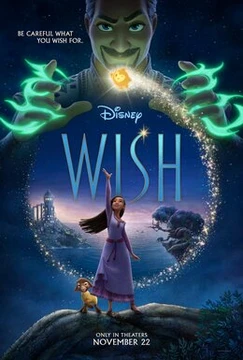
The journey from concept to screen for Wish stretched across nearly half a decade. Creative work kicked off in 2018, yet the project remained under wraps until January 2022, when industry reports first confirmed that Jennifer Lee was developing an original feature at Walt Disney Animation Studios. By September of that year, the title had been officially unveiled alongside the casting of Ariana DeBose and Alan Tudyk. Chris Buck and Fawn Veerasunthorn, who had previously collaborated with Lee on Frozen and its sequel, were locked in as co-directors, and Allison Moore was brought on to co-write the screenplay. The musical score was handled by Julia Michaels and Benjamin Rice, while longtime Disney orchestrator Dave Metzger composed the instrumental score. The film was conceived as a centennial celebration, weaving together the recurring Disney motif of wishes being fulfilled and positioning itself as the origin tale for the beloved wishing star. Visually, the production blended computer-generated imagery with the aesthetic sensibility of hand-drawn animation, giving the story a distinctly painterly quality.
Narrative & Thematic Core
Set on a Mediterranean island kingdom called Rosas, the story centers on seventeen-year-old Asha, who discovers that her sorcerer-king Magnifico has been hoarding the sealed wishes of his citizens rather than truly granting them. After her attempt to secure her grandfather's wish is rebuffed, Asha makes a desperate plea to the night sky and is answered by a living, luminous star that descends to earth. This star grants the kingdom's animals the gift of speech and reveals a profound truth: every living thing is composed of stardust. As Asha and her new companion work to liberate the trapped wishes, Magnifico—paranoid and increasingly desperate—turns to forbidden dark magic to cling to power. A trusted friend, Simon, betrays Asha in exchange for a knightly title, only to be bewitched into servitude. The climax hinges not on individual heroism but on collective will: when the citizens of Rosas unite in a shared wish for a better future, their combined desire shatters Magnifico's control, frees the star, and ultimately traps the sorcerer within his own staff's mirror. Queen Amaya then steps forward as the sole ruler, helping her people pursue their dreams independently.
Box Office & Critical Reception
Wish opened its theatrical run with a premiere at the El Capitan Theatre in Hollywood on November 8, 2023, followed by a wide U.S. release on November 22. Critical response was notably divided, with reviewers offering mixed assessments of the film's storytelling and animation. At the global box office, the picture collected approximately $255 million against a reported production budget in the range of $175 to $200 million. Industry analysts subsequently classified it as a box-office bomb, estimating that even after factoring in revenue from streaming platforms and home-entertainment sales, the studio absorbed a loss of roughly $131 million. However, the film found a second life on Disney+, where it registered as the third most-watched premiere among titles produced by Walt Disney Animation Studios, suggesting a strong audience appetite for the story once it became accessible at home. On the awards circuit, Wish earned a nomination for the Golden Globe Award for Best Animated Feature Film, acknowledging its place in the year's competitive animated slate despite its commercial underperformance.
Centennial Significance & Legacy
Conceived as a milestone project marking Disney's one-hundredth anniversary, Wish was deliberately designed to thread together the wish-fulfillment motif that runs through the studio's entire animated canon. The filmmakers positioned the picture as the origin story for the wishing star—a small but meaningful addition to Disney mythology that gives audiences a narrative explanation for a symbol they have recognized since childhood. The voice cast, led by Ariana DeBose as the spirited Asha and Chris Pine as the antagonistic Magnifico, was joined by Alan Tudyk, Angelique Cabral, Victor Garber, and Natasha Rothwell. Director Chris Buck described his protagonist as an energetic, community-minded young woman who takes pride in her home, while co-writer Allison Moore emphasized that Magnifico's villainy stems from a fundamental misunderstanding of what wishes represent to the people who make them. The decision to merge computer-generated tools with the visual language of traditional hand-drawn animation further underscored the film's intent to honor the studio's heritage while looking forward, making it a thematic and stylistic bookend for the centennial era.
Gallery
Frequently Asked Questions
What is The Little Mermaid (1989 film)?
It is a 1989 Disney animated musical fantasy directed by John Musker and Ron Clements, loosely inspired by Hans Christian Andersen's 1837 Danish fairy tale. The story follows Ariel, a teenage mermaid princess, as she makes a dangerous deal to experience life in the human world.
What is Ariel's role and what can she do in The Little Mermaid (1989 film)?
Ariel is a curious mermaid princess whose defining trait is an intense longing to explore the surface world. She has no conventional magical abilities, but her powerful singing voice becomes the key bargaining chip she trades to the sea witch Ursula in exchange for human legs.
How does The Little Mermaid (1989 film) end?
After Ursula's scheme is undone and Ariel regains her voice, Prince Eric finally recognizes her as his true love. King Triton restores Ariel's humanity permanently, and the film closes with Ariel joining the human world as a member of the royal family.
Why is The Little Mermaid (1989 film) considered important to animation history?
The film is widely credited with rescuing Disney feature animation from a long stretch of underperforming theatrical releases and re-establishing the studio as a creative force. Its score by Alan Menken and Howard Ashman, combined with strong character writing, set a new benchmark for the studio's animated output going forward.
What is Ariel's central wish in The Little Mermaid (1989 film)?
Ariel's driving wish is to leave the ocean and live as a human so she can be with Prince Eric and experience the surface world she has spent years collecting artifacts about. This desire propels the entire plot, as she risks losing her voice and her place in her family to fulfill it.
More in Animated films about wish fulfillment 1-24
Spotted an error? Know more?
Reader corrections go straight into our review queue. Suggest an edit · How this site is sourced