1001 Arabian Nights (1959 film)
Mr. Magoo stars in a loose Aladdin adaptation.

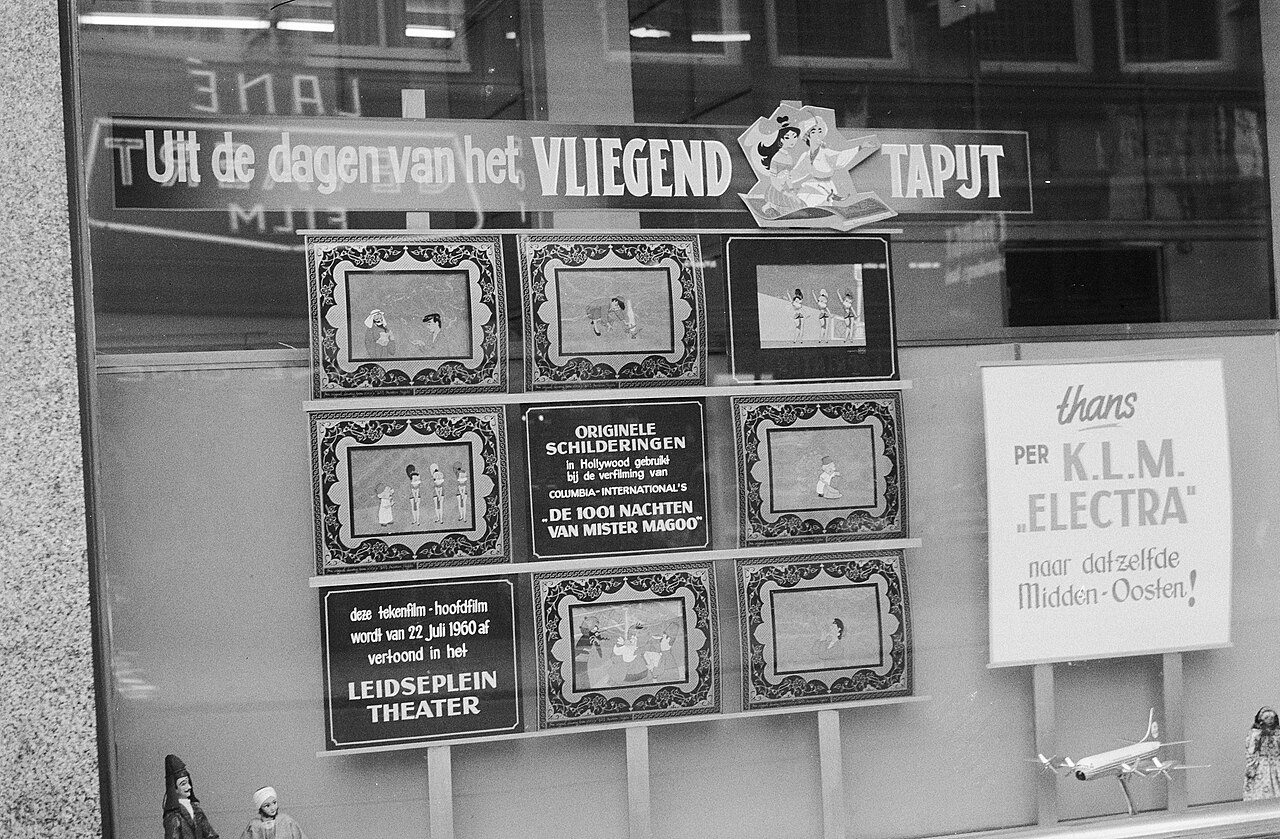
Harry Pot / Anefo · CC0
1001 Arabian Nights, a 1959 American animated comedy from United Productions of America (UPA), hit theaters on December 1, 1959, distributed by Columbia Pictures. The film loosely adapts the "Aladdin" story from *One Thousand and One Nights*, but adds UPA’s signature character, Mr. Magoo, as Aladdin’s uncle, Abdul Azziz Magoo. It marked Columbia Pictures’ first animated feature release.
In a distant Middle Eastern kingdom, the nearsighted, stubborn uncle Abdul Azziz Magoo runs a lamp shop and worries that his nephew Aladdin is lazy and irresponsible, pushing him to marry. Meanwhile, the wizard Wazir drains the royal treasury and convinces the bankrupt Sultan to have his daughter, Princess Yasminda, wed the richest man—now Wazir himself. Aladdin and Yasminda fall in love during a royal procession. Seeking absolute power, Wazir needs Aladdin to retrieve a magic lamp from a sealed cave, but the lamp falls back inside with Aladdin. Aladdin meets the genie and escapes with treasure. Magoo brings the treasure as a dowry, unintentionally disrupting Wazir and Yasminda’s wedding with his naïveté and poor eyesight. The genie provides Aladdin a palace and wealth, persuading the Sultan to approve the marriage, but Wazir steals the lamp and genie, exposing Aladdin as a fraud. Aladdin is sentenced to execution. Wazir kidnaps Yasminda, but the clueless Magoo accidentally retrieves the lamp and genie, dodging Wazir’s murder attempts. Wazir falls into the sea, eaten by sharks. Wanting the best for his nephew, Magoo wishes for Aladdin and Yasminda to live happily ever after; the genie saves Aladdin, and the couple marries.
The voice cast includes Jim Backus as Uncle Abdul Azziz Magoo, Kathryn Grant as Princess Yasminda, Dwayne Hickman as Aladdin, Hans Conried as the Wicked Wazir, Herschel Bernardi as the Jinni of the Lamp, Alan Reed as the Sultan, Daws Butler as Omar the Rugmaker, and The Clark Sisters as the Three Little Maids from Damascus. Uncredited, Daws Butler voiced the Royal Accountant and Heralds, and Hans Conried voiced the Magic Flame.
Originally directed by Pete Burness, who helmed the Mr. Magoo theatrical cartoons from 1949 to 1959, the film faced disagreements between Burness and producer/owner Stephen Bosustow, leading to Burness’s resignation. Bosustow then hired Jack Kinney, director of many Disney Goofy cartoons, as the new director.
Quick Facts
- Director
- Jack Kinney
- Producer
- Stephen Bosustow
- Writer
- Dick Shaw / Dick Kinney / Leo Salkin / Pete Burness / Lew Keller / Ed Nofziger / Ted Allen / Margaret Schneider / Paul Schneider
- Based On
- One Thousand and One Nights · Czenzi Ormonde
- Music
- George Duning
- Starring
- Jim Backus / Kathryn Grant / Dwayne Hickman / Hans Conried / Herschel Bernardi / Alan Reed / Daws Butler / The Clark Sisters
- Runtime
- 75 minutes
- Language
- English
- Studio
- UPA
- Distributor
- Columbia Pictures
- Released
- 1 December 1959
- Country
- United States
Facts from the source article.
Lore & Background
The film was originally directed by Pete Burness, who had been the series director on the popular Mr. Magoo theatrical cartoons. Disagreements with producer and UPA owner Stephen Bosustow led to Burness resigning, and Bosustow recruited Jack Kinney, the director of many of Disney's Goofy cartoons, as the new director. The voice of Magoo, Jim Backus, reprised his role, with Kathryn Grant as Princess Yasminda and Dwayne Hickman as Aladdin.
The plot follows Aladdin, who lives with his nearsighted uncle, Abdul Azziz Magoo, a lamp-shop owner. The wizard Wazir, siphoning money from the royal treasury, seeks the magic lamp for power. Aladdin and Princess Yasminda fall in love, and after a series of events involving the genie, Magoo inadvertently obtains the lamp and wishes for Aladdin and Yasminda to live happily ever after. Wazir falls into the sea and is devoured by sharks.
Reader's Guide
1001 Arabian Nights was the first full-length feature produced by UPA, a studio that had revolutionized animation during the 1950s by incorporating design and limited animation. The film was not a box-office success and was UPA's final release through Columbia, which ended its distribution of UPA short subjects in favor of lower-cost Loopy De Loop cartoons from Hanna-Barbera Productions. Following the film's release, Bosustow sold UPA to Henry G. Saperstein, who moved the studio into television production and a second feature, Gay Purr-ee, before closing the animation studio. The film remains notable as the first animated feature from Columbia Pictures and as a unique crossover of the Mr. Magoo character into a classic folktale.
Did You Know?
- 1001 Arabian Nights is the first animated feature to be released by Columbia Pictures.
- The film was originally directed by Pete Burness, who resigned due to disagreements with producer Stephen Bosustow, and was replaced by Jack Kinney.
- The voice of Mr. Magoo, Jim Backus, reprised his role from the theatrical short cartoons.
Production & Creative Direction
Behind the camera, the making of this feature was marked by a significant creative shake-up. Pete Burness, who had helmed the beloved Mr. Magoo theatrical shorts for Columbia between 1949 and 1959, was originally at the helm. However, friction with UPA owner and producer Stephen Bosustow prompted Burness to step down, and Bosustow turned to Jack Kinney—a name well known for directing Goofy cartoons at Disney—to take over the project. The voice cast was a star-studded ensemble: Jim Backus returned to breathe life into Magoo, while Kathryn Grant, the singing wife of Bing Crosby, lent her voice to Princess Yasminda. Dwayne Hickman, familiar to television audiences from The Bob Cummings Show and The Many Loves of Dobie Gillis, voiced Aladdin. Hans Conried brought menace to the villain Wazir, Herschel Bernardi supplied the Jinni, Alan Reed played the Sultan, and Daws Butler handled Omar the Rugmaker along with several uncredited bits. The Clark Sisters provided voices for the Three Little Maids from Damascus.
Plot & Narrative
The story takes a familiar Aladdin skeleton and grafts UPA's signature comic character onto it as a nearsighted, stubborn uncle named Abdul Azziz Magoo, who runs a lamp shop in a far-off kingdom. Magoo, convinced his nephew is drifting toward laziness, pushes him toward marriage. The villain, a wizard called Wazir, has drained the royal treasury and manipulates the broke Sultan into arranging a wedding between his daughter, Princess Yasminda, and the wealthiest man in the realm—Wazir himself. Aladdin and Yasminda spark during a royal procession, but Wazir needs Aladdin to retrieve the genie sealed in a magic cave. The lamp tumbles back into the cave, and Aladdin, trapped inside, encounters the genie and escapes with treasure. Magoo delivers the treasure as a dowry and wrecks the villain's wedding. The genie builds Aladdin a palace, convincing the Sultan to approve the union, but Wazir steals the lamp and the genie's loyalty, exposing Aladdin as a fraud and sending him to the scaffold. In the climax, the clueless Magoo inadvertently retrieves the lamp, dodges every assassination attempt, and watches Wazir tumble into the sea where sharks finish the job. Magoo's final, well-meaning wish—Aladdin and Yasminda living happily ever after—saves the day and seals their marriage.
Legacy & UPA's Final Chapter
Released to theaters on December 1, 1959, this picture holds a dual distinction: it was the first full-length animated feature to come out of UPA's studio, and it was the first animated feature ever distributed by Columbia Pictures. UPA had spent the 1950s reshaping the look of American animation, favoring bold graphic design and limited animation over the exhaustive frame-by-frame approach dominant elsewhere. Yet the film failed to find an audience at the box office, and it marked the end of UPA's relationship with Columbia, which had already shifted its short-subject distribution to the lower-cost Loopy De Loop cartoons produced by Hanna-Barbera. In the aftermath, Bosustow sold the studio to Henry G. Saperstein. Under new ownership, UPA pivoted toward television production and mounted one more feature, Gay Purr-ee, before shuttering its animation division entirely and redirecting the company's resources toward other business ventures. For animation historians, the film stands as both a showcase of UPA's distinctive visual language and a poignant marker of a studio's brief but influential run in feature-length storytelling.
Home Video & Availability
Despite its modest theatrical performance, the film has found a steady afterlife on home media. Its first consumer release came in 1985, when RCA/Columbia Pictures Home Video put it on VHS videocassette. A full two decades later, in 2011, a DVD edition appeared as a manufactured-on-demand title from the Sony Pictures Choice Collection, a line that is now accessible through Warner Archive. The film's most notable home-video placement came in 2014, when Shout! Factory included it as disc four of the four-disc Mr. Magoo: The Theatrical Collection 1949-1959 boxed set, situating it alongside the entire run of theatrical shorts that had built the character's reputation. A further appearance followed in 2018, when Mill Creek Entertainment folded the picture into its compilation A Thousand and One Nights: The Story of Aladdin - 8 Magical Tales, grouping it with other animated Aladdin adaptations. For fans of mid-century American animation, these releases have kept the film accessible even as its original theatrical context has long since faded from public memory.
Gallery
Frequently Asked Questions
What is 1001 Arabian Nights (1959 film) and who made it?
It is a 1959 American animated comedy produced by United Productions of America and released in theaters on December 1, 1959, through Columbia Pictures. The film reimagines the classic Aladdin folktale with UPA's iconic Mr. Magoo inserted as Aladdin's grumpy, nearsighted uncle.
How does the wish-fulfillment element work in 1001 Arabian Nights?
The magic lamp serves as the story's central wish-granting device, giving Aladdin the supernatural help he needs to overcome the villainous wizard's schemes. It anchors the plot's comedic and adventurous beats as Aladdin repeatedly calls on its power to get out of trouble.
Who is Mr. Magoo's role in 1001 Arabian Nights?
Jim Backus voices Abdul Azziz Magoo, a stubborn, nearsighted uncle who runs a lamp shop and constantly pressures his lazy nephew Aladdin to grow up and find a wife. His bumbling, oblivious presence provides the film's primary comic engine alongside the Aladdin storyline.
Why is 1001 Arabian Nights (1959 film) significant in animation history?
It is recognized as Columbia Pictures' first animated feature to hit the big screen, marking a milestone for the studio. It also showcases UPA's distinctive, painterly visual style applied to a Middle Eastern folktale, setting it apart from the more conventional cartoons of its era.
Who directed 1001 Arabian Nights (1959 film) and who else is in the voice cast?
Pete Burness was the original director, with Jack Kinney stepping in to finish the project. The voice cast includes Kathryn Grant, Dwayne Hickman as Aladdin, Hans Conried, Herschel Bernardi, Alan Reed, and Daws Butler alongside Jim Backus as Mr. Magoo.
More in Animated films about wish fulfillment 1-24
Spotted an error? Know more?
Reader corrections go straight into our review queue. Suggest an edit · How this site is sourced