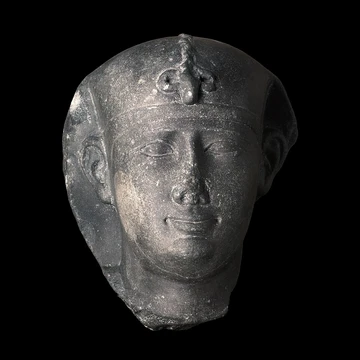
Khufu
Second pharaoh of the Fourth Dynasty, builder of the Great Pyramid.

Khufu, also called Cheops, was the second king of Egypt’s Fourth Dynasty, ruling in the 26th century BC during the early Old Kingdom. He took the throne after his father, Sneferu. Khufu is widely credited with ordering the construction of the Great Pyramid of Giza, one of the Seven Wonders of the Ancient World, but much else about his rule remains unclear. He also appears as the main figure in the Westcar Papyrus, a text from the 13th Dynasty.
The only complete portrait of Khufu that survives is a small ivory figurine, discovered in 1903 among the ruins of a later temple at Abydos. All other statues and reliefs exist only as fragments, and many of his buildings have been lost. His legacy is mixed: he was remembered positively during the Old and New Kingdoms, but ancient writers such as Manetho, Diodorus, and Herodotus described him harshly. This has left a vague and critical impression of his character.
Khufu’s name means “He protects me” and was dedicated to the god Khnum, possibly reflecting a rise in Khnum’s importance. Several royal and religious titles from this period suggest that pharaohs tried to emphasize their divine nature by linking their cartouche names to specific gods. Khufu may have seen himself as a divine creator, a role already held by Khnum, the god of creation and growth. His full name, Khnum-khufu, means “Khnum protects me.” Modern Egyptologists pronounce it Khufu, but in his own time it was likely said as Kha(w)yafwi(y), and during the Hellenistic period as Khewaf(w). The king used two versions of his birth name: the full Khnum-khufu and the shorter Khufu. The longer form shows his loyalty to Khnum, while the shorter one does not. Why he used the shorter version is unknown, since it hides the god’s name and the connection to it; it may have been meant to avoid any link to a deity at all. Khufu is well known by the Hellenized name Cheops (from Diodorus and Herodotus) and less so as Suphis (from Manetho). Josephus used a rare variant, Sofe. Arab historians, who wrote mystical stories about Khufu and the pyramids, called him Saurid or Salhuk.
Khufu’s royal family was large. Whether he was actually Sneferu’s biological son is uncertain. Egyptologists generally believe Sneferu was his father, based on later historians’ accounts that the eldest son or a chosen heir inherited the throne. In 1925, the tomb of Queen Hetepheres I was found east of Khufu’s pyramid. It held valuable grave goods, and inscriptions gave her the title “mother of a king,” along with the name of King Sneferu. This initially suggested she was Sneferu’s wife and Khufu’s mother. However, some now doubt this because Hetepheres never held the title “king’s wife,” which was essential for confirming a queen’s royal status. Instead, she bore only the title “daughter of his divine body,” a phrase used for the first time. Researchers now think Khufu may not have been Sneferu’s biological son, but that Sneferu legitimized his rank through marriage. By elevating his mother as the daughter of a living god, Khufu secured his position. This theory is supported by the fact that Hetepheres was buried near her son, not in her husband’s necropolis, as would be expected.
Certain family members can be assigned to Khufu with confidence. His wives were Meritites I, his first wife, and Henutsen, his second, who is named on the Inventory Stela. His siblings include Hetepheres, wife of Ankhhaf; Ankhhaf, the eldest brother, whose nephew later became Pharaoh Khafra; Nefermaat, a half-brother buried at Meidum; and Rahotep, an elder brother or half-brother. Khufu’s sons were Kawab, likely the eldest and crown prince, who died before Khufu; Wepemnofret; Djedefre, who became the first successor; Khafre, possibly the second successor; Djedefhor; Babaef I; Khufukhaf I; Minkhaf I; and Horbaef. His daughter was Hetepheres II, who married Prince Kawab and later King Djedefre. Grandchildren include Mindjedef and Meresankh III. Nephews and nieces include Hemiunu, director of the Great Pyramid’s construction; Djedi; Itu; Neferkau; Mereret; Nedjemib; and Sethtet.
- Name
- Khufu (Cheops)
- Reign
- 26th century BC
- Dynasty
- Fourth Dynasty
- Known for
- Commissioning the Great Pyramid of Giza
- Legacy
- Conflicting; negative depictions by Manetho, Diodorus, and Herodotus
Quick Facts
- Golden
- Bikwy-nub / Bjk.wj-nb.w / The twice golden falcon · G5 G5:S12
- Nebtyhiero
- Aa24:D21
- Nebty
- Nebty-r-medjed / Mḏd-r-Nnb.tj / He who crushes/smites (the enemies) of the two Ladies
- Horus
- Medjedu / Mḏd.w / He who crushes/smites (the enemies) for Horus · Alternative form: Medjed / Mḏd
- Predecessor
- Sneferu
- Successor
- Djedefre
- Spouse
- Meritites I, Henutsen
- Children
- Kawab, Wepemnofret, Djedefre, Khafre, Djedefhor, Hetepheres II, Minkhaf I, Khufukhaf I, Babaef, and Horbaef
- Dynasty
- 4th Dynasty
- Father
- Possibly Sneferu
- Mother
- Possibly Hetepheres I
- Died
- 26th century BC
Facts from the source article.
Lore & Background
Khufu succeeded his father, Sneferu, as king, and mainstream consensus holds that he was Sneferu's biological son, with no strong evidence to the contrary. The tomb of queen Hetepheres I, found east of Khufu's pyramid, contained inscriptions suggesting she was Khufu's mother, and she is generally accepted as Sneferu's wife and Khufu's mother, often titled 'king's wife' in inscriptions. Khufu's full name, Khnum-khufu, means 'Khnum protects me,' reflecting a connection to the god Khnum, and he used both this full version and a shorter form, Khufu, for unknown reasons. Khufu's reign length is unclear: the Royal Canon of Turin gives 23 years, while Herodotus and Manetho claim 50 and 63 years respectively, figures now considered exaggerated. The highest known date from his reign is a year 27 (or possibly 28) from the Diary of Merer. Political activities are sparsely documented, with his name appearing in inscriptions at Elkab, Elephantine, Hatnub, and Wadi Hammamat. Khufu's family was large, with multiple spouses, sons, daughters, and grandchildren listed in records. His eldest son, Kawab, likely died before Khufu, and Djedefre became the first throne successor, followed by Khafre.
Reader's Guide
Khufu's significance lies primarily in his commission of the Great Pyramid of Giza, the only surviving Wonder of the Ancient World, which has made him one of the most famous pharaohs despite the scarcity of contemporary records. His reign, though poorly documented, represents a peak of Old Kingdom pyramid-building and centralised state power. The conflicting legacy—positive cultural preservation during the Old and New Kingdoms versus negative characterisations by later historians such as Manetho, Diodorus, and Herodotus—illustrates how ancient sources shaped perceptions of pharaohs long after their deaths. Khufu's religious innovations, such as linking his name to the god Khnum, may reflect efforts to emphasise divine kingship. The uncertainty about his parentage and reign length underscores the challenges of reconstructing early Egyptian history from fragmentary evidence. His enduring fame, however, ensures continued scholarly and public interest in his life and monuments.
Did You Know?
- Khufu's full name, Khnum-khufu, means 'Khnum protects me,' linking him to the god of creation.
- Khufu is the main character in the Westcar Papyrus from the 17th dynasty.
- Ancient historians Manetho, Diodorus, and Herodotus handed down a very negative depiction of Khufu's character.
More in Ancient Egyptian Pharaohs 1-18
Spotted an error? Know more?
This is a living reference — every entry is fact-audited, and reader corrections feed straight into our audit queue. Suggest an edit · See this site's audit record