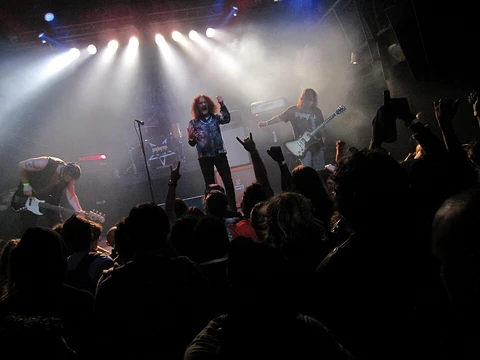
Acid Witch
American extreme metal band known as 'Halloween metal.'

Acid Witch is an American extreme metal band that came together in Detroit, Michigan, in 2007. Their sound pulls from death metal, doom metal, stoner metal, and psychedelic music, with heavy nods to horror films and soundtracks like John Carpenter’s *Halloween*. The band calls this mix "Halloween metal." Their first album, *Witchtanic Hellucinations*, came out in 2008 on Razorback Records. Two EPs followed: *Witch House* in 2009 and *Midnight Mass* in 2010. That same year, they released a second album, *Stoned*, on Hells Headbangers Records. In 2012, that label re-released *Witchtanic Hellucinations*. Lyrically, the band focuses on witchcraft, Halloween, and Satanism, often inspired by horror movies and featuring gore, sex, and drugs. Lead vocalist Slasher Dave has named Pagan Altar and Witchfinder General as influences, and some listeners also hear the new wave of British heavy metal in their music.
- Formed
- 2007
- Origin
- Detroit, Michigan, United States
- Genre
- Extreme metal (death metal, doom metal, stoner metal, psychedelic music)
- Label
- Razorback Records, Hells Headbangers Records
- Known for
- Self-described 'Halloween metal' blending horror film soundtracks with extreme metal
Lore & Background
Acid Witch was formed in Detroit, Michigan, in 2007. Their first album, Witchtanic Hellucinations, was released in 2008 on Razorback Records. The band followed with two EPs: Witch House in 2009 and Midnight Mass in 2010. Their second album, Stoned, came out in 2010 on Hells Headbangers Records, which later re-released Witchtanic Hellucinations in 2012. The band's discography also includes later albums Evil Sound Screamers (2017) and Rot Among Us (2022), as well as several EPs and singles.
Reader's Guide
Acid Witch's significance lies in their distinctive fusion of extreme metal subgenres with horror film aesthetics, particularly the soundtracks of John Carpenter's Halloween. By dubbing themselves 'Halloween metal,' they carved a niche that appeals to fans of both heavy music and horror culture. Their lyrics, focusing on witchcraft, Halloween, Satanism, gore, sex, and drugs, draw heavily from horror films, while their musical influences include death metal, doom metal, stoner metal, psychedelic music, and the new wave of British heavy metal. Lead vocalist Slasher Dave has cited Pagan Altar and Witchfinder General as influences. The band's work on labels like Razorback Records and Hells Headbangers Records helped solidify their place in the underground metal scene, and their consistent thematic focus has made them a reference point for horror-themed metal.
Did You Know?
- The band has dubbed their style 'Halloween metal.'
- Their debut album Witchtanic Hellucinations was re-released in 2012 on Hells Headbangers Records.
- Their music draws from the soundtracks of John Carpenter's Halloween.
The Sonic Architecture of Doom
Doom metal's sound is built on a foundation of deliberate slowness and weight. The core instrumentation—electric guitar, bass guitar, and drums, occasionally supplemented by keyboards—draws its melodic vocabulary from the same scales that underpin blues music. What distinguishes the genre is the extreme degree of down-tuning applied to both guitar and bass, combined with heavy distortion to produce what listeners describe as a thick, almost physical wall of low-end sound. Guitar and bass frequently lock onto the same riff in unison, amplifying that bass-heavy density. Tempo is consistently slow, and the harmonic language leans heavily on minor tonality and dissonance, particularly the tritone interval. Rather than chasing complex chord changes, compositions tend to favor repetitive rhythmic patterns with comparatively little concern for traditional harmonic progression or formal musical structure. The overall effect is one of immovable, grinding pressure—a sonic landscape designed to evoke dread and the feeling of an inescapable, approaching catastrophe.
Vocal Expression and the Range of Suffering
The human voice in doom metal carries the emotional weight that the instruments provide structurally. Traditional practitioners favor clean vocal delivery, channeling a palpable sense of despair, desperation, or raw pain. This approach traces a direct lineage to the high-tone wailing of Ozzy Osbourne in Black Sabbath, as well as the distinctive voices of Frank Ferrara in Bang, Bobby Liebling in Pentagram, and Zeeb Parkes in Witchfinder General. At the other end of the spectrum, what has come to be called epic doom pushes vocal performance toward an operatic register, demanding a kind of theatrical grandeur. When doom metal intersects with other extreme subgenres—death-doom, black-doom, and funeral doom—the vocal palette shifts dramatically toward growled or screamed delivery, borrowing the aggressive timbres of those adjacent styles. This wide range means that a single genre can accommodate everything from aching, melodic laments to guttural, almost inhuman outbursts, all in service of the same underlying emotional architecture of dread and suffering.
Lyrical Philosophy: Grief, Symbol, and the Occult
Lyrics occupy a central role in doom metal's identity, drawing deeply from the blues tradition of artists like Robert Johnson and Son House. The dominant emotional register is one of gloom and pessimism—suffering, depression, fear, grief, dread, death, and anger recur as persistent thematic concerns. Some bands approach these subjects in an intensely personal, introspective manner, while others deploy symbolism rooted in occult arts and literature to convey their themes. Religious imagery features prominently: Trouble, one of the genre's earliest pioneers, were among the first to weave Christian imagery into their songwriting, while other acts incorporate occult and pagan references. For many of these groups, the religious content serves an aesthetic and symbolic function rather than a devotional one—references to the Last Judgment exist to amplify dread, and crucifixes or cross-shaped headstones operate as symbols of mortality. A separate current, particularly within stoner doom, turns toward drug culture, with lyrics frequently describing hallucinogenic or psychedelic experiences as a parallel form of altered consciousness.
From Sabbath to the Big Four: A Genre's Lineage
The earliest whispers of doom in rock music can be traced to the Beatles' 1969 track "I Want You (She's So Heavy)," but Black Sabbath are widely regarded as the true progenitors. Their blues-rooted playing, Tony Iommi's deliberately heavy and dark guitar work, and their pessimistic lyrical atmosphere established a template that would define the genre for decades. Throughout the 1970s, a constellation of acts—including Pentagram and their side project Bedemon, Blue Cheer, Uriah Heep, Budgie, Led Zeppelin, and even Japanese psychedelic rock groups like Flower Travellin' Band—contributed essential ingredients. The genre crystallized in the early-to-mid 1980s: Witchfinder General's 1982 debut Death Penalty, Saint Vitus and Trouble's 1984 releases, Cirith Ungol's 1984 King of the Dead, Pentagram's 1985 debut Relentless, and Candlemass's 1986 Epicus Doomicus Metallicus collectively forged doom metal into a recognized category. Pentagram, Saint Vitus, Trouble, and Candlemass are often collectively called the Big Four of Doom Metal, while the Swedish band's record gave its name to the epic doom subgenre.
Frequently Asked Questions
Who is Acid Witch?
Acid Witch is an American extreme metal band that formed in Detroit, Michigan, back in 2007. They fuse death metal, doom, stoner, and psychedelic influences into a style they themselves label "Halloween metal," drawing heavy inspiration from horror film soundtracks.
Where is Acid Witch from?
The band hails from Detroit, Michigan, and has been rooted in that scene since their 2007 formation.
What does the term "Halloween metal" mean?
It's a genre tag the band coined for their own sound, which layers extreme metal riffs over the eerie, cinematic atmosphere of classic horror scores—think John Carpenter's *Halloween* meets stoner and doom metal.
What albums and EPs has Acid Witch put out?
Their debut full-length *Witchtanic Hellucinations* arrived in 2008, followed by the *Witch House* and *Midnight Mass* EPs in 2009 and 2010, and a second album titled *Stoned* in 2010.
Which labels has Acid Witch released on?
The group has worked with both Razorback Records (their 2008 debut) and Hells Headbangers Records (their 2010 material and a 2012 reissue of the debut).
More in American doom metal musical groups 1-24
Spotted an error? Know more?
Reader corrections go straight into our review queue. Suggest an edit · How this site is sourced