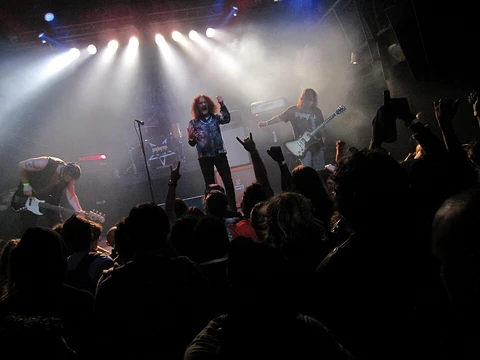
Abscess (band)
Oakland (California) death/doom metal band, 1994–2010.

In June 1994, Chris Reifert and Danny Coralles — both still active in Autopsy at that point (the band was on hiatus and would not officially disband until 1995) — started a two-piece in Oakland, California. They named it Abscess. Over the next sixteen years the pair put out six studio albums and a whole pile of demos, EPs, splits, and live recordings before breaking up in 2010.
- Genre
- Death/doom metal
Lore & Background
Abscess was formed in June 1994 by Chris Reifert (drums, vocals) and Danny Coralles (guitar), both still members of Autopsy at the time (Autopsy was on hiatus and did not officially disband until 1995). The band's last lineup also included bassist Joe Allen (Joe Trevisano), who joined in 1998 and remained until the band's end. Past members included guitarist Clint Bower (1994–2005), bassist Frank 'Freeway' Migliore (1995–1997), and bassist Jim Mack (2000–2002). The band released six studio albums: Seminal Vampires and Maggot Men (1996), Tormented (2001), Through the Cracks of Death (2002), Damned and Mummified (2004), Horrorhammer (2007), and Dawn of Inhumanity (2010). They also issued live albums, compilation albums, EPs, demos, and several split recordings with other bands such as Deranged, Machetazo, Bloodred Bacteria, Bonesaw, and Population Reduction. Abscess disbanded in 2010. Their discography includes early demos like Abscess (1994) and Raw Sick & Brutal Noize! (1994), as well as the live album Pustulation of Embrionic Flesh (1995) recorded on KZSU in 1994.
Reader's Guide
Abscess occupies a notable place in American death metal as a direct continuation of the style pioneered by Autopsy, with founding members Reifert and Coralles carrying forward a raw, gore-obsessed sound. Over sixteen years, the band maintained a consistent output of studio albums, EPs, and splits, culminating in their final album Dawn of Inhumanity in 2010. Their discography reflects a commitment to underground death metal aesthetics, with titles and artwork emphasizing visceral horror themes. While never achieving mainstream crossover, Abscess remained a respected act within the extreme metal community, particularly for fans of Autopsy and old-school death metal. The band's legacy is tied to their prolific recording history and their role in sustaining the Oakland death metal scene. Their work is documented in sources such as Blabbermouth.net and The Gauntlet, which covered album releases and other activities.
Did You Know?
- The band released six studio albums between 1996 and 2010.
- Bassist Joe Allen (Joe Trevisano) is a single individual.
- Abscess disbanded in 2010.
Origins in the Bay Area Underground
Abscess emerged from the fertile soil of the Oakland, California metal scene in June 1994, when two former Autopsy members—drummer and vocalist Chris Reifert and guitarist Danny Coralles—decided to forge a new creative vehicle. Their shared history in Autopsy gave the new project an immediate foundation in extreme, visceral death metal, and the band quickly established itself as a distinct force within the American underground. What began as a two-person core expanded to include guitarist and vocalist Clint Bower, who remained with the group from 1994 through its final year in 2010. The band's very first recordings, including the 1994 demo simply titled Abscess and the live KZSU performance released as Pustulation of Embrionic Flesh, signaled a raw, aggressive approach that would define their sound for the next sixteen years. Though they never achieved mainstream visibility, Abscess carved out a dedicated following in the death metal community, releasing material consistently from their inception until their disbandment in 2010.
A Prolific Catalog of Extreme Metal
Over the course of their sixteen-year run, Abscess produced an impressive volume of recorded material that reflected both their creative stamina and their commitment to the death metal genre. Their studio output spans six full-length albums, beginning with the 1996 release Seminal Vampires and Maggot Men and continuing through Tormented (2001), Through the Cracks of Death (2002), Damned and Mummified (2004), and Horrorhammer (2007), before culminating in Dawn of Inhumanity in 2010. Beyond their studio work, the band released a single EP, Throbbing Black Werebeast, in 1997, along with a remarkable string of five demos between 1994 and 1998, including Raw Sick & Brutal Noize! and Crawled up from the Sewer. They also issued two compilation albums, Urine Junkies and Thirst for Blood, Hunger for Flesh, plus a live KZSU recording. Perhaps most telling of their standing in the underground scene were their numerous split releases with fellow extreme metal acts such as Deranged, Machetazo, Bloodred Bacteria, Bonesaw, and Population Reduction, demonstrating a collaborative spirit that extended well beyond their own recordings.
Lineup Stability and the Bassist Shuffle
One of the most notable aspects of Abscess's personnel history is the remarkable stability of its core members contrasted against a revolving door in the bassist position. Chris Reifert on drums and vocals, Danny Coralles on guitar, and Clint Bower on guitar and vocals all remained with the band for its entire existence from 1994 to 2010, providing a consistent creative spine throughout two decades of activity. The bass chair, however, saw three different occupants over the band's lifetime. Frank "Freeway" Migliore held the position during the early years from 1994 to 1997, followed by a brief stint by Jim Mack from 2000 to 2002. Joe Allen, also credited as Joe Trevisano, ultimately became the longest-serving bassist, occupying the role from 1998 to 2000 and then again from 2002 until the band's dissolution in 2010. This pattern of a fixed rhythmic and melodic core with a shifting low-end player suggests a band that valued its foundational sound while remaining flexible in its personnel choices, ultimately settling on a configuration that carried them through their final years of recording.
Final Chapter and Lasting Mark
2010 was the year Abscess wrapped up sixteen years of making records, and that same year saw the release of Dawn of Inhumanity, their final studio album. Heading into the end, the band was still putting out new material — the 2009 split LP with Population Reduction and the 2008 Bonesaw collaboration prove they weren't coasting. Early 2010 coverage on Blabbermouth.net and The Gauntlet walked through the new artwork and shared audio samples, which told you Abscess was still moving and visible in the underground press right up to the finish line. Looking back, the band never once chased a commercial hit. From that 1994 inception as a two-piece peeled out of Autopsy to their 2010 last release, they kept making the same kind of blunt, aggressive death metal for a small but loyal group of listeners. The catalog — demos, EPs, compilations, live recordings, and six studio albums — is what you're left with, and it's a lot. Enough to spend years getting through if you want to, with none of it padded out.
Frequently Asked Questions
Who is Abscess (band)?
Abscess was an American death metal band out of Oakland, California, active from 1994 until they broke up in 2010. Over those sixteen years they issued six studio albums.
Who founded Abscess and what was their background?
The group was put together in June 1994 by Chris Reifert and Danny Coralles, both of whom had previously been members of the death metal band Autopsy. They operated out of Oakland, California.
What are Abscess's most well-known albums?
Fans frequently point to the 1996 double release Seminal Vampires and Maggot Men, the 2001 record Tormented, and their closing studio effort Dawn of Inhumanity in 2010 as standout entries in their catalog.
When did Abscess disband and what was their final release?
The band ended their run in 2010, concluding a sixteen-year career that began in 1994. Their last studio album, Dawn of Inhumanity, was released that same year.
Why is Abscess important in American death metal?
As a direct spin-off from Autopsy, Abscess sustained the brutal, visceral death metal sound out of the Bay Area for well over a decade. Their consistent output of six studio albums made them a reliable presence in the American extreme metal underground.
More in American doom metal musical groups 1-24
Spotted an error? Know more?
Reader corrections go straight into our review queue. Suggest an edit · How this site is sourced