
Adventure game
Story-driven interactive games focused on exploration and puzzle-solving.

Shubhangi Parganiha · CC BY-SA 4.0
Adventure games are a video game genre where players take on the role of a protagonist in an interactive story, with gameplay built around exploration and solving puzzles. Because story is so central, these games often borrow from other narrative forms like books and movies, covering many different genres. Most adventure games are made for a single player, as the focus on story and character makes multiplayer design challenging. The first game of this kind is generally considered to be *Colossal Cave Adventure*, first released in 1976, with other well-known series including *Zork*, *King's Quest*, *Monkey Island*, *Syberia*, and *Myst*.
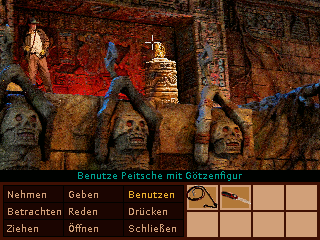
The genre began in the 1970s and early 1980s as text-based interactive stories, where players typed commands that a text parser turned into actions. As personal computers got more powerful and graphics improved, graphic adventure games became popular. At first, these added pictures to text commands, but soon shifted to point-and-click interfaces. Later advances in computing allowed for more immersive graphics, using real-time or pre-rendered three-dimensional scenes, or full-motion video from a first- or third-person perspective. Today, many adventure games exist as hybrids that blend adventure elements with other genres.
In Western markets, the genre was most popular from the late 1980s to the mid-1990s, when it was seen as one of the most technically advanced genres. However, it became a niche genre in the early 2000s, largely due to the rise of first-person shooters, which made it hard for developers to find publishers for adventure games. Since then, the genre has seen a revival, driven by independent game development, especially through crowdfunding, the ease of digital distribution for episodic releases, and the growth of new platforms like portable consoles and mobile devices.
In Asian markets, adventure games remain popular in the form of visual novels, which account for nearly 70% of PC games released in Japan. Asian countries have also found a market for adventure games on portable and mobile devices. Japanese adventure games tend to be distinct, with a slower pace and a greater focus on dialogue, while Western adventure games typically emphasize more interactive worlds and complex puzzle-solving. These differences stem from their separate development histories.
- First known game
- Colossal Cave Adventure (1976)
- Genre origin
- 1970s text-based interactive stories
- Peak popularity (western)
- late 1980s to mid-1990s
- Notable series
- Zork, King's Quest, Monkey Island, Syberia, Myst
- Current status
- niche in early 2000s; resurgence via indie development, crowdfunding, digital distribution, and new platforms
Lore & Background
Adventure games were initially developed in the 1970s and early 1980s as text-based interactive stories, using text parsers to translate the player's commands into actions. As personal computers became more powerful with better graphics, the graphic adventure-game format became popular, initially by augmenting player's text commands with graphics, but soon moving towards point-and-click interfaces. Further computer advances led to adventure games with more immersive graphics using real-time or pre-rendered three-dimensional scenes or full-motion video taken from the first- or third-person perspective.
Reader's Guide
For markets in the Western hemisphere, the genre's popularity peaked during the late 1980s to mid-1990s when many considered it to be among the most technically advanced genres, but it had become a niche genre in the early 2000s due to the popularity of first-person shooters, and it became difficult for developers to find publishers to support adventure-game ventures. Since then, a resurgence in the genre has occurred, spurred on by the success of independent video-game development, particularly from crowdfunding efforts, from the wide availability of digital distribution enabling episodic approaches, and from the proliferation of new gaming platforms, including portable consoles and mobile devices. Within Asian markets, adventure games continue to be popular in the form of visual novels, which make up nearly 70% of PC games released in Japan. Asian countries have also found markets for adventure games for portable and mobile gaming devices. Japanese adventure-games tend to be distinct, having a slower pace and revolving more around dialogue, whereas Western adventure-games typically emphasize more interactive worlds and complex puzzle solving, owing to them each having unique development histories.
Did You Know?
- The term 'adventure game' originated from the 1970s text computer game Colossal Cave Adventure.
- Adventure games are defined by their gameplay, unlike the literary genre, which is defined by subject.
- Combat and action challenges are limited or absent in adventure games, distinguishing them from action games.
- Adventure games lack the numeric rules or relationships seen in role-playing games and seldom have an internal economy.
Defining the Hybrid Identity
The action-adventure genre occupies a crossroads between two established video game traditions. At its core, it demands the reflexive, physical skill sets players associate with action titles while simultaneously weaving in the narrative depth, character interactions, inventory management, and puzzle-solving that define adventure games. This dual nature makes pacing noticeably quicker than a pure adventure experience, since players must juggle both bodily and intellectual challenges in real time. Story delivery leans heavily on audio and video presentation, and the narrative is tightly coupled to the protagonist's movement—events trigger as the character traverses the world rather than being passively narrated. Popular franchises like The Legend of Zelda, God of War, Grand Theft Auto, and Tomb Raider exemplify this blend. Yet the very breadth of the label sparks ongoing debate among genre purists. Some argue that an action game with simple puzzles remains an action game, while adventure purists reject any title introducing time pressure or physical dexterity demands. The result is a term that functions less as a precise category and more as a wide umbrella covering an enormous range of subgenres.
A Family of Distinct Subgenres
Despite the difficulty of pinning down a single definition, the action-adventure umbrella shelters several recognizable subgenres, each with its own design DNA. The Grand Theft Auto clone category refers to open-world, third-person titles where players roam freely, piloting a wide array of vehicles and wielding diverse weapons across sprawling maps. Metroidvania games, a portmanteau of Metroid and Castlevania, anchor themselves in two-dimensional platforming while emphasizing deep exploration and puzzle-solving; fans sometimes call them search action titles. Survival horror, popularized by the Resident Evil franchise, foregrounds inventory management—balancing scarce ammunition and healing items against a terrifying setting—though the subgenre's thematic focus allows for considerable gameplay variation. Then there are Zelda-likes, games whose mechanics echo The Legend of Zelda series. What unites all of these is the shared commitment to blending physical challenge with narrative and problem-solving, even as their visual perspectives range from bird's-eye to first-person to over-the-shoulder views.
Gameplay Architecture and Player Experience
The gameplay loop of an action-adventure title follows a recognizable pattern drawn from adventure traditions: gathering items, exploring interconnected environments often linked by an overworld map, and solving puzzles. Yet the controls remain arcade-style—character movement plus a small set of action commands—while the ultimate objective stretches well beyond accumulating a high score. In most cases, the player commands a single avatar who serves as the story's protagonist, a structure that brings the genre close to role-playing games. Dialogue with non-player characters typically unfolds through a conversation tree: the player selects a line, the NPC delivers a scripted reply, and the system branches into further response options. Because the genre's broad scope can overwhelm players and make completion difficult, developers have introduced assistive measures such as contextual clues or the option to skip particularly stubborn puzzles. The genre also draws a clear line from graphic adventures, which offer a wider command vocabulary but fewer action elements, and from text adventures, where a complex text parser replaces free character movement entirely.
Roots in the Early Arcade Era
The action-adventure genre did not emerge fully formed; its DNA can be traced to a handful of pioneering titles in the late 1970s and early 1980s. Atari's Superman (1979) is frequently cited as an early example, with Retro Gamer acknowledging it as the first game to use multiple screens as a continuous playing area. Adventure (1980), also for the Atari VCS, is credited by Mark J.P. Wolf as the earliest known action-adventure game, blending 2D exploration, item-based abilities, and real-time dragon combat. Muse Software's Castle Wolfenstein (1981) pushed the formula further, merging maze-like exploration with stealth, combat, and item collection, drawing inspiration from arcade shoot 'em ups, war films like The Guns of Navarone, and maze-shooter Berzerk. Konami's Tutankham (1982) brought the formula to arcades, fusing maze navigation, shooting, puzzle-solving, and adventure elements. As Wizardry developer Roe R. Adams observed, these early titles were essentially arcade games done in a fantasy setting, laying the structural groundwork for everything that followed.
Gallery





Frequently Asked Questions
What is an adventure game?
An adventure game is a single-player video game genre centered on following a protagonist through an interactive narrative, with gameplay built primarily around exploring environments and solving puzzles. Because storytelling is the core focus, these titles frequently draw on narrative techniques from literature and film, spanning a wide range of sub-genres.
What is considered the first adventure game?
The title generally credited as the origin of the genre is Colossal Cave Adventure, released in 1976. It established the text-based, exploration-and-puzzle format that defined the genre throughout the 1970s.
Which adventure game series are the most well-known?
Fans most commonly cite Zork, King's Quest, The Secret of Monkey Island, Syberia, and Myst as landmark series within the genre. Each brought a distinct flavor to the format, from text-based dungeon crawling to point-and-click cinematic storytelling.
When did adventure games reach their peak popularity in the West?
The genre enjoyed its broadest commercial success roughly from the late 1980s through the mid-1990s, a period that produced many of the most celebrated titles in gaming history. After that window, the category contracted into a smaller niche audience.
Are adventure games still being made today?
Yes, though the genre shrank considerably in the early 2000s, it has experienced a notable resurgence driven by indie developers, crowdfunding campaigns, digital distribution platforms, and the arrival of new hardware. Modern titles continue to explore the genre's core pillars of narrative, exploration, and puzzle-solving.
More in Adventure games 1-24
Spotted an error? Know more?
Reader corrections go straight into our review queue. Suggest an edit · How this site is sourced