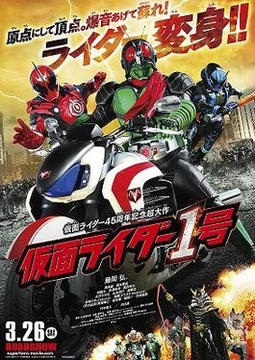
Kamen Rider × Kamen Rider Ghost & Drive: Super Movie War Genesis
Two Riders travel ten years into the past.

Kamen Rider × Kamen Rider Ghost & Drive: Super Movie War Genesis is a 2015 Japanese crossover film in the Kamen Rider Series, linking the television series Kamen Rider Ghost and Kamen Rider Drive. The film follows the two lead heroes as they travel back in time due to the actions of an evil monster, and it was released nationally in Japan on December 12, 2015.
- Release date
- December 12, 2015
- Country
- Japan
- Genre
- Tokusatsu, crossover film
- Director
- Not specified in source
- Main antagonist voice
- Kendo Kobayashi (Da Vinci Gamma)
- Series
- Kamen Rider Series
Lore & Background
Three months after the Roidmude threat ended, Shinnosuke Tomari attempts to propose to Kiriko but is drawn into a paranormal investigation. At Daitenkū-ji temple, he meets Takeru Tenkūji, who transforms into Kamen Rider Ghost to fight a Gamma Superior. A wormhole opens, pulling Takeru and Shinnosuke ten years into the past, where they meet Takeru's father Ryū Tenkūji. They learn that the Gamma are incarnations of Renaissance artists seeking to revive Leonardo da Vinci as a Gamma using Akari's feelings and an Eyecon. In the past, young Takeru witnesses his father's death protecting him from the Da Vinci Gamma, which then escapes to the future. Returning to the present, the Riders face Leonardo Gamma and his revived allies, ultimately destroying the gigantic Renaissance Gamma with the help of Ryū's spirit, which grants the Toucon Boost Eyecon. The film ends with Shinnosuke and Kiriko marrying, attended by colleagues and police officers.
Reader's Guide
The film serves as a direct crossover between Kamen Rider Ghost and Kamen Rider Drive, bridging the two series' narratives through time travel. It introduces the Da Vinci Gamma, voiced by comedian Kendo Kobayashi, and features the Raphael and Michelangelo Gammas voiced by the comedy duo Sissone. The movie also briefly includes Kamen Rider Necrom prior to his television debut. Its significance lies in establishing the shared universe of the two series and providing closure for Shinnosuke Tomari's character arc with his marriage to Kiriko. The film's plot explores themes of legacy and sacrifice, particularly through Takeru's relationship with his father Ryū.
Did You Know?
- Kendo Kobayashi, who voiced the Da Vinci Gamma, was a fan of Kamen Rider since childhood, watching reruns of the original series and up to The New Kamen Rider (Skyrider).
- The Raphael and Michelangelo Gammas were voiced by Jiro and Shinobu Hasegawa of the owarai comedy duo Sissone, their first voiceover work.
- The film features Kamen Rider Necrom briefly, before his debut in the Kamen Rider Ghost TV series.
The Question of Who Wears the Title
The exact criteria for being classified as a Kamen Rider have shifted throughout the franchise's long history. In-universe, the 2023 entry Kamen Rider Gotchard references a picture book called The Great Path of Alchemy, which traces the title back 120 years to the Alchemist of Daybreak, a figure who battled Malgams—creatures born from broken alchemical rules. From that origin, the title was extended to those who saved lives and carried hearts as kind as that legendary figure. Broader franchise definitions simply describe Riders as protectors of Earth's peace. Yet the picture is complicated: from the Heisei era onward, many individuals bearing the Rider name harbor malicious intent. Producers like Shin-Ichiro Shirakura and the 2012 series Kamen Rider Wizard propose an alternative lens—the Cross of Fire—suggesting every Rider's power is somehow tethered to the very villains they oppose. University of Tokyo researcher Haruka Tsutsui captures the tension poetically, describing a Rider as a being who wanders the boundary between enemy creatures and humanity, never fully at home on either side. These overlapping and sometimes contradictory definitions have even sparked conflict between Riders who are otherwise allies.
The Mechanics of Becoming a Rider
Despite the philosophical debates over identity, nearly every Kamen Rider shares a core toolkit of abilities. The foundational act is transformation—shifting from an ordinary civilian into a costumed, superpowered form. This is typically triggered by a Henshin Belt, also called a Driver, often paired with a signature pose and the shouted call of "Henshin!" Beyond the base form, many Riders carry optional weapons and can switch between multiple configurations. Their primary mode of transport is usually a motorcycle, known in franchise terminology as a Rider Machine. The single most recognizable finishing technique across the entire series is the Rider Kick: a diving strike delivered when an opponent has already been battered down, generating enough force to detonate the target on impact. These shared mechanics create a visual and narrative grammar that audiences recognize instantly, regardless of which specific Rider or era is on screen, and they form the common language that crossovers like Super Movie War Genesis draw upon when multiple Riders from different periods share the same battlefield.
The Shōwa Foundation and Its Burdens
The Riders who debuted during Japan's Shōwa period (1926–1989), alongside those tied to creator Shotaro Ishinomori before his 1998 passing, form what is called the Shōwa lineage. With the notable exceptions of Kamen Riders X, Amazon, Super-1, and J, their powers were originally granted by the very evil organizations they later fought, applied through cybernetic surgery. The first ten of these figures are sometimes grouped as the Ten Veteran Kamen Riders. Their initial drive to use their abilities for good was rooted in personal vengeance—avenging loved ones killed by their enemies—though Hayato Ichimonji, Rider 2, was the early exception until his battles with Hiroshi Tsukuba as Skyrider against Neoshocker gave him a similar cause. Their Henshin Belts depend on wind energy, requiring the Riders to perform specific poses to activate the belt's mechanical systems, then leap into the air to complete the transformation, often landing on elevated surfaces to preserve their secret identities. Cybernetic upgrades allowed them to shift into different forms. Yet this unwanted enhancement placed them at odds with ordinary society, and many grew weary of endless fighting once the people they were avenging were gone.
The Post-Shōwa Reimagining
After Kamen Rider Black RX wrapped in 1989, the franchise entered a hiatus—interrupted only by the Shin, ZO, and J films—until Kamen Rider Kuuga premiered in 2000, two years after Ishinomori's death. Since then the series has run continuously, spanning both the Heisei and Reiwa periods. A significant shift occurred in how powers are sourced: out of concern for occupational discrimination and the increasing role of technology in everyday life, post-Shōwa Riders no longer receive their abilities through cybernetic surgery. Instead, their power draws on mystical or technological origins that are generally neutral, wielded differently by heroes and antagonists alike. This neutrality means many lead villains in post-Shōwa seasons are themselves classified as Kamen Riders. The transformation process also evolved: while early Heisei belts resembled Shōwa designs, Kamen Rider Ryuki in 2002 introduced external devices inserted into the belt, which would announce their own names and trigger transformation without the need for poses or aerial jumps. Subsequent entries layered in jingles and musical cues, a choice that also boosted toy sales.
Frequently Asked Questions
What is Kamen Rider × Kamen Rider Ghost & Drive: Super Movie War Genesis?
It is a 2015 Japanese tokusatsu crossover movie that brings together the heroes of the Kamen Rider Ghost and Kamen Rider Drive television series into a single story. The film was released theatrically across Japan on December 12, 2015.
What is the basic premise of the film?
The two lead Riders are sent ten years into the past as a result of an evil monster's machinations, forcing them to confront threats in an era that predates their own timelines. The story revolves around their efforts to stop the antagonist and restore the proper flow of time.
Who is the main villain in Super Movie War Genesis?
The primary antagonist is Da Vinci Gamma, a monstrous figure whose actions trigger the time-displacement at the heart of the plot. The character is voiced by Kendo Kobayashi.
What are the Riders' roles and abilities in this crossover?
Each Rider retains the signature powers established in their respective TV series—Ghost's ghost-card-based transformations and Drive's vehicle-themed gear—while the film pits their combined strengths against the time-travel crisis. The crossover format lets their distinct fighting styles and gadgets interact in ways the individual shows never explored.
Why does this film matter to the Kamen Rider franchise?
Super Movie War Genesis serves as a narrative bridge between two consecutive Kamen Rider series, giving fans a shared storyline that acknowledges both heroes' ongoing arcs. As a mid-2010s crossover entry, it also reinforced the tradition of pairing adjacent Riders in theatrical events, a staple of the franchise's marketing and storytelling.
More in 2010s Kamen Rider films 1-24
Spotted an error? Know more?
Reader corrections go straight into our review queue. Suggest an edit · How this site is sourced