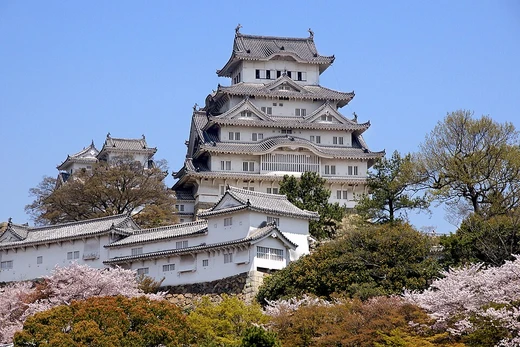
Hagi Castle
Seat of the Mōri clan for over 250 years.
Last updated
Hagi Castle is a Japanese castle in Hagi, Yamaguchi Prefecture, built in 1604 as the main castle of the Mōri clan. It served as the seat of the Chōshū Domain for over 250 years until 1863. Its ruins were designated a National Historic Site in 1924 and are part of a UNESCO World Heritage Site.
Last updated 2026-10-22 from the source article.
Layout
Hagi Castle was built with two square enclosures on Mount Shigetsu and the sandbank connecting it to the mainland. The ocean forms a natural moat at the rear, and a water moat linked to the sea protects the front. From the landward side, the enclosures are angled so a corner faces the mainland to the southeast.
Stone walls and compound gates defend both areas. The keep was five stories tall, with many turrets placed at intervals along the stone walls. On the mainland, a third area with moats housed the residences of higher-ranked retainers and the castle town.
History
The site originally held a minor fortification of the Yoshimi clan, retainers of the Ōuchi clan. In the mid-Muromachi period, the Ōuchi were overthrown by their general Sue Harukata, who was then defeated by the Mōri clan. Mōri Motonari, originally a minor warlord from Aki Province, rose to rule most of the Chugoku region after defeating Sue Harutaka and the Amago clan. Under his grandson Mōri Terumoto, the Mōri expanded but eventually conflicted with Oda Nobunaga, whose general Hashiba Hideyoshi pushed them back.
After the battle, Tokugawa Ieyasu seized two-thirds of Mōri holdings, including Aki Province. Forced back to Nagato and Suō, the Mōri needed a new stronghold. The shogunate rejected their petitions to build in Yamaguchi or Hōfu and ordered construction at Hagi, then a small fishing village. Construction began in 1604 and finished in 1608.
Although Chōshū Domain was important in Bakumatsu Japan and the Meiji restoration, Hagi Castle saw no major conflict. In 1863, the Mōri moved their seat to Yamaguchi Castle due to fear of foreign naval attack after the Shimonoseki campaign.
Destruction and ruins
In 1874, the Meiji government ordered the demolition of most of Hagi Castle's structures, and some moats were filled in. Despite this, the stone walls of the central and hilltop areas remain largely intact. The outer gate and a corner turret were later restored. The ruins were designated a National Historic Site in 1951, and Hagi Castle Town received the same designation in 1967.
Mount Shigetsu was named a National Natural Monument in 1971. In 2006, the Japan Castle Foundation selected Hagi Castle as one of Japan's Top 100 Castles. On July 5, 2015, it was registered as a UNESCO World Heritage Site as part of the Sites of Japan’s Meiji Industrial Revolution: Iron and Steel, Shipbuilding and Coal Mining, and it is registered as part of Hagi's Castle Town.
More in 100 Fine Castles of Japan
Sources
Compiled from Wikipedia and the sources listed below. Text from Wikipedia is available under CC BY-SA 4.0; this entry is adapted from it.
- Wikipedia: Hagi Castle (CC BY-SA 4.0).
Spotted an error? Know more?
Reader corrections go straight into our review queue. Suggest an edit · How this site is sourced