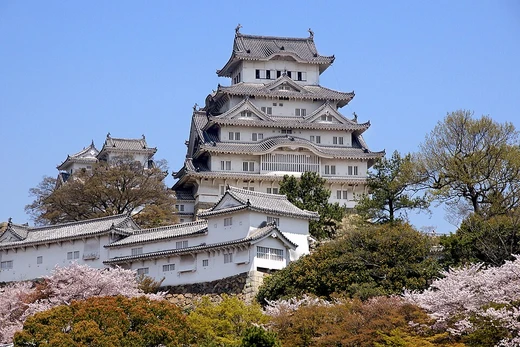
Hikone Castle
Last updated

via Wikipedia: Hikone Castle · see source
Where it is
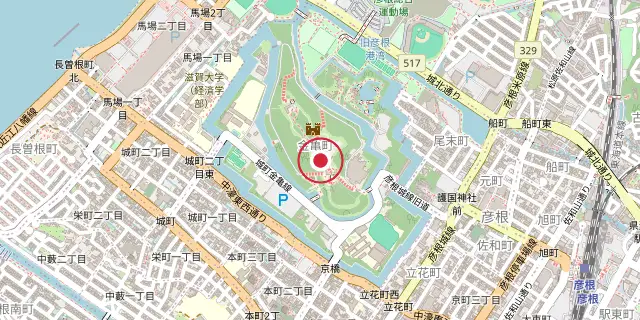
Coordinates: 35°16′34″N 136°15′07″E (35.2760, 136.2520) · Open in OpenStreetMap
Coordinates and connected clubs: the infobox of Wikipedia: Hikone Castle (CC BY-SA 4.0). Map: drawn by Codexery from OpenStreetMap tiles.
In the city of Hikone, Shiga Prefecture, Japan, stands Hikone Castle, a fortification built during the Edo period.[1]
Geography and history
The three-story tenshu was brought from Ōtsu Castle, originally built in 1575, and modified from what was originally a five-story tower.[2] Originally, the castle's north and east sides were lapped by the waters of Lake Biwa, but subsequent land reclamation has placed it one kilometer inland from the shore.[3] From a strategic standpoint, this location was crucial for shielding the capital against assaults originating from the east.[3] During the Sengoku period, the Azai clan held sway over this region and constructed Sawayama Castle roughly two kilometers away.[3]
Ii Naomasa chose to move his administrative base to a fresh spot on Lake Biwa's shore, erecting a new castle following the most advanced design of the era on land that had earlier held the Buddhist temple Hogon-ji.[4]
What the cited sources add
According to the International Dictionary of Historic Places, Ii Naomasa was among Ieyasu's most able and trusted generals, renowned for his martial skill, diplomatic acumen, and strategic thinking.[4][5] The National Historic Site Encyclopedia records that the castle's initial main entrance was the west-facing "Otemon" gate; subsequently, the southeast-facing "Sawaguchi" gate, which connected to the Nakasendō, became the primary entrance.[3][6] This hill is split into three zones: the "Kane-no-maru" enclosure lies to the southeast, the "Nishi-no-maru" enclosure to the northwest, and the "Honmaru" inner bailey occupies the central area.[3][6] Bridges cross dry moats that shield these inner enclosures, and the moats' sides are reinforced with stonework.[3][6]
References
- Wikipedia, "Hikone Castle" (CC BY-SA 4.0), which cites: "彦根城跡", Cultural Heritage Online (original not read by us) en.wikipedia.org
- Wikipedia, "Hikone Castle" (CC BY-SA 4.0), which cites: Nagahama Castle (original not read by us) en.wikipedia.org
- Wikipedia, "Hikone Castle" (CC BY-SA 4.0), which cites: Isomura, "(国指定史跡事典) National Historic Site Encyclopedia", 学生社, 2012 (we also read that source) en.wikipedia.org
- Wikipedia, "Hikone Castle" (CC BY-SA 4.0), which cites: Isomura, "(国指定史跡事典) National Historic Site Encyclopedia", 学生社, 2012; "International Dictionary of Historic Places, Volume 5: Asia and Oceania", Fitzroy Dearborn Publishers, 1996, p. 338 (we also read that source) en.wikipedia.org
- Open Library record, ISBN 1884964044 ("International dictionary of historic places"). CC0 (metadata); book content not read. openlibrary.org
- Open Library record, ISBN 9784311750403 ("Kuni shitei shiseki jiten"). CC0 (metadata); book content not read. openlibrary.org
Each numbered sentence above was checked against the source it cites before publication. Sentences citing Wikipedia adapt text from the English Wikipedia article Hikone Castle (contributors), used under CC BY-SA 4.0; this entry is available under the same licence. Other sources were used for facts only; no text or images are copied from them.
More in 100 Fine Castles of Japan
Sources
Compiled from Wikipedia and the sources listed below. Text from Wikipedia is available under CC BY-SA 4.0; this entry is adapted from it.
- Wikipedia: Hikone Castle (CC BY-SA 4.0).
Spotted an error? Know more?
Reader corrections go straight into our review queue. Suggest an edit · How this site is sourced