The Statue of Liberty
A French gift symbolizing freedom and democracy.
Last updated
Where it is
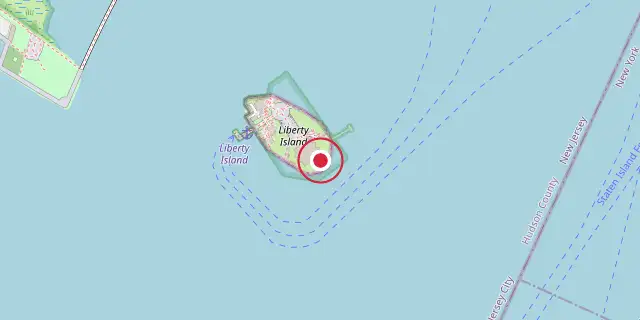
Coordinates: 40°41′20″N 74°02′38″W (40.6890, -74.0440) · Open in OpenStreetMap
Coordinates and connected clubs: the infobox of Wikipedia: Statue of Liberty (CC BY-SA 4.0). Map: drawn by Codexery from OpenStreetMap tiles.
The National Park Service states the statue was a symbol of democratic government and a celebration of the Union's victory and the end of slavery.[1]
Key facts and history
French historian and abolitionist Édouard de Laboulaye first proposed a monument in 1865 to honor the upcoming centennial of U.S. independence and the liberation of the nation's slaves.[2] The National Park Service notes that Laboulaye, president of the French Anti-Slavery Society, hoped the gift would inspire the French people to demand their own democracy.[3][1] Sculptor Frédéric Auguste Bartholdi was inspired by a conversation with Laboulaye in mid-1865.[3] The French people financed the statue, while Americans paid for the pedestal.[4]
The completed statue was formally presented to the U.S. ambassador in Paris on July 4, 1884.[5] The statue arrived in New York in crates on the French steamer Isère on June 17, 1885.[6] Bartholdi had earlier proposed a similar colossal lighthouse for the Suez Canal in Egypt, but the Khedive and Ferdinand de Lesseps declined it due to high cost.[7][8] Bartholdi selected copper for the statue because it was cheaper, lighter, and simpler to transport than bronze or stone.[9]
What the cited sources add
A National Park Service report found that the dinner-party legend of the statue's conception in 1865 is traceable to an 1885 fundraising pamphlet by Bartholdi, and that the statue was most likely conceived in 1870 or 1871.[10] The same report found no evidence that the statue was intended to memorialize black Civil War combatants.[10] The report states that the statue's design almost certainly evolved from Bartholdi's earlier concept for an Egyptian monument, for which he used drawings of Egyptian women as models.[10] Bartholdi changed a broken shackle and chain in the statue's left hand to tablets at Laboulaye's request, to emphasize a broader vision of liberty.[10]
The National Park Service notes that after the statue's dedication, the Black Press debunked romantic notions of the statue, and African Americans were reluctant to embrace a symbol of a nation that did not fully include them.[1]
References
- "Abolition", National Park Service. facts only, no text reused. nps.gov
- Wikipedia, "Statue of Liberty" (CC BY-SA 4.0), which cites: "The French Connection", National Park Service, May 19, 2019 (original not read by us) en.wikipedia.org
- Wikipedia, "Statue of Liberty" (CC BY-SA 4.0), which cites: Harris 1985, p. 7–9; Joseph, "The Black Statue of Liberty Rumor", National Park Service, September 2000 (we also read that source) en.wikipedia.org
- Wikipedia, "Statue of Liberty" (CC BY-SA 4.0), which cites: Khan 2010, p. 60–61; Tharoor, "The Middle Eastern origins of the Statue of Liberty", The Washington Post, November 20, 2015; Harris 1985, p. 7–9; Khan 2010, p. 60–61; Harris 1985, p. 7–9 (original not read by us) en.wikipedia.org
- Wikipedia, "Statue of Liberty" (CC BY-SA 4.0), which cites: Bell Abrams 1984, p. 25; Bell Abrams 1984, p. 25 (original not read by us) en.wikipedia.org
- Wikipedia, "Statue of Liberty" (CC BY-SA 4.0), which cites: Harris 1985, p. 7–9; "The Isere-Bartholdi Gift Reaches the Horseshoe Safely", The Evening Post, June 17, 1885; Harris 1985, p. 7–9 (original not read by us) en.wikipedia.org
- Wikipedia, "Statue of Liberty" (CC BY-SA 4.0), which cites: Hayden Despont 1986, p. 45; "The Statue of Liberty and its Ties to the Middle East", University of Chicago; Harris 1985, p. 7–9 (original not read by us) en.wikipedia.org
- Wikipedia, "Statue of Liberty" (CC BY-SA 4.0), which cites: Harris 1985, p. 7–9; Harris 1985, p. 7–9; Karabell, "Parting the desert: the creation of the Suez Canal", Alfred A. Knopf, 2003, p. 243 (we also read that source) en.wikipedia.org
- Wikipedia, "Statue of Liberty" (CC BY-SA 4.0), which cites: Hayden Despont 1986, p. 45 (original not read by us) en.wikipedia.org
- Joseph, "The Black Statue of Liberty Rumor", National Park Service, September 2000. facts only, no text reused. home.nps.gov
Each numbered sentence above was checked against the source it cites before publication. Sentences citing Wikipedia adapt text from the English Wikipedia article Statue of Liberty (contributors), used under CC BY-SA 4.0; this entry is available under the same licence. Other sources were used for facts only; no text or images are copied from them.
More in World Wonders
Sources
Compiled from Wikipedia and the sources listed below. Text from Wikipedia is available under CC BY-SA 4.0; this entry is adapted from it.
- Wikipedia: Statue of Liberty (CC BY-SA 4.0).
Spotted an error? Know more?
Reader corrections go straight into our review queue. Suggest an edit · How this site is sourced