
Titiek Puspa
The grand dame of Indonesian entertainment.
Last updated

Crisco 1492 · Public domain
Titiek Puspa, whose birth name was Sudarwati, came into the world on 1 November 1937 in Tanjung, Dutch Borneo (today part of South Kalimantan). Her father, Tugeno Puspowidjojo, was Javanese and had relocated the family there for work; shortly after her birth, they moved again to Semarang. Over time, her family changed her name first to Kadarwati and then to Sumarti—she was a sickly child, and local customs held that altering a name could aid her recovery.
She was the fourth of twelve children. As a young girl, she dreamed of becoming a kindergarten teacher, but after winning several singing contests, she decided around age fourteen to pursue entertainment instead. Her parents forbade this choice.

Career
Puspa sang alto, with a warm, husky, and strong timbre—a contrast to the many soprano voices popular in 1960s Indonesia. She shaped her singing style by studying Dutch singer Anneke Gronloh, American jazz vocalist Ella Fitzgerald, and American pop and country singer Patti Page. She considered her professional career to have begun in 1954, when she won a Radio Republik Indonesia singing competition in Semarang. President Sukarno himself gave her the stage name “Titiek Puspa” during the 1950s.
In 1959, she moved to Jakarta and started performing for a living; that same year, she made her first recording with Lokananta, the nation’s first record label. The following year, she began working as a lounge singer at Hotel Des Indes in Harmoni, Jakarta. Sjaiful Bachri of the Jakarta Symphony Orchestra invited her to sing with them, and after she performed Ismail Marzuki’s song “”, the orchestra kept her as their regular singer. She left the group in 1962.

In 1974, Puspa won the National Pop Song Festival with her song “”. That November, she represented Indonesia at the World Popular Song Festival in Tokyo, reaching the semi-finals. A decade later, in 1984, she and Euis Darliah took home the Bronze Prize at the World Song Festival in Los Angeles with the song “”. Puspa also served as a palace singer for both Sukarno and Suharto, performing at national ceremonies and state functions for foreign dignitaries.
She was part of two Indonesian cultural missions—one to Malaya in 1960 and another to the Netherlands in 1965. In 1985, she composed the song “Bapak Pembangunan” for Suharto. Her song “” became popular in the 1980s. In a 2008 interview with The Jakarta Post, she said, “Songs are my medicine, my vitamins, they make my life better.”

Songwriting and themes
As a composer, Puspa learned from her husband, jazz pianist Mus Mualim, early in their marriage. She wrote mostly in the hiburan genre—a Western-influenced style often compared to easy listening, which was popular in the United States at the time. Her influences ranged across pop, rock ’n’ roll, jazz, Broadway, and blues.
To avoid censorship of songs with strong foreign musical elements, she paired them with patriotic or nationalistic lyrics. In the 1960s, many of her songs focused on ordinary people and their economic struggles; one piece even referenced the 1966 student protests. During the 1970s, she recorded several songs about modern women. Her best-known work from that period, “” (recorded in 1977), sympathetically portrays a sex worker, noting the stigma she faces and the difficulties of her life.

The song’s narrator suggests that the woman, working to survive, has done less wrong than the men who pay for her services. Another song from the decade, “”, tells the story of a village girl who moves to the city. In 1997, her song “” won Best Children’s Song at the Anugerah Music Indonesia Awards.
Acting and theatre
Puspa also acted in films from the mid-1960s into the 1980s. Her first movie was “” (1965), which helped establish her as a potential actress in Indonesia; she played a main character whose life reflected village society and its challenges, delivering a social message. Her next film, “” (1966), directed by Misbach Yusa Biran, placed her in an art troupe and explored the behind-the-scenes struggles of artists.
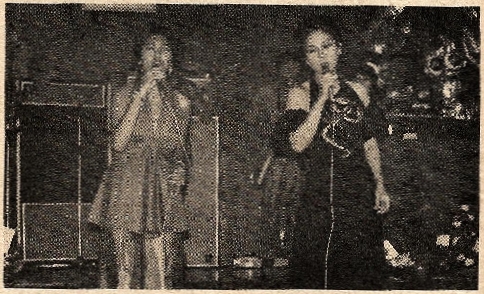
In 1974, she starred in “”, a legendary musical drama based on a folk tale, playing the antagonist Mak Bakung, a hateful stepmother whose performance moved audiences. She then appeared in “” (1975) as one of three young women searching for work, showing natural comedic talent and promoting women’s empowerment through humor. Her final film, “” (1983), depicted a woman in a complicated relationship with a Chinese man, one of three examples in her career of exploring urban social life.
Lore & Background
Puspa was born in Tanjung, Dutch Borneo (now South Kalimantan), on 1 November 1937. Her stage name was chosen by President Sukarno during the 1950s. She considered her career to have started in 1954 after winning a Radio Republik Indonesia singing competition. In 1974, she won the National Pop Song Festival and was sent to the World Popular Song Festival in Tokyo as Indonesia's representative, reaching the semi-finals.
In 1984, Puspa and Euis Darliah won the Bronze Prize at the World Song Festival in Los Angeles. She was a palace singer for Sukarno and Suharto. She composed the song 'Bapak pembangunan' for Suharto in 1985.
Reader's Guide
Puspa was an alto with a warm, husky, and strong timbre. She modeled her singing on Anneke Gronloh, Ella Fitzgerald, and Patti Page. She largely composed in the hiburan genre, drawing from pop, rock 'n' roll, jazz, Broadway, and blues.
Her best-known song is 'Kupu-Kupu Malam' (recorded 1977), which sympathetically describes a sex worker. She also acted in films from the mid-1960s into the 1980s, and composed multiple operettas in the 1970s. In 1972, she founded the arts organization Papiko.
Did You Know?
- She wrote 61 songs while undergoing chemotherapy in Singapore in 2009.
- She traveled to Mecca on pilgrimage in the early 2000s.
Frequently Asked Questions
Who is Titiek Puspa?
Titiek Puspa (born Sudarwati, 1 November 1937) was an Indonesian singer, songwriter, and actress celebrated for her warm, husky alto voice. She composed songs that frequently explored the lives of ordinary people and the experiences of modern women.
What songs is Titiek Puspa most known for?
Her most recognizable compositions include "Kupu-Kupu Malam," "Bing," "Gang Kelinci," and "Mari-Mari." In 2009, Rolling Stone Indonesia named four of her tracks among the greatest Indonesian songs ever recorded.
When did Titiek Puspa pass away?
Titiek Puspa died on 10 April 2025, at the age of 87. Born in Tanjung, Dutch Borneo (present-day South Kalimantan), her death marked the close of a career spanning more than seven decades.
More in World & Folk Traditions
Sources
Compiled from Wikipedia and the sources listed below. Text from Wikipedia is available under CC BY-SA 4.0; this entry is adapted from it.
- Wikipedia: Titiek Puspa (CC BY-SA 4.0).
Spotted an error? Know more?
Reader corrections go straight into our review queue. Suggest an edit · How this site is sourced