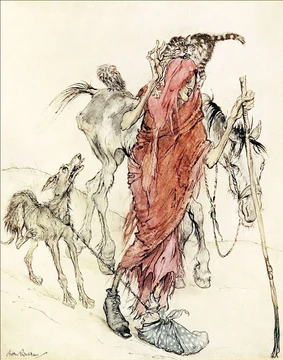
Gingerbread Witch
Cannibalistic witch who builds a candy house to trap children.
Last updated

via Wikipedia: Hansel and Gretel · see source
She is the cannibalistic witch who builds a house made of bread, cake, and sugar to lure children. In the Brothers Grimm's "Hansel and Gretel," published in 1812 as part of Grimms' Fairy Tales (KHM 15), she intends to fatten and eat Hansel, but Gretel saves her brother by pushing the witch into her own oven, killing her. The children then escape with the witch's treasure. The tale has been adapted into various media, including Engelbert Humperdinck's opera Hänsel und Gretel, first performed in 1893.
Origin
The story now known as "Hansel and Gretel" was credited by the Brothers Grimm to tales from Hesse, but scholars believe they first heard it in 1809 from the family of Wilhelm’s future wife, Dortchen Wild, along with other sources. A note in the Grimms’ own copy of the first edition shows that in 1813, Wild contributed the children’s verse reply to the witch: “The wind, the wind, / The heavenly child,” which rhymes in German as “Der Wind, der Wind, / Das himmlische Kind.”
Folklorist Jack Zipes places the tale’s origin in late medieval Germany, between 1250 and 1500. Soon after, written variants like Martin Montanus’s Garten Gesellschaft (1590) appeared. Scholar Christine Goldberg sees the episode of marking paths with stones and crumbs—already present in the French tales “Finette Cendron” and “Hop-o’-My-Thumb” (1697)—as an elaboration of Ariadne’s thread guiding Theseus from the labyrinth. A house made of sweets also appears in a 14th-century manuscript about the Land of Cockayne.
From the 1810 pre-publication manuscript to the sixth edition in 1850, the Grimms made many changes: the story grew longer, gained psychological depth and vivid imagery, and took on a more Christian tone, shifting blame for the abandonment from a mother to a stepmother linked to the witch. In the original edition, the woodcutter’s wife was the biological mother, but from the fourth edition (1840) she was called “stepmother.” The final 1857 version remains ambiguous, calling her “the mother” twice and “the stepmother” once.
The scene where a duck helps the children cross a river was added later. Wilhelm Grimm also altered the text by inserting Alsatian dialects, taken from August Stöber’s 1842 version, to make the tale sound more folksy.
Plot
The stepmother gave Hansel and Gretel small pieces of bread the next morning before their father led them into the woods. As they walked deeper, Hansel dropped white pebbles along the path. Their parents left them there, and the children waited until nightfall. Moonlight made the pebbles glow, so they followed the trail safely home.
The stepmother was furious. When food ran low again, she angrily ordered her husband to take the children even farther into the woods. Hansel tried to gather more pebbles, but the door was locked. The following morning, the stepmother handed them even smaller pieces of bread.
On the way, Hansel left a trail of bread crumbs instead. After being abandoned once more, the children discovered birds had eaten every crumb. Lost, they wandered for three days. A dove led them to a clearing where they found a cottage made of bread walls, a cake roof, and sugar windows.
Starving and exhausted, they started eating the house. An elderly woman opened the door and invited them inside, offering delicious food and soft beds. What the children did not realize was that this kind hostess was actually an evil witch. She had built the edible house specifically to lure children so she could cook and eat them.
The next morning, the witch locked Hansel in a stable and made Gretel her servant. She fed Hansel regularly to fatten him up, but gave Gretel only crab shells. To check Hansel’s weight, the witch tried to feel his finger. Hansel cleverly held out a thin bone he had found in the cage.
Because her eyesight was too poor to notice the trick, the witch believed Hansel was still too skinny to eat. After four weeks of this, she grew impatient and decided to eat him anyway.
Variants
According to folklorists Iona and Peter Opie, the story of Hansel and Gretel is part of a broader European tradition, particularly common in the Baltic region, where children manage to outsmart the ogres who have trapped them. This tale serves as the original model for the Aarne–Thompson–Uther (ATU) type 327A. A key feature of this type is Gretel’s trick of pretending she does not know how to check the oven, asking the witch to demonstrate, though this same ruse appears in other versions of ATU 327 as well. Stith Thompson suggested that the story’s straightforward nature helped it spread across many different cultures worldwide.
ATU 327A tales
A very similar story is Finette Cendron, written by Marie-Catherine d'Aulnoy in 1697. In it, a poor king and queen abandon their three daughters in the wilderness three separate times. The cleverest daughter, Finette, leads them home the first time by following a thread she had unwound. On the second trip, she uses ashes as a trail, and on the third, peas, but pigeons eat them.
The girls then find the home of a hag and her ogre husband. Finette heats the oven and tricks the ogre into testing it with his tongue, causing him to fall in and burn to death. She then cuts off the hag’s head. The sisters stay in the ogre’s house, and the tale continues like Cinderella.
In the Russian story Vasilisa the Beautiful, a stepmother sends her despised stepdaughter into the forest to borrow a light from her sister, who is actually Baba Yaga, a cannibalistic witch. Across these tales, common themes include the danger children face and their own cleverness, along with a strong focus on eating and harming children. The mother or stepmother acts out of fear of starvation, while the witch lures children by offering a candy house, only to plan to eat them.
A Flemish variant called The Sugar-Candy House features siblings Jan and Jannette, who get lost in the woods and spot a hut made of sweets. As they approach, a giant wolf named Garon leaps from a window and chases them to a riverbank. The brother and sister ask two ducks to help them cross the river to escape.
Garon threatens the ducks to carry him over, but they refuse. He then tries to swim across, sinking and surfacing three times before disappearing on the fourth attempt. This version also includes a rhyming pattern between “child” and “wind” that appears in the German tale.
Cultural legacy
The story has been adapted for the stage many times, with Engelbert Humperdinck's opera Hansel and Gretel being a standout. It follows the Brothers Grimm version closely but leaves out the parents deliberately abandoning the children. This opera also started the trend of making the witch's house out of gingerbread and sweets instead of plain bread. A modern take, Ami & Tami, is a musical fairy tale by Matti Kovler that was staged in Israel and the United States and later released as a symphonic album.
Literature
Various authors have used the tale as inspiration, including Robert Coover in his 1969 story "The Gingerbread House," Anne Sexton in her 1971 collection Transformations, Garrison Keillor in his 1982 piece "My Stepmother, Myself," and Emma Donoghue in her 1997 story "A Tale of the Cottage." Adam Gidwitz's 2010 children's book A Tale Dark & Grimm and its sequels, In a Glass Grimmly and The Grimm Conclusion, are loosely based on the story and have the siblings meet characters from other fairy tales.
Terry Pratchett often mentions gingerbread cottages in his books, usually when a witch has turned evil and started cackling, with the house representing a stage of increasing insanity. In The Light Fantastic, the wizard Rincewind and Twoflower are taken by a gnome to such a cottage after the witch dies, and they are warned to avoid the doormat because it is made of candy floss. Neil Gaiman wrote an expanded version of Hansel and Gretel in 2014, with art by Lorenzo Mattotti.
Stephen King published his own retelling in 2025, using illustrations by Maurice Sendak that were originally set and costume designs for Sendak's 1998 production of Humperdinck's opera. A 1954 stop-motion animated film called Hansel and Gretel: An Opera Fantasy was directed by John Paul and released by RKO Radio Pictures. That same year, the Bugs Bunny cartoon Bewitched Bunny, directed by Chuck Jones, parodied the story and introduced the character Witch Hazel.
The Bewitched episode "Hansel and Gretel in Samanthaland" features Tabitha Stephens magically swapping places with the fairy tale siblings, and her mother Samantha enters the story to save her from the child-eating witch. The episode includes Bobo Lewis as the stepmother, Billie Hayes as the witch, and Richard X. Slattery as a policeman.
More in Witchcraft in Fairy Tales
Sources
Compiled from Wikipedia and the sources listed below. Text from Wikipedia is available under CC BY-SA 4.0; this entry is adapted from it.
- Wikipedia: Hansel and Gretel (CC BY-SA 4.0).
Spotted an error? Know more?
Reader corrections go straight into our review queue. Suggest an edit · How this site is sourced