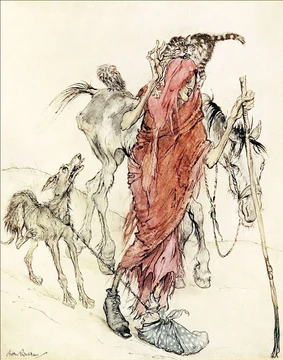
Brother and Sister
A brother transformed into a deer, a sister's loyalty, and a witch's defeat.
Last updated
The tale "Brother and Sister," also called "Little Sister and Little Brother" or "Brüderchen und Schwesterchen," is a European fairy tale recorded by the Brothers Grimm as KHM 11 and falls under Aarne–Thompson Type 450. In Russia, it was better known as "Sister Alionushka, Brother Ivanushka" and was gathered by Alexander Afanasyev.
Synopsis
A brother and sister flee their home because of cruel mistreatment by their stepmother, who is an evil witch. They wander into the countryside and spend the night in the woods. The next morning the boy is thirsty, so they search for a spring of clear water. Their stepmother has bewitched all the springs in the forest.
At the first spring, the sister hears its rushing sound say, "whoever drinks from me will become a tiger" (or lion). She begs her brother not to drink, and he agrees. At the second spring, the water warns that whoever drinks will become a wolf; again she persuades him to refrain. At the third spring, the water says, "whoever drinks from me will become a deer."
Before the sister can stop him, the brother drinks and turns into a deer. The children decide to live in the woods forever. The girl ties her gold chain around the deer's neck, and they settle in a little house deep in the forest. Years later, a hunting party and the king follow the deer home.
The king sees the beautiful girl and asks her to marry him; she accepts, and they live in the king's castle. The queen gives birth to a son. The witch discovers they are alive and plots against them. She kills the queen and replaces her with her own disfigured daughter, transformed to look like the queen.
The queen's ghost visits her baby's bedside for three consecutive nights; the king catches on and exposes the stepmother's plan. The queen comes back to life when the king embraces her. The witch's daughter is banished into the woods and eaten by wild animals; the stepmother is burned at the stake. At the moment of the witch's death, the deer becomes human again, and the family is reunited.
Analysis
The tale type known as "Brother and Sister" shares its classification, AT-450, with stories like "The Lambkin and the Little Fish." In certain tellings, the queen does not die but is instead placed into a trance by her wicked stepmother, only to be revived by the king. West-Slavic versions feature siblings fleeing home to escape their parents' cannibalistic intentions. This story type has connections to several others, including "The Black and the White Bride," "The Seven Ravens," "Salvatica," and "Our Lady's Child." Folklorists Linda Dégh and Stith Thompson observed a close relationship between types 450 and 403. Ines Köhler, a German scholar, pointed out shared elements like the brother's role and the heroine's replacement, but stressed that the defining trait of ATU 450 is the brother's transformation into an animal.
Variants
Paul Delarue noted that this tale type is extremely familiar in Eastern Europe but much less common in Western Europe. Waldemar Liungman, a Swedish researcher, suggested its distribution follows the Lower Danube, West Slavic areas, and the Balkans. Stith Thompson found variants across Eastern Europe, including Russia, the Baltic region, and the Balkans, as well as in the Near East and India. Bronislava Kerbelyte, a Lithuanian folklorist, said the tale is popular in Lithuania and nearby countries.
In the early twentieth century, Elsabet Róna-Sklarek described the story as very popular in Hungary, and the Hungarian Folktale Catalogue lists forty-eight variants under type 450, called "The Roe Deer Sibling." Kurt Ranke, a German scholar, considered ATU 450 uncommon in Germany, though he identified up to fourteen texts collected after the Brothers Grimm version. In Greece, Anna Angelopoulou and Aigle Broskou reported the type is widespread, with 124 recorded variants.
Hasan El-Shamy noted its presence on the Iberian Peninsula is infrequent, and folktale catalogs from Portugal and Spain confirm only a few variants—some in specific Spanish regions and very few in Portugal.
Interpretations
In "Brother and Sister," as in "The Twelve Brothers," "The Seven Ravens," and "The Six Swans," a woman is the one who rescues her brother. When and where this story was collected, kings often drafted men to serve as mercenary soldiers. Because of this, many fathers left their property to their daughters, but they also kept tighter control over those daughters and who they married. Some have read these tales as expressing a wish from women that their brothers would return home, freeing them from that control.
But the exact time of collection is uncertain, and versions of this story appear in many other cultures where that specific situation could not have been the inspiration. A modern psychoanalytic reading sees the brother and sister as a metaphor for two sides of human nature: the animalistic and the spiritual. The brother stands for instinct, the sister for reason. At the start, the two children are young and clearly at odds over each other's choices.
The brother cannot resist drinking from a spring, and his punishment is to become a deer. The sister then ties her gold chain around his neck, a symbolic act that suggests taming the wild, instinctive side.
After this, the two live in relative harmony. In this light, "Brother and Sister" can be seen as a hidden coming-of-age story, where the animalistic side is linked to the male and the rational, spiritual side to the female. The tale has also been read as a lesson about staying faithful to family through hardship and separation.
Adaptations
The Japanese studio Nippon Animation included the story in a second-season episode of its anime series Grimm's Fairy Tale Classics. The brother and sister are given names: Rudolph and Rosa. Rosa is not killed by the Witch but is kidnapped and taken into a mountain. She uses a form of bilocation to send her soul out to feed her baby, which drains her strength.
Her husband the King and his soldiers save her just before she fades away. The evil stepsister does not appear, and the Witch dies offscreen instead of being burned at the stake. In 1999, Simsala Grimm adapted the tale as its 13th episode. This version stays close to the original, naming the twins John and Joanna.
The stepsister is called Grimelda. The stepmother uses a potion that can turn people to stone or poison water, intending to kill Joanna and let Grimelda take her place. When their plans backfire, Grimelda runs away before she can be caught, and her mother trips, turns to stone, and all spells are broken. A Hungarian version of the tale appeared in an episode of the series Magyar népmesék, titled Cerceruska.
In this variant, the maiden has a little sister who drinks from a forest pool and turns into a deer. A Russian adaptation was made into a cartoon in 1953. Modern literary works that explore this fairy tale and its themes include Ellen Steiber's story "In the Night Country," Terri Windling's poem "Brother and Sister," and Barth Anderson's poem "Sister and Brother."
Did You Know?
- At times, Brother and Sister has been confused with Hansel and Gretel, which has also been known under the alternate title of Little Brother and Little Sister.
- The Grimm version is based on the account of the German storyteller Marie Hassenpflug (1788–1856).
More in Witchcraft in Fairy Tales
Sources
Compiled from Wikipedia and the sources listed below. Text from Wikipedia is available under CC BY-SA 4.0; this entry is adapted from it.
- Wikipedia: Brother and Sister (CC BY-SA 4.0).
Spotted an error? Know more?
Reader corrections go straight into our review queue. Suggest an edit · How this site is sourced